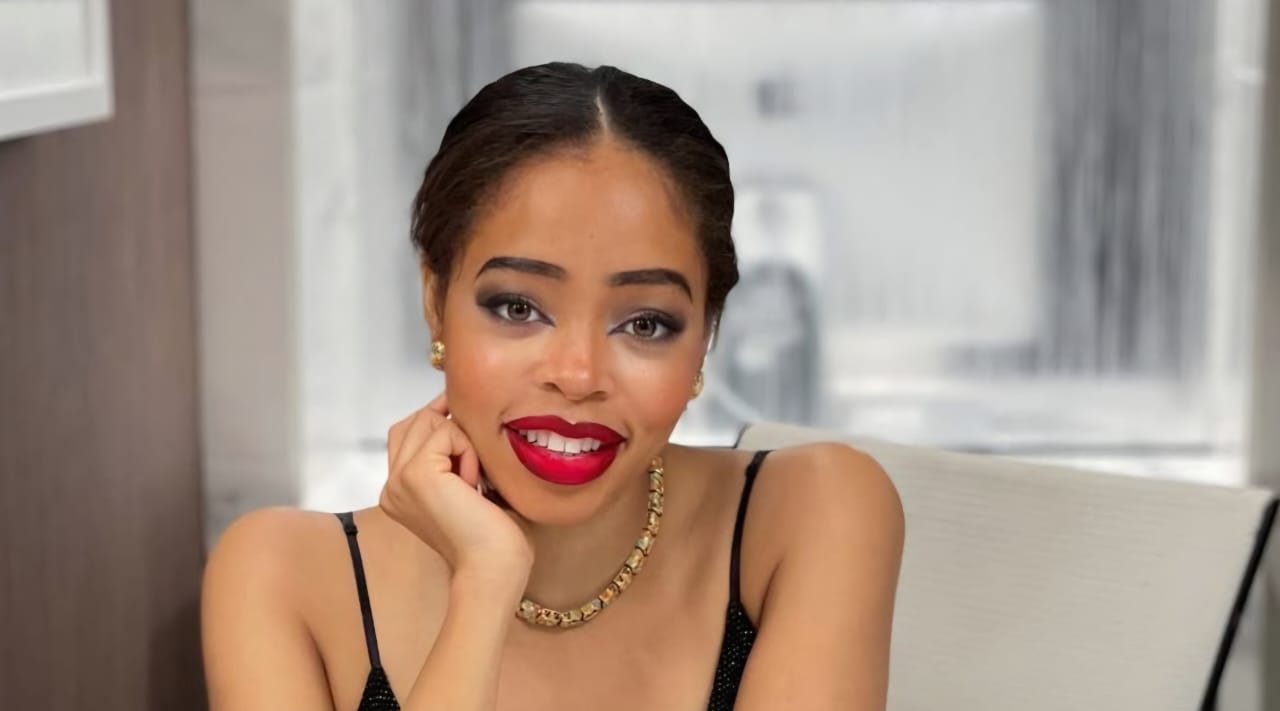

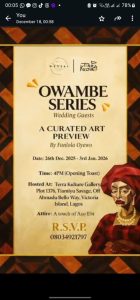
In a country where politics is loud, power is performative, and culture is often reduced to spectacle, Funlola Oyewo’s Owambe Series – Wedding Guests arrives as a quiet but radical intervention. Opening on December 26 at Terra Kulture Victoria Island Lagos and running through January 3, 2026, the exhibition is not merely an artistic debut, it is a cultural statement. In the midst of Nigeria’s endless motion, campaign rallies, social media outrage, religious fervor, and economic anxiety, Oyewo dares to slow us down. She asks us to look closely at what we often miss, posture, presence, silence, and the unspoken politics of being seen. In doing so, she offers a mirror to Nigerian society itself, where stillness is often mistaken for irrelevance, and noise for power.
 Oyewo’s journey into this moment is itself a study in return and reckoning. Trained initially in Architecture at the Academy of Art in San Francisco, later refining her professional life through Communications and a Master’s in Project Management, she built a solid career across marketing, branding, and the travel industry. Yet, like many Nigerians shaped by displacement, ambition, and global exposure, something essential kept calling her back. Art, for Oyewo, was never acquired, it was remembered. Her early recognition as a child was not a footnote but a prophecy deferred. Owambe Series marks a homecoming to that original language, a language that speaks Yoruba sensibility fluently, where aesthetics are inseparable from ethics, and beauty carries responsibility.
What makes this exhibition intellectually arresting is Oyewo’s choice to center stillness within the chaos of owambe culture. Yoruba celebrations are famously exuberant, music blaring, fabrics shimmering, money spraying, bodies in motion. Yet Oyewo fixes her gaze on those moments when movement pauses, a guest seated quietly, a gaze held, a posture composed amid excess. This is not accidental. In Yoruba philosophy, “ìwà” character often reveals itself not in speech but in restraint. Oyewo’s still figures echo this moral grammar. They remind us that power does not always announce itself loudly, sometimes it sits calmly, fully aware of its place in the room. In a nation where political leadership often confuses volume with vision, this artistic choice feels pointed.





Her use of oil on canvas, complemented by restrained mixed media, reinforces this discipline. There is no gimmickry here, no desperate bid for relevance. The materials are classic, intentional, almost reverent. Every color choice, frame, and spatial arrangement works collectively to draw the viewer inward. The exhibition does not ask you to observe owambe from a distance, it implicates you. You are not a spectator, you are a guest. This immersive quality, carefully amplified by Terra Kulture’s curatorial depth and its concurrent staging of Fela and the Kalakuta Queens, situates Oyewo’s work within a broader conversation about performance, resistance, and Nigerian identity across generations.


Perhaps most subversive is her decision to focus on guests rather than the celebrated couple. In weddings as in politics and religion, the spotlight is usually fixed on the central figures, the bride and groom, the governor, the pastor, the general overseer. Oyewo shifts that lens. She understands that real culture lives in the margins, in the aunties, the observers, the ones who bring life to the event without owning the stage. This is a deeply democratic impulse, resonant with both interfaith ethics and civic values. Christianity and Islam alike teach the dignity of the unseen, the moral weight of intention over performance. Oyewo’s guests embody this truth, quietly asserting that society is sustained not by its figureheads alone, but by those who show up, sit still, and endure.
Looking ahead, Oyewo’s intention to expand the Owambe Series to other Nigerian rites, naming ceremonies, birthdays, and beyond signals a long-term cultural project rather than a one-off exhibition. This matters. In a time when Nigeria’s governance struggles with continuity, memory, and trust, sustained artistic inquiry becomes an act of citizenship. Funlola Oyewo is not shouting slogans or painting propaganda, she is doing something far more difficult. She is paying attention. And in today’s Nigeria, attention, deep, honest, morally grounded attention is a revolutionary act.
©️ Adebamiwa Olugbenga Michael is a Lagos-based political and social analyst and publisher of The Insight Lens Project, where he writes on governance, ethnic economics, and public policy using open-source data.