
By Newspot Nigeria Editorial Desk
Before many office workers began worrying that artificial intelligence might take their jobs, scientists in one of the world’s most specialized fields had already faced a more dramatic version of that fear.
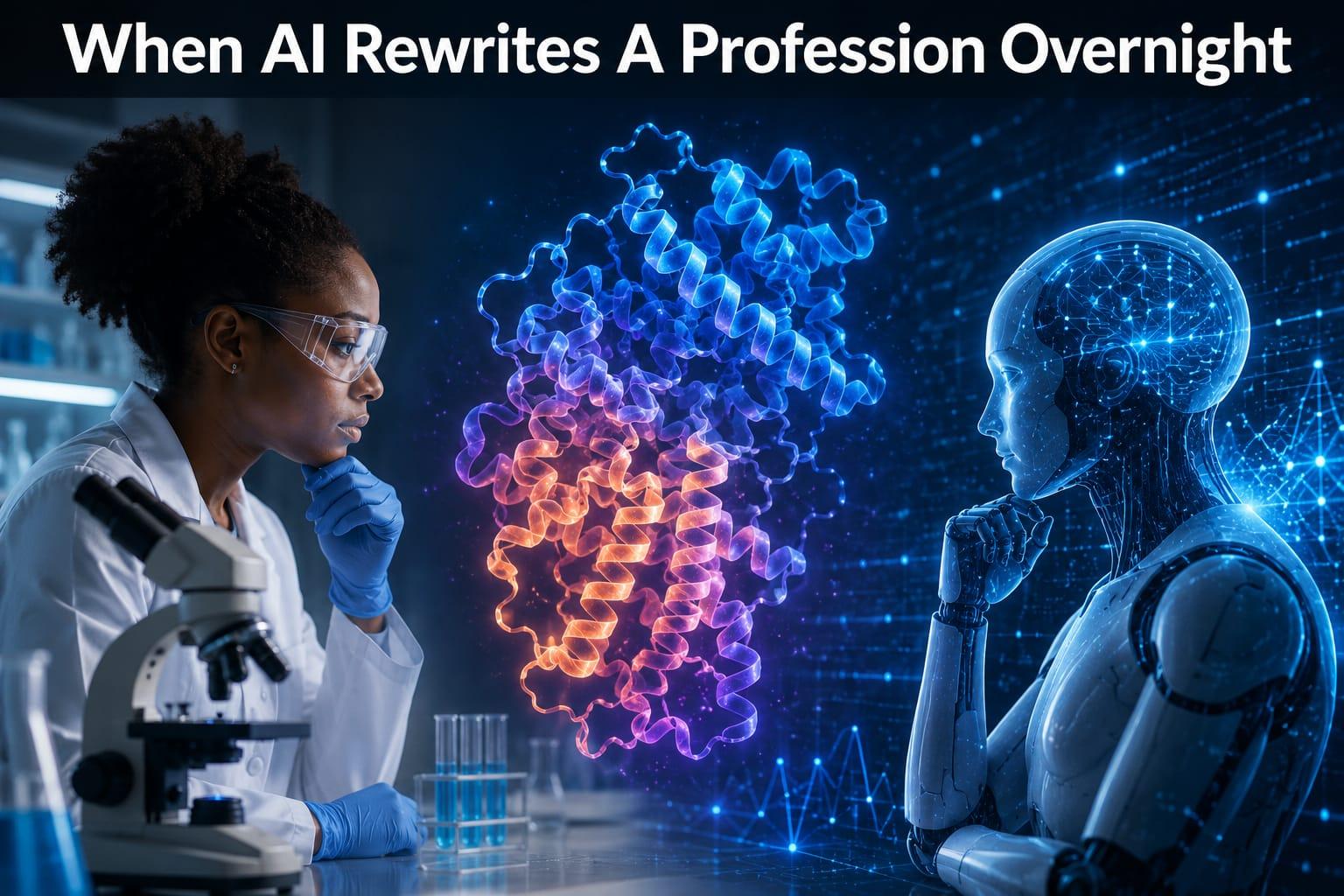
In 2020, Google DeepMind unveiled AlphaFold2, an artificial intelligence model that could predict the three-dimensional structure of proteins with a level of accuracy that stunned the scientific world. For structural biologists, this was not a small software update. It was a sudden disruption of a difficult scientific process that had traditionally required expensive equipment, deep expertise, long laboratory work, and years of patient experimentation.
The story matters far beyond biology. It offers one of the clearest early lessons about what happens when AI enters a highly skilled profession, performs one major task better and faster than humans, and forces experts to rethink the value of their own work.

Proteins are the tiny machines of life. They help drive nearly every biological process in the human body, from immunity to disease, aging, metabolism, and drug response. To understand what a protein does, scientists often need to know its shape. But discovering that shape through experimental methods can be slow, costly, and technically demanding.




AlphaFold changed that equation. By predicting structures for more than 200 million proteins through the AlphaFold Protein Structure Database, it expanded scientific access in a way that laboratory methods alone could not have achieved at the same speed. What once looked like a narrow technical achievement quickly became a major example of how AI can remove a bottleneck in human knowledge.
The easy assumption would be that AlphaFold replaced structural biologists. That is the fear many people now carry into their own professions. If AI can write, code, diagnose, summarize, design, analyze, translate, and predict, what remains for the trained human being?


Research by Ryan Hill of Northwestern University’s Kellogg School of Management and Carolyn Stein of UC Berkeley complicates that fear. Their study, “How Artificial Intelligence Shapes Science: Evidence from AlphaFold”, examined AlphaFold’s impact on science and found that the arrival of the AI tool did not simply wipe out experimental structural biology. Scientists continued to publish, and the best work did not vanish from top journals.
Instead, the stronger story was one of augmentation. AI handled a task that had been a major obstacle, while human scientists used the result to ask better questions, test difficult cases, validate uncertain predictions, and move into areas that had previously been too slow or expensive to explore.
That lesson should interest every country, company, university, newsroom, hospital, bank, and government agency. AI does not always replace a profession wholesale. More often, it changes the center of gravity inside the profession. It reduces the value of some tasks while increasing the value of judgment, verification, interpretation, creativity, ethics, and domain knowledge.
This is why the AlphaFold story is not only about science. It is also about the future of work. The professionals most at risk may not be those whose fields are touched by AI. They may be those who refuse to learn how AI is changing the structure of work inside their fields.
Other research points in the same direction. A major NBER study on generative AI in customer support found that AI assistance improved productivity, especially for less experienced workers. Another study from Harvard Business School described AI as a tool with a “jagged frontier,” meaning it can improve performance on some tasks while making people worse on others when they trust it blindly.
That is an important warning. AI is powerful, but it is not magic. It can be brilliant in one part of a task and dangerously weak in another. It can make a worker faster while also making errors easier to spread. It can create confidence where caution is needed. It can expand access to knowledge while also rewarding those who understand its limits.
AlphaFold itself shows this balance. Its predictions opened new doors, but they did not eliminate the need for experiments. Protein structures are not the same as fully developed medicines. Drug discovery still requires testing, safety checks, clinical trials, manufacturing, regulation, funding, and time. One bottleneck may fall, but others remain.
That is the sober side of the AI revolution. Breakthroughs do not automatically become public benefit. A model may solve a technical problem, but society still needs institutions, investment, regulation, infrastructure, and trained people to convert that solution into better lives.
This is where Nigeria and much of Africa must pay attention. The AI race is not only about who builds the biggest model. It is about who prepares students, workers, researchers, entrepreneurs, and public institutions to use these tools productively. Countries that treat AI as a foreign curiosity will become consumers of other people’s breakthroughs. Countries that build capacity will use AI to solve local problems.
In healthcare, AI could support diagnosis, drug research, hospital administration, epidemic monitoring, and medical training. In agriculture, it could help with crop disease detection, weather intelligence, soil analysis, and supply-chain planning. In education, it could support tutoring and curriculum design. In government, it could improve record-keeping, service delivery, fraud detection, and policy analysis.
But none of this will happen by accident. It requires universities that teach AI literacy beyond computer science departments. It requires policymakers who understand that data infrastructure is now national infrastructure. It requires ethical rules that protect citizens from abuse. It requires local research funding so that Africa does not remain permanently dependent on imported solutions.
The AlphaFold example also offers a humbling message for professionals. Expertise is no longer only about knowing how to perform a task manually. It is increasingly about knowing when to trust a tool, when to challenge it, when to combine it with human judgment, and when to insist on evidence.
That is the new professional advantage. The best doctor will not be the one who ignores AI. The best lawyer will not be the one who blindly copies it. The best journalist will not be the one who publishes machine-written claims without verification. The best scientist will not be the one who abandons experiments because a model produced a beautiful prediction.
The future belongs to those who can work with intelligent tools without surrendering their own intelligence.
AlphaFold’s lesson is therefore both hopeful and demanding. AI can floodlight neglected areas of knowledge. It can make experts faster. It can help younger workers learn from patterns previously trapped in the heads of senior professionals. It can open doors that money, geography, and institutional weakness once kept closed.
But it also rewards preparation. It punishes complacency. It exposes weak systems. It widens the gap between those who adapt and those who merely complain.
AI has already transformed one specialized field almost overnight. The real question now is not whether it will transform others. It is whether societies like ours will be ready to turn disruption into opportunity.
— Newspot Nigeria