
By Newspot Nigeria International Desk


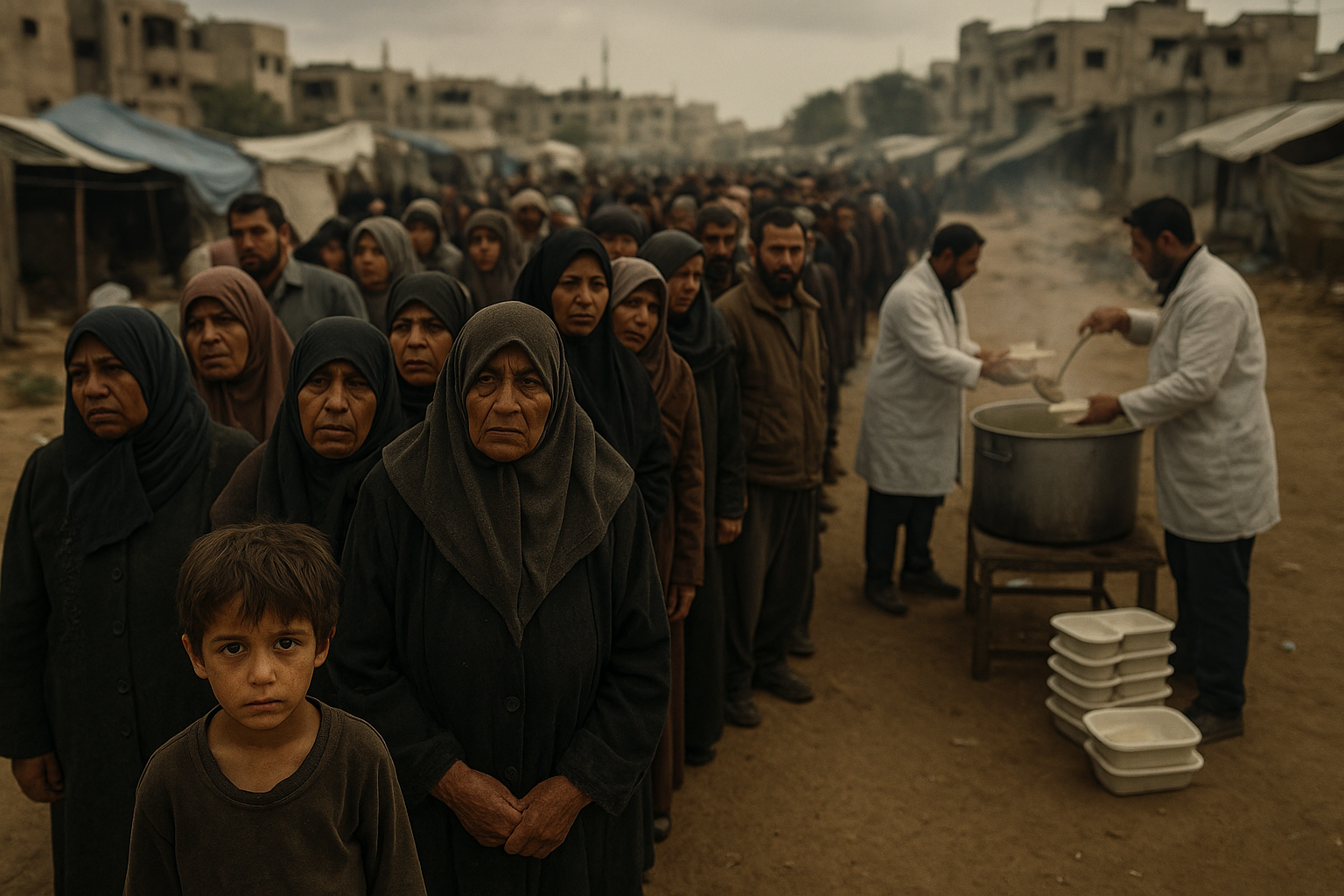
In the heart of Gaza, starvation has become not only a byproduct of war but a weapon of war itself. As Israel’s military intensifies its offensive under “Operation Gideon’s Chariots,” Palestinians are caught between the lethal threat of airstrikes and the desperate search for food. Humanitarian workers warn that the crisis has reached a breaking point, with aid now manipulated as a tool of forced displacement.
This past week, a tragic airstrike near a United Nations-run school in Mashrou’ Beit Lehia killed several civilians, including Samih Ibrahim Almadhoun, a 16-year-old volunteer for the Gaza Soup Kitchen. The kitchen, a critical lifeline for many, was forced to relocate further south after the attack. Hani Almadhoun, a relative and director of the mobile kitchen, lost his younger brother in a similar strike months ago — one of many aid workers allegedly targeted.
“This is the final stage of ethnic cleansing,” said Almadhoun, who also leads UNRWA USA’s philanthropy efforts. He fears his family will be forced into what Israel calls a “sterile zone” — controlled areas in southern Gaza where aid will be restricted to a few U.S.-secured sites run by a Swiss NGO, the Gaza Humanitarian Foundation (GHF).

GHF’s $100 million plan, supported by former military contractors and controversial U.S. security firms, sidelines over 13,000 UNRWA aid workers and slashes distribution centers from 400 to four. Critics, including the U.N., Oxfam, and UNICEF, have condemned it as both unworkable and illegal under international law.





“This is collective punishment,” said Yousef Munayyer of the Arab Center Washington, D.C. “You cannot deny food to millions to isolate a few.”
U.N. Secretary-General António Guterres added that current aid deliveries — just 100 trucks, compared to the 600 needed daily — were a “teaspoon of aid when a flood is required.” More than 1 in 5 Gazans face starvation, with thousands of children and pregnant women already showing signs of severe malnutrition. Nearly 30 starvation-related deaths were reported last week alone.


Despite these grim statistics, Israeli officials including Finance Minister Bezalel Smotrich and Prime Minister Netanyahu have doubled down on rhetoric suggesting Palestinians should be pushed out of Gaza altogether. Netanyahu praised Trump’s “Riviera Plan” to relocate Palestinians to third countries as a “correct and revolutionary” solution — a sentiment U.S. officials have hesitated to deny.
Amid continued bombardments — with over 800 targets hit since Sunday, including homes and hospitals — Israel issued new evacuation orders for northern Gaza, targeting heavily populated areas like Jabalia and Beit Lehia. Aid workers warn that civilians who stay may be buried beneath rubble; those who flee may face death from hunger.
Mara Kronenfeld of UNRWA USA compared the situation to “the concentration camps my grandfather fled from,” calling the new humanitarian zones “a combination of laughable and evil.”
As international pressure mounts and ceasefire talks stall, many Gazans are left with an unthinkable choice: starve in place or flee into what critics describe as internment camps.
For now, the trucks of aid that do manage to enter Gaza symbolize not relief, but the agonizing reminder that even food is no longer neutral.
This report is brought to you by Newspot Nigeria, continuing to spotlight global humanitarian crises and amplify voices that matter.