By Olugbenga Adebamiwa
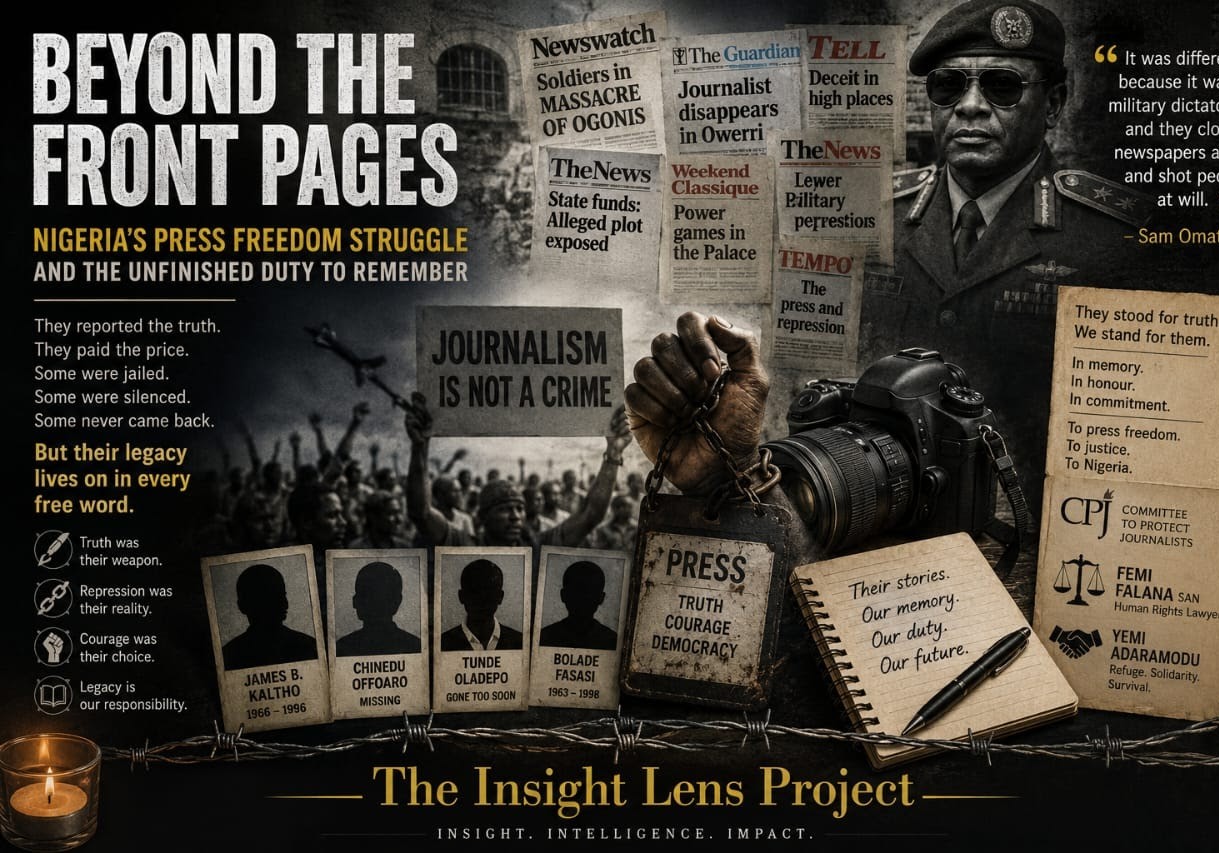
The story of Nigeria’s press freedom struggle is written not only in newspapers and archives, but also in absences, journalists who never returned from assignments, editors detained without trial, and families left without answers. One of the most haunting cases from this era is that of James Bagauda Kaltho, a reporter with TheNews magazine who disappeared in 1996 during the military rule of General Sani Abacha, a period widely marked by severe repression of the press.
Reflecting on that era, veteran journalist Remi Oyeyemi recalled the climate of fear under the Abacha regime, when press freedom was systematically constrained and the state’s coercive power often felt absolute. As journalist Sam Omatseye later put it, “It was different because it was a military dictatorship and they closed newspapers at will and shot people at will,” underscoring the extreme conditions under which journalists operated. Oyeyemi recounted a chance encounter on November 12, 1995, when he met Kaltho at the entrance of TheNews and TEMPO offices. Their brief exchange centered on the growing dangers facing journalists under military rule and the increasingly thin line between professional duty and personal survival.






That memory would later acquire deeper, more tragic weight after the execution of Ken Saro-Wiwa and other Ogoni activists in November 1995. The killings intensified an already suffocating atmosphere of fear among journalists, activists, and civil society actors. Against this backdrop, Kaltho would disappear under disputed circumstances in 1996. While official accounts at the time were inconsistent, colleagues, press freedom advocates, and human rights organisations have consistently described him as a casualty of a hostile environment in which dissent carried grave risks.


The repression of the period extended far beyond individual journalists. Families became collateral targets in a widening security dragnet. In one widely reported case, security operatives detained Ladi Olorunyomi and her infant son Aramide after failing to locate her husband, journalist Dapo Olorunyomi. She was later detained again in 1997 for 48 days without formal explanation, an episode frequently cited as symbolic of the era’s institutionalised intimidation.
Media organisations were also placed under sustained pressure. Newswatch journalists Ray Ekpu, Dan Agbese, and Yakubu Mohammed were detained over a publication involving allegations against military leadership. Mee Mofe-Damijo of Weekend Classique was arrested in connection with reporting on internal military disputes. Editors across the industry faced repeated summons, intimidation, and demands to surrender themselves to authorities.
A wider wave of arrests soon followed. Bayo Onanuga was detained multiple times during the period. Editors including Ben Charles Obi, Chris Anyanwu, Kunle Ajibade, and George Mba were tried before military tribunals and held for extended periods over publications deemed critical of the regime. Each case further underscored the shrinking space for independent journalism.
Some journalists narrowly escaped arrest or were forced into exile. Alex Kabba, a correspondent with TheNews, reportedly fled after security operatives attempted to detain him over a report involving state funds. He later escaped abroad following a tense encounter at the Abuja Press Centre, where journalists were briefly held during a security operation.
Across the country, arrests spread through newsrooms and news beats alike. Osa Director was detained in Kano over a military-related report. Veteran journalist Godwin Agbroko faced repeated arrests linked to sensitive political coverage. Nosa Igiebor of Tell magazine spent months in detention after refusing to disclose sources. Even street vendors such as Jude Sinnee were arrested, illustrating how far the crackdown extended beyond editors and reporters.
The repression also reached regional correspondents and broadcast journalists. Remi Oyeyemi himself came under state pressure, including being declared wanted during the Abacha years over investigative reporting. He would later go into exile, continuing his work and contributing to international human rights documentation from abroad.
Elsewhere in the country, similar incidents were recorded. George Onah of Vanguard was detained over military-related reporting. Okina Deesor of Radio Rivers was arrested following a controversial broadcast. Chinedu Offoaro of The Guardian reportedly went missing after an assignment in Owerri and was later presumed dead, though accounts of his fate remain contested and unresolved.
Within this landscape, Folu Olamiti represents resistance through endurance. A veteran of the Nigerian Tribune, he rose to senior editorial leadership, helping sustain one of Nigeria’s oldest newspapers through periods when continuity itself was a quiet form of press resistance under political pressure.
By the late 1990s, repression had further intensified. Moshood Fayemiwo of Razor was abducted after going into exile and later detained upon return. Mohammed Adamu and editor Soji Omotunde were targeted over critical cover stories. Other journalists, including Adetokunbo Fakeye, Jenkins Alumona, Onome Osifo-Whiskey, Akin Adesokan, Rafiu Salau, Babafemi Ojudu, and Ben Adaji were detained in separate incidents tied to their reporting activities.
Alongside arrests and detentions, the period was marked by a disturbing number of violent, suspicious, or unresolved deaths of journalists. Among them were Tunde Oladepo of The Guardian, Okezie Amaruben of Newsservice, Bolade Fasasi of the National Association of Women Journalists, Fidelis Ikwuebe (freelancer), Sam Nimfa-Jan of Details, Samson Boyi of The Scope, Godwin Agbroko of ThisDay, Paul Abayomi Ogundeji of ThisDay, Ephraim Audu of Nasarawa State Broadcasting Service, Bayo Ohu of The Guardian, Nathan S. Dabak of The Light Bearer, Sunday Gyang Bwede of The Light Bearer, and Edo Sule Ugbagwu of The Nation. Many of these cases remain unresolved or marked by competing narratives and unanswered questions.
International press freedom organisations, including the Committee to Protect Journalists (CPJ), have documented many of these incidents over time. Within Nigeria, legal advocates such as Femi Falana played a critical role in defending detained journalists, while colleagues and civil society groups sustained informal networks of support for those under threat. Together, they formed a fragile but persistent resistance to censorship and intimidation.
As Nigeria reflects on its democratic journey, these unresolved cases, including that of James Bagauda Kaltho and many others remain a reminder that recognition without accountability is incomplete. The unfinished task is not only to remember, but to formally acknowledge, investigate where possible, and integrate these stories into the nation’s democratic consciousness.
In this sense, the question is not only what was lost, but what is still owed.
Adebamiwa Olugbenga Michael is a Lagos-based journalist, political economy and policy analyst, and publisher of TheInsightLensProject.com, delivering data-driven open-source intelligence insights on Nigeria, Africa, and global affairs.