What should have been a solemn and orderly transition to one of Yorubaland’s most revered traditional stools has instead become a matter of deep contention, as questions mount over the integrity of the process to install a new Awujale of Ijebuland.

At the centre of the dispute lies what insiders describe as a “paper trail” — a sequence of documents and decisions, revealed in stages, that now appears to explain the prolonged delay in resuming the selection process. While the roots of the crisis stretch further back, this account begins at a critical juncture: the day the Fusengbuwa ruling family concluded its internal assessment of eligible candidates.
It was from this point that suspicions began to crystallise. Chief Fassy Yusuf, one of the principal figures in the process, publicly distanced himself from the resulting list of nominees — a move that has since prompted widespread speculation. According to those familiar with the document, a closer examination reveals irregularities that cast doubt on its authenticity.
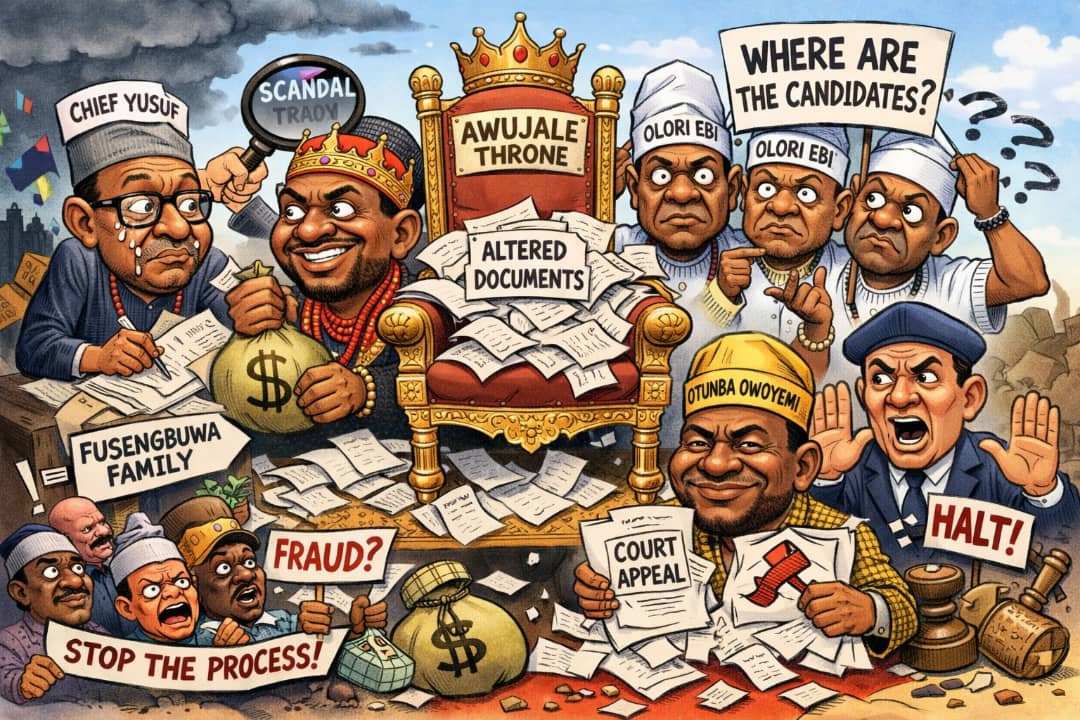
The structure of the document itself has raised eyebrows. The signatures of the three Olori Ebi — the recognised heads of family branches — appear only on the final page, while the substantive alterations and candidate listings are contained on the first. It is on that first page that a candidate reportedly favoured by the Afobajes, the kingmakers, is listed among those deemed qualified.

Yet this inclusion presents a contradiction. By the account of the Olori Ebi themselves, none of the candidates they initially approved corresponds with the individual now being advanced. This discrepancy has fuelled rumours of inducements and backroom dealings, though no verifiable evidence has emerged to substantiate such claims. People wonder at the refusal of the Olori Ebis to parade candidates from them to the family — who, where are these candidates? The absence of clarity on this point has only deepened suspicion and eroded confidence in the process.





Further scrutiny of the document reveals deeper anomalies. Candidates are split across multiple pages, with some of the most credible contenders — those considered to possess strong qualifications — reportedly disqualified unilaterally by a single Olori Ebi, without the knowledge or consent of the others. In the process, names and lineages appear to have been altered or misrepresented. In some instances, family branches were incorrectly reassigned, raising serious questions about how such errors could occur in a matter of such cultural and historical importance.
The timeline of these alterations is now a focal point of inquiry. If, as suggested, the document was prepared within Chief Yusuf’s office, yet later disowned by him, attention inevitably turns to the period between its departure from his custody and its eventual submission to the Afobajes. It is within this window that many believe the document may have been tampered with — though who was responsible remains unclear.


Accounts from those present during the process suggest that Chief Yusuf may have signed the document under pressure, with assurances that the kingmakers were awaiting its submission. Only upon a subsequent review did he reportedly discover that his preferred candidate — described as a medical professional — had been misclassified. By then, however, the document had already been transmitted onward.
That same list would later form the basis of the presentation made by the Afobajes to the state governor, purportedly identifying the most qualified candidate from the Fusengbuwa family. It is this submission that has since come under intense scrutiny.
Complicating the matter further is the case of Owoyemi, also known as Otunba Jadiara, whose longstanding ambitions within the traditional hierarchy have been shaped by a contentious legal history. Despite a prior judicial proceeding in which the late Awujale reportedly questioned his royal lineage, Owoyemi secured a favourable judgment at the Court of Appeal — a decision that went unchallenged at the time, largely due to the absence of key opposing figures.
That ruling has since strengthened his position within the family, even as debates over its validity persist.
As tensions escalated, efforts were made to stabilise the process. Chief Fassy Yusuf asserted his standing within the Fusengbuwa family alongside Ajidagba and another principal figure, leading to the formation of a 12-member committee. Each elder nominated four individuals in what was intended to restore balance and credibility.
Yet this intervention has only deepened the mystery. Questions now abound as to how such a committee could collectively endorse a document now widely regarded as flawed. Were all members privy to the same version of the list? How was it presented, and by whom? And at what point did discrepancies emerge?
Some within the family have described the situation as a “double-cousining” arrangement — a suggestion that elements within both the Olori Ebi and the Afobajes may have acted in concert. It is this perception of collusion that reportedly prompted the governor to suspend the process altogether, citing concerns serious enough to undermine both governance and tradition.
The crisis now enters a second and more uncertain phase. Should the kingmakers proceed with a selection based on a document widely alleged to have been altered, they risk further eroding public trust. Yet to withdraw the list entirely would signal a lack of preparedness within the ruling family itself.
Among the wider Ijebu community, opposition is growing. Many argue that no legitimate selection can emerge from a process so evidently compromised. At the same time, competing claims over eligibility continue to divide opinion. Owoyemi, for instance, has maintained that only descendants of Fusengbuwa are entitled to the throne, a position that has itself provoked controversy, particularly regarding the exclusion of certain lineages.
Adding to the confusion is the sheer scale of the candidate list, said to contain between 85 and 95 names. Critics allege that a significant number of these individuals cannot be verified, existing only on paper with explanations that they reside abroad. For sceptics, this raises a more troubling possibility: that some names may be entirely fictitious.
Calls are now intensifying for a full assembly of the Fusengbuwa family, where each nominee would be physically identified and verified. Until such a process takes place, confidence in the selection remains fragile.
For now, the paper trail — intended to guide a seamless transition — has instead become a source of division. And as the controversy deepens, the path to the Awujale throne remains as uncertain as it is contested.
Olumide Fashina is a Lagos-based public affairs commentator writing on power institutions and legitimacy in Nigeria.