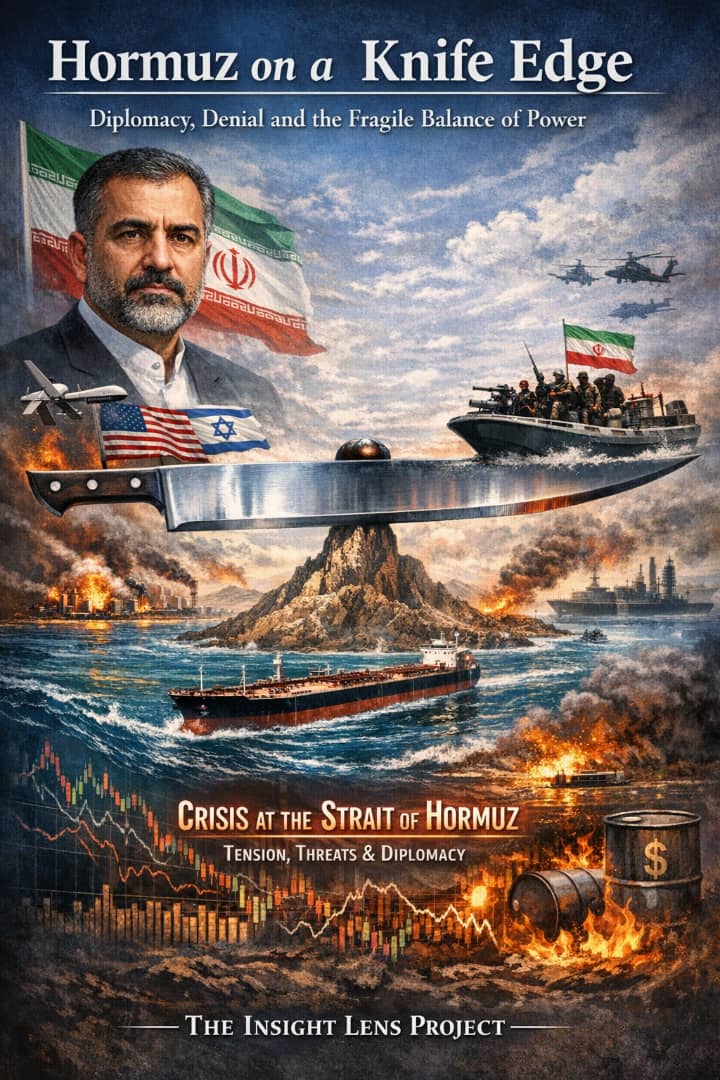
In the careful language of diplomacy, Iran insists that the Strait of Hormuz remains open. In reality, the world’s most critical energy corridor has seldom felt so constrained.
At the centre of the tension is Ali Mousavi, Iran’s ambassador to the United Kingdom and its representative to the International Maritime Organization. His formulation is precise, the strait is open to global shipping, except for vessels linked to Tehran’s adversaries, notably the United States and Israel, and even then subject to coordination with Iranian authorities and respect for national sovereignty. It is a position that preserves legal openness while imposing practical limits.
For shipowners and insurers, such distinctions offer little comfort. The waterway may not be formally closed, but heightened risk has become its defining feature. War-risk premiums have surged, traffic has slowed, and vessels increasingly hesitate at its threshold. What once carried roughly a fifth of the world’s seaborne oil and a substantial share of liquefied natural gas now operates under a cloud of uncertainty.





Into this ambiguity stepped Donald Trump, whose initial response was characteristically forceful. He issued a 48-hour ultimatum demanding that the strait be reopened without restriction, warning that failure to comply would invite strikes on Iranian energy infrastructure. Tehran’s reply was swift and uncompromising, signalling that any such action would trigger retaliation against American and allied assets across the region.


Yet within a day, the tone shifted. The American president announced a five-day suspension of planned strikes, citing what he described as “very good and productive conversations” with Tehran. The pause, presented as an opportunity for diplomacy, hinted at a possible de-escalation while preserving the threat of force.
Iran, however, rejected the claim outright. Officials denied that any negotiations, direct or indirect had taken place, insisting that messages from Washington had merely been relayed through intermediaries. State-aligned media went further, portraying the pause as a retreat under pressure rather than a diplomatic opening. Senior figures dismissed reports of talks as fabrication, intended to steady markets and buy time.
The result is a crisis defined by contradiction. Washington speaks of dialogue, Tehran denies it. The United States pauses military action, Iran frames the pause as evidence of deterrence. Between these competing narratives lies a narrow waterway upon which much of the global economy depends.
The stakes are immense. The Strait of Hormuz remains the single most important chokepoint in the energy system, funnelling Gulf oil and gas to markets across Asia and beyond. Even partial disruption is enough to unsettle prices and strain supply chains. Recent market movements reflect this reality, with oil benchmarks carrying a persistent geopolitical premium despite brief moments of calm on signs of de-escalation.
Yet restraint, as much as risk, defines the present moment. Iran’s calibrated approach, asserting control without imposing a total blockade preserves leverage while avoiding the immediate consequences of closure. The United States, for its part, appears to be testing a familiar strategy, applying pressure to compel engagement while leaving space for negotiation.
History suggests that such balance, however uneasy, can endure. The narrow waters of Hormuz have long conferred outsized influence on those who command them, but they have also resisted prolonged closure. Mutual dependence, even among adversaries, has tended to impose its own limits.
For now, the strait exists in a state of suspended tension, open in principle, restricted in practice, and overshadowed by the threat of escalation. The five-day window announced in Washington offers a brief and uncertain opportunity for diplomacy. Whether it produces a genuine breakthrough or merely delays confrontation will soon become clear.
In a region where geography magnifies every decision, the Strait of Hormuz remains both conduit and constraint, a narrow passage through which not only crude oil flows, but the wider fortunes of the global economy.
©️ Adebamiwa Olugbenga Michael is a Lagos-based journalist and policy analyst, and publisher of The Insight Lens Project, offering principled, data-driven insights on Nigeria and West Africa.