

..…A Kingdom in Transition


By Jamal Christopher Ogunlade
The passing of Oba Sikiru Kayode Adetona, the legendary Awujale of Ijebuland, on July 13, 2025, after a 65-year reign, has plunged Ijebuland into a royal storm. According to the 1957 Ijebu Chieftaincy Declaration and the Ogun State Chiefs Law, it is now the turn of the Fusengbuwa Ruling House to produce the next Awujale. But what should have been a graceful transition has turned into one of the most contentious succession battles in modern Yoruba history entangled in litigation, rival claims, and deep ancestral disputes that have split the royal lineage down the middle.
Agunsebi Ile-Nla – Sacred Ground, Contested Territory

At the heart of the crisis lies Agunsebi Ile-Nla, the ancestral compound and spiritual headquarters of the Fusengbuwa dynasty. Traditionally, it is the venue for rites of verification, ancestral invocation, and the presentation of aspirants to kingmakers. Today, Agunsebi has become contested ground. Rival factions now battle for control of its sacred halls, each insisting on the right to host the family’s crucial meetings and ceremonies. For many elders, the desecration of Agunsebi’s sanctity through infighting is not only unthinkable but spiritually perilous, a wound to the very soul of Ijebuland.




The Struggle for the Olori Ebi Crown
The conflict’s nerve center is the Olori Ebi (family head) dispute, which has polarized the Fusengbuwa House. One camp recognizes Otunba Abdulateef Owoyemi, a former ICAN President and respected elder, as the legitimate Olori Ebi, a position validated by a 2024 Court of Appeal judgment in Ibadan. The rival faction, led by Otunba Adedokun Ajidagba, challenges Owoyemi’s lineage and authority, insisting he is not a true descendant of Fusengbuwa. In September 2025, Ajidagba’s group filed a lawsuit at the Ijebu-Ode High Court, restraining Owoyemi from “parading himself” as family head. That suit has effectively frozen the entire succession process.


Royal Contenders – Hassan vs. Onanuga
Amid the leadership vacuum, two prominent princes have emerged as frontrunners, Dr. Adekunle (Kunle) Hassan, a renowned ophthalmologist and founder of the Eye Foundation Hospital, and Otunba Biodun Onanuga (Nugacon), billionaire businessman and philanthropist. Both have strong claims to the throne and significant community influence. Yet, both have reportedly been barred from participating in family deliberations at Agunsebi. Palace insiders allege that their genealogical credentials are under review with one accused of not being a direct male descendant and the other’s lineage deemed “complicated.”
The Identity Card Controversy
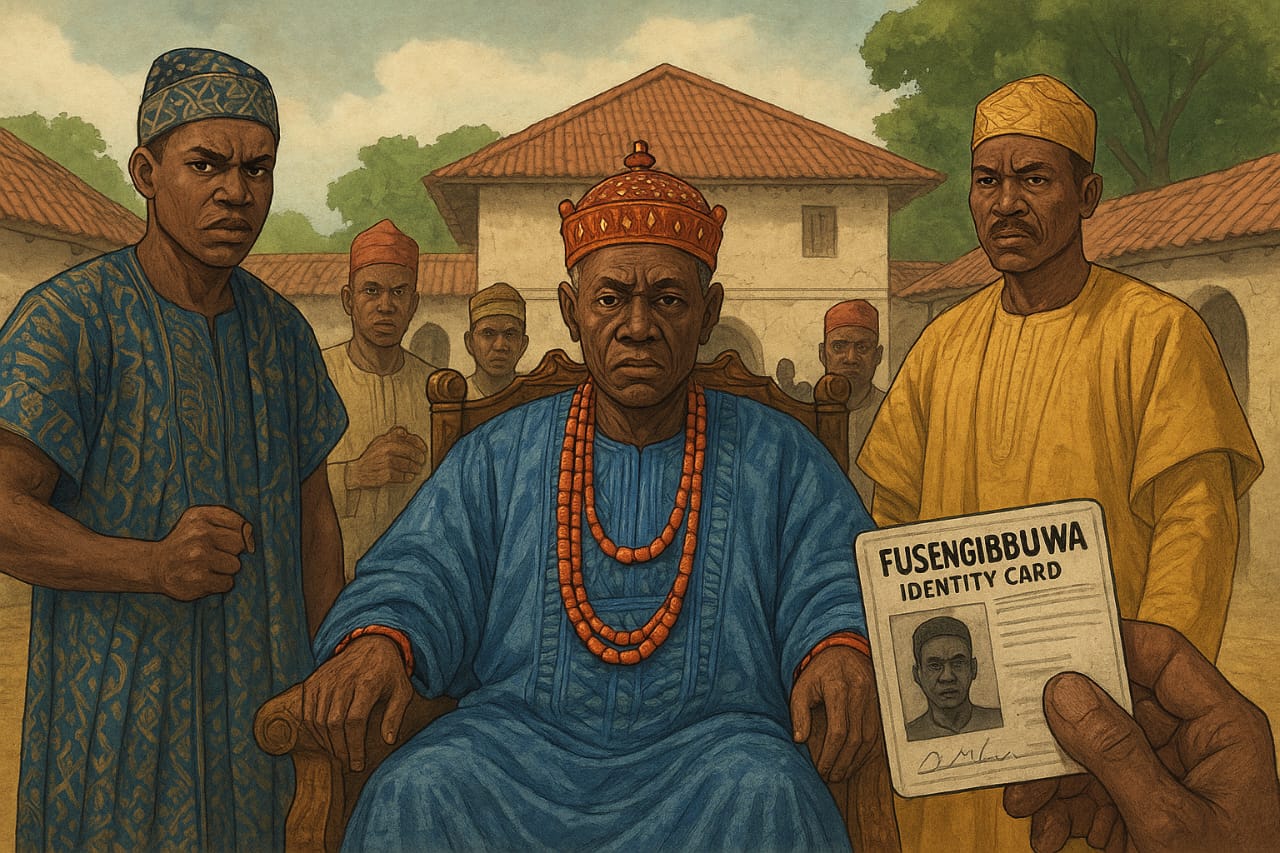
Perhaps the most polarizing development in the crisis is the Fusengbuwa Identity Card, a symbolic document said to verify a person’s authentic descent from the royal bloodline. The card, reportedly issued by Ajidagba’s faction at Agunsebi, has become both a badge of legitimacy and a weapon of exclusion. Aspirants without the card are being denied participation in key rites and meetings, prompting accusations of manipulation and disenfranchisement. Some family members describe it as a “modern gatekeeping tool,” while others see it as a necessary safeguard against impostors. As one royal observer quipped, “No card, no crown that’s the new reality in Fusengbuwa.”
Money, Power, and the Corruption of Tradition
Critics fear that money and political influence are overshadowing age-old customs. Both leading contenders Hassan and Onanuga are known for their wealth and have reportedly made significant contributions to traditional appeasements and family meetings. Yet, traditionalists argue that these financial gestures risk corrupting the sacred process. “Money can buy followers,” a palace elder warned, “but it cannot buy the blood of a king.” The growing perception that the race for the throne can be “influenced” has polarized opinion across Ijebuland and raised questions about the moral health of Yoruba traditional institutions.
Old Wounds, New Battles
The Fusengbuwa family’s internal rivalries are not new. Historical records show similar disputes dating back to the early 1900s, particularly between the Bubiade, Olufadi, Adeberu, and Tunwase branches. Those old fractures have resurfaced, now intensified by modern politics and social media. Each branch insists on ancestral purity, and every claim is contested by another’s oral history. Even the late Awujale, known for his diplomatic tact, once lamented that Fusengbuwa’s inability to unite could one day endanger Ijebu’s royal heritage — a prophecy that now seems to be unfolding.
Courts, Customs, and the Crisis of Legitimacy
The legal overtones of the dispute highlight the complex intersection of customary law and modern jurisprudence. While the Chiefs Law provides procedural guidance, it cannot adjudicate spiritual legitimacy or genealogical truth. Can a court determine who carries royal blood? Can ancestral identity be documented through paperwork or an “ID card”? These questions lie at the heart of the Fusengbuwa crisis and underscore the broader challenge facing Yoruba monarchies: balancing tradition with contemporary governance.
Government Neutrality, Family Division
The Ogun State Government has urged neutrality, insisting that the Fusengbuwa family follow due process in accordance with the Chiefs Law. Yet, unity remains elusive. With multiple lawsuits pending and powerful political figures rumored to be backing various aspirants, the path to resolution grows murkier. The kingmakers, traditionally the arbiters of royal succession, are said to be watching quietly, unwilling to act until the internal leadership crisis within the ruling house is resolved.
A Kingdom at a Crossroads
For now, the Awujale throne one of the most respected in Yoruba history remains empty. The Agunsebi compound continues to echo with both prayers and protests, as the Fusengbuwa sons battle over bloodlines, authority, and authenticity. What emerges from this crisis will determine not just who wears the next crown, but whether Ijebuland can preserve the delicate harmony between its ancient spiritual heritage and the modern ambitions now threatening to redefine it.
….Jamal Christopher Ogunlade writes from Jos