

By Newspot Nigeria Editorial Board


The world watched — again — as missiles lit up the skies over Iran.
On June 13, 2025, Israeli jets launched a sweeping assault on Iranian nuclear sites. Days later, American B-2 bombers followed with strikes of their own, hitting Fordow, Natanz, and Isfahan with the kind of precision that shakes cities — and consciences. The damage is still being counted, the dead still being buried. And now, people across the world are asking a heavy, honest question:
Was this necessary? Was this right?

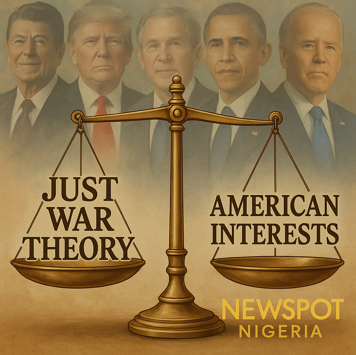
To find answers, we step beyond politics and soundbites. We turn to two powerful tools: Just War Theory, which helps us decide when war is morally defensible, and Graham Allison’s framework on American national interest, which helps us judge whether military action makes strategic sense.





Let’s walk through both — slowly, soberly, and with the lives at stake in mind.
Did the War Begin Right? (Jus ad Bellum)
Just War Theory teaches that war must meet strict moral criteria before it begins. The first test: Was the reason just? Was the authority legitimate? And — most of all — was war truly the last resort?


Was There a Just Cause?
Supporters say the strikes were necessary to slow Iran’s nuclear ambitions. But Iran hadn’t launched an attack. There was no sudden threat. No intelligence brief. No “red line” crossed. The move was preemptive — not reactive.
Verdict: ❌ No direct threat. No clear trigger. The cause doesn’t hold.
Was There Legitimate Authority?
President Trump ordered the strikes without asking Congress — again. There was no U.N. vote, no coalition, no global mandate. It was done quickly, quietly, and without debate.
Yes, presidents have done this before. But tradition doesn’t always make something just. Authority, in the moral sense, isn’t just about power — it’s about process.
Verdict: ❌ No congressional approval. No international backing. No legitimacy in the eyes of the world.
Was It Truly the Last Resort?
This is where the case really falls apart.
There was no sign that diplomacy was tried. No press conference about negotiations. No talk of a new nuclear deal. No back-channel with Iran. Not even a U.N. resolution.
And most crucially: There was no evidence that Iran was on the verge of launching a weapon or attack.
Just War Theory says war must come only after all peaceful options have been tried. Not skipped. Not ignored. Tried — seriously.
Verdict: ❌ Not a last resort. Not even close.
Did the War Play Out Justly? (Jus in Bello)
Even if a war begins with reason, it must also be fought with reason — sparing civilians and using only what’s needed to stop the threat.
Were Civilians Protected?
Iran says over 200 civilians died. Hospitals, homes, and roads near military targets were destroyed. Videos showed fireballs near residential blocks. Even if the military targets were valid, the human fallout was massive.
Verdict: ❌ Civilians were not spared. Lives were not protected.
Was the Force Proportional?
Was the devastation necessary to stop Iran’s nuclear progress? Or was it an overreach — a show of strength with no clear path forward? The retaliation from Iran, the economic fallout, the tension in the region — none of it feels like success.
Verdict: ❌ The scale of the attack outweighed its benefit.
Did This Serve America’s Interests?
Graham Allison’s national interest model helps us cut through emotion. He asks: Was the action vital to America’s survival? Was it extremely important, important, or just… symbolic?
Here’s how the strike stacks up:
Vital Interest?
Preventing a nuclear attack on the U.S. or allies? Iran wasn’t there — not close. The threat was distant and uncertain.
❌ Not vital.
Extremely Important?
Preventing dominance of a region by an enemy? Iran is a player — but hardly dominant. The Gulf has checks and balances.
⚠️ Important, but not urgent.
Important?
Nonproliferation matters — yes. But not this way. Bombing without diplomacy undermines long-term goals. It teaches that talks don’t matter.
❌ The method hurt the mission.
🔁 And What Did It Cost?
-
Over 600 lives, many of them civilians.
-
Hundreds of retaliatory missiles from Iran.
-
Oil prices spiking. Global markets shaking.
-
The world on edge — again.
-
Allies divided. Institutions sidelined.
-
Morality questioned.
And for what?
Final Thought
No one denies that nuclear threats matter. No one wants to see Iran armed with weapons of mass destruction. But when the answer skips diplomacy, skips Congress, skips the U.N., skips restraint — we don’t just risk war. We risk who we are.
This wasn’t a war of last resort. It was a choice.
A costly, solitary, and deeply questionable choice.
Newspot Nigeria
Truth before triumph. Justice before justification.