
By Olugbenga Adebamiwa
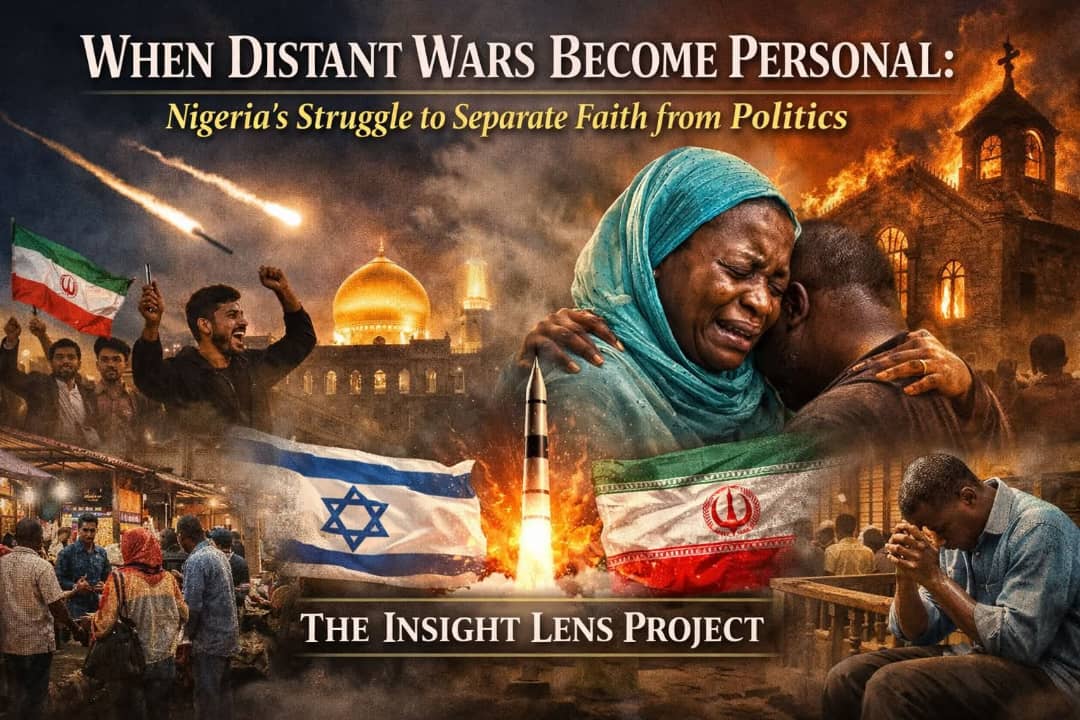
Across Nigeria, on bustling streets, in mosques, in churches, and across the restless sprawl of social media, a curious drama is unfolding. A war thousands of miles away has become intensely personal. Iran and Israel exchange fire, and here at home, allegiances are declared with a passion that suggests the missiles are landing in Abuja or Kano rather than Tehran or Tel Aviv.
The divisions are familiar. Some Nigerians rally in solidarity with Iran, invoking shared faith. Others instinctively back Israel, citing their own religious affinity. The conflict, distant in geography, becomes intimate in identity. Yet beneath the heat of online debates lies an inconvenient truth, Israel is predominantly Jewish, not Christian, and Iran’s ruling establishment is Shi’ite, while most Nigerian Muslims are Sunni. The theological bonds invoked in these arguments are rarely as direct as claimed.




It is not sympathy itself that is remarkable, global events have long stirred emotions across borders, but the intensity of selective outrage. In Nigeria, extremists have attacked mosques, murdering worshippers, and stormed churches, slaughtering congregants. Yet these domestic tragedies rarely spark the same sustained, feverish mobilisation now visible over events thousands of miles away. The grief at home is fleeting, the anger abroad, enduring.


The missiles crossing Middle Eastern skies carry no scripture. Israel and the United States did not launch strikes citing the Bible. Iran’s military actions are not framed as chapters from the Qur’an. And when Tehran acts against fellow Muslim-majority states like the United Arab Emirates, Bahrain, or Qatar, these strikes are expressions of power, not piety. The disruption at Dubai’s airport last week, shaking the shadow of the Burj Khalifa, was a calculation of political strategy, not faith.
Wars are fought for security, influence, deterrence, and dominance not theology. Yet in Nigeria, the rhetoric often devolves into something more primal, projecting religious identity onto distant geopolitical chess moves.
This raises a difficult question. Why do conflicts thousands of miles away provoke more outrage than domestic crises? Why does a missile launched in the Persian Gulf ignite collective extremism, while blood spilled in Kaduna or Plateau struggles to sustain attention?
It is possible to follow global events without reducing them to sectarian scorecards. Solidarity does not require performance. Critique does not require personal crusades. In a world of instant outrage, sometimes the most radical act is restraint.
The reality is stark. If Israel were to face Iran without the support of America or NATO, the disparity in military capabilities is clear. This is not a divine war, it is a struggle shaped by power, strategy, and corruption, not scripture. Those who frame it as a universal battle risk losing sight of law, evidence, and reason.
Faith, if genuine, should guide reflection, not blind allegiance. God, as believers hold, does not condone unprovoked aggression or the elevation of one nation over another. Religious texts are not instruments of war, they are tools of guidance. To claim otherwise is to misunderstand both the message and the world.
For Nigerians, the more pressing battles remain closer to home, insecurity, economic strain, and fragile communal trust. Observing the world with clarity, without letting distant conflicts dictate local passions, is not apathy, it is wisdom. Not every headline demands allegiance. Not every war is ours to fight.
In the streets of Tehran, some people celebrate. On Nigerian social media, arguments rage. But perhaps the true act of courage is to watch, understand, and resist the pull of symbolic anger. Sometimes, peace begins with the simple act of restraint.
©️ Adebamiwa Olugbenga Michael is a Lagos-based political economy and policy intelligence analyst and publisher of The Insight Lens Project, providing data-driven insights across Nigeria and West Africa using open-source data.