
By Managing Editor


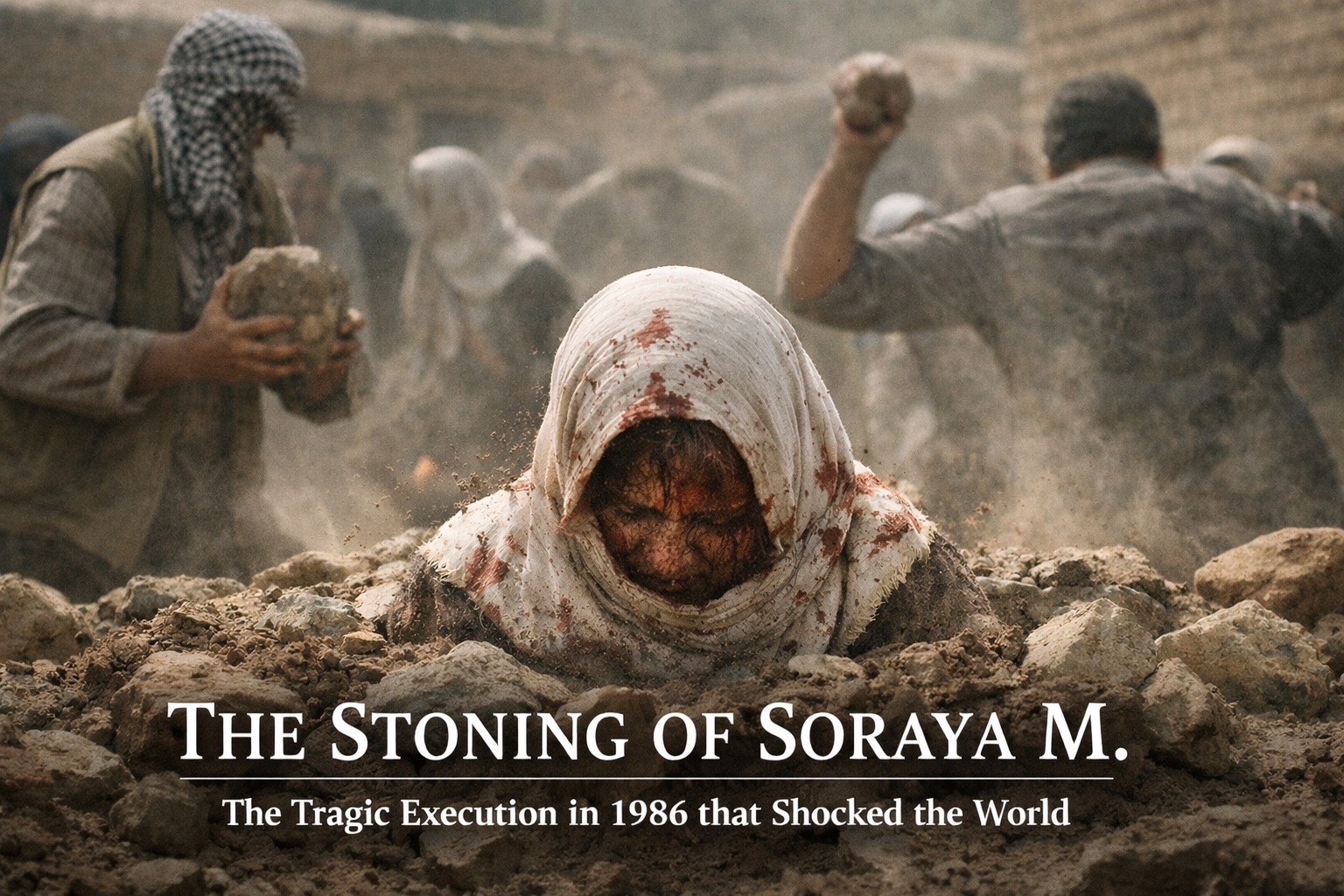
In August 1986, a woman named Soraya Manutchehri was stoned to death in the village of Kuhpayeh in Iran after being accused of adultery. Nearly four decades later, the story remains one of the most haunting reminders of how fragile justice can become when law, culture, and mob sentiment collide.
The case later gained global attention through the 1990 book “La Femme Lapidée” (The Stoned Woman), written by French-Iranian journalist Freidoune Sahebjam, and through the 2008 film “The Stoning of Soraya M.,” directed by Cyrus Nowrasteh. The story is disturbing not merely because of the violence it depicts, but because of the deeper questions it raises about power, justice, and the manipulation of public sentiment.
According to widely reported accounts, Soraya’s husband sought to divorce her to marry a much younger girl. Faced with the financial obligations associated with divorce under the law at the time, he allegedly accused her of adultery. Local authorities and influential figures in the village reportedly supported the accusation. In a setting where legal safeguards were weak and social pressure was strong, the accusation quickly transformed into a death sentence.

Soraya was buried up to her waist in the ground while stones were thrown at her by members of the community. Among those reportedly forced to participate were her own relatives. What unfolded that day was not merely an execution; it was the transformation of a village into a tribunal. The story resonates far beyond Iran. Around the world, societies continue to confront variations of the same dangerous phenomenon: justice administered by anger rather than by law.





Nigeria itself is not unfamiliar with this challenge. From street lynchings of suspected thieves to viral videos of mob punishment circulated on social media, the country has repeatedly faced the grim reality that public rage can quickly overwhelm due process. Each incident carries the same underlying message: when institutions fail or are perceived to fail, crowds attempt to replace them. But crowds are rarely just. History shows that mob justice rarely punishes the guilty with certainty; it simply punishes the accused with speed. Once a community’s collective anger is activated, evidence becomes secondary. Rumors become facts. Suspicion becomes proof.
Soraya’s tragedy illustrates how easily accusations can be weaponized. In environments where legal systems are weak, social pressure is intense, and gender inequalities are pronounced, the most vulnerable often become the first victims. Yet the lesson of Soraya’s story is not merely about one woman in one village. It is about the universal danger that arises when law is replaced by spectacle.


A functioning justice system exists precisely to prevent this outcome. Courts are designed to slow down judgment, not accelerate it. Procedures exist to test claims, not amplify them. Rights exist to protect individuals from the emotional tides of public opinion. Without those safeguards, justice becomes theater.
Nigeria has a lot to learn from this incident. As a country striving to deepen democracy and strengthen the rule of law, the challenge is not only to punish crime but also to ensure that punishment itself remains lawful. Strengthening police investigations, improving judicial efficiency, and educating communities about the dangers of mob action are not merely administrative tasks. They are essential safeguards against the erosion of justice.
Soraya Manutchehri’s story continues to circulate decades later because it exposes a universal truth: when societies allow anger to replace institutions, tragedy follows. The measure of a civilization is not how quickly it punishes wrongdoing, but how carefully it protects the innocent while doing so. That principle remains as urgent today as it was in a small Iranian village in 1986.