By Olugbenga Adebamiwa

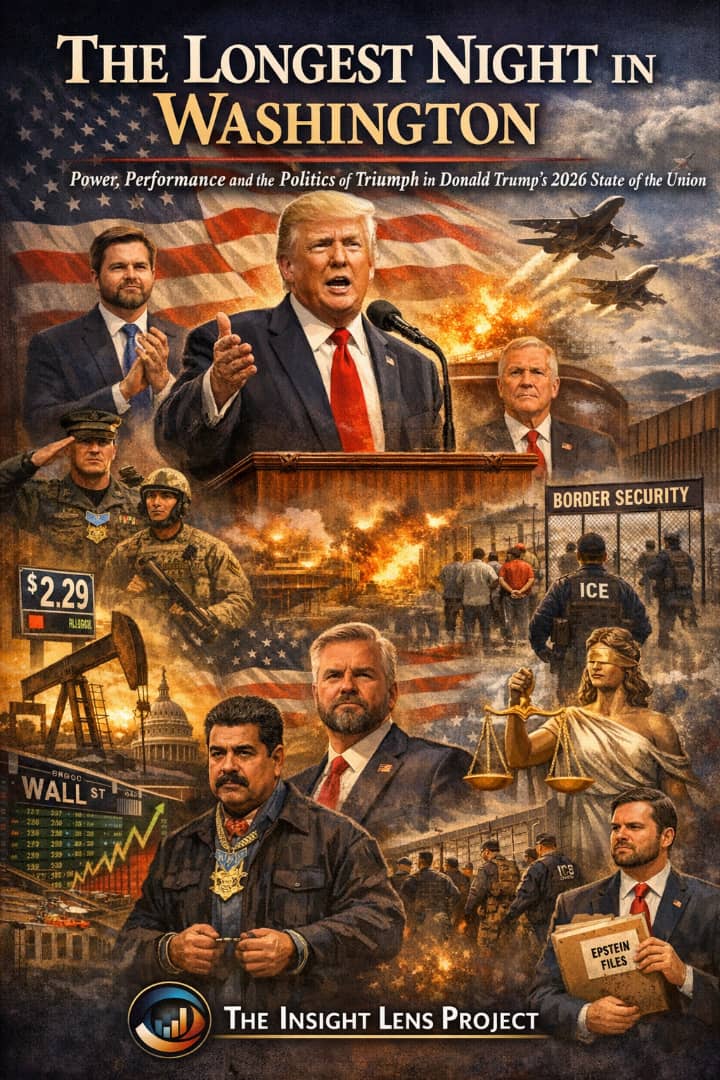
When Donald Trump strode into the House chamber on February 24, 2026, for his first State of the Union of a second, improbable presidency, he did so with the swagger of a man intent on rewriting both history and narrative. By the time he concluded, one hour and forty-seven minutes later, he had delivered the longest State of the Union address in American history, surpassing even his own prior records and transforming a constitutional ritual into a political spectacle of endurance, defiance, and unrelenting self-affirmation.
Declaring the state of the union “strong,” Trump cast his first year back in office as nothing less than “a turnaround for the ages.” The address unfolded less as a legislative roadmap and more as a sweeping testament to restoration, of markets, borders, military might, and national pride. Yet beneath the applause lines and theatrical flourishes lay a deeper story about the American presidency in an age of partisan divide, a speech designed not merely to inform Congress, but to dominate the national conversation ahead of critical midterm elections.
From the outset, the economy formed the rhetorical backbone of Trump’s case for renewal. He promised relief through eliminating taxes on tips, overtime, and Social Security benefits for seniors. He unveiled “Trump accounts,” federally backed investment vehicles for newborns that he framed as generational wealth incubators. He floated once again his long-standing fascination with tariffs, suggesting they could ultimately replace income taxes altogether. The stock market, he declared, had broken 53 records since the 2024 election. Gasoline prices, he said, had fallen below $2.30 per gallon in most states. Foreign investors, he boasted, had pledged more than $18 trillion to the American economy.

Some of those claims stood on firmer ground than others. Markets have indeed touched historic highs in the past year, though not quite at the pace he described. Other figures proved more elastic under scrutiny, gas prices nationally hovered far above the levels he cited, and investment commitments appeared significantly lower than advertised. Mortgage rates were nowhere near four-year lows. Yet in Trump’s telling, statistical nuance mattered less than symbolic momentum. The message was clear, prosperity had returned, and he was its architect.





If the economy provided the promise of revival, immigration supplied the language of urgency. Trump proclaimed the “strongest and most secure border in American history,” crediting mass deportations and aggressive enforcement measures. In the gallery sat families of crime victims, “angel families,” as he called them, whose stories he used to underscore the human toll of unlawful entry. He proposed what he termed the “Delilah Law,” targeting shell companies that issue fraudulent identification documents, and accused Democrats of deliberately sabotaging border security through funding decisions affecting the Department of Homeland Security. The chamber, already tense, hardened into visible partisan camps.
Crime and corruption followed. Trump asserted that the United States had experienced the largest decline in murder rates ever recorded, reaching the lowest levels in more than a century. While experts acknowledge a notable drop in violent crime in 2025, long-term historical comparisons are far more complex than his framing suggested. He announced a “war on fraud” to be spearheaded by Vice President JD Vance and demanded a ban on congressional insider trading, invoking the lingering specter of the Epstein files without directly naming them. In doing so, he fused populist grievance with institutional critique, casting himself as both outsider and enforcer.


On foreign policy, Trump embraced forceful confidence. He described the 2025 U.S. strikes on Iran’s nuclear facilities as having “obliterated” the program, language that critics argue oversimplifies a more complicated strategic reality. He confirmed the dramatic capture of Venezuelan leader Nicolás Maduro and celebrated the heroism of Army Chief Warrant Officer Eric Slover, whom he awarded the Medal of Honor during the address. The ceremony extended to two Purple Hearts, a Legion of Merit, and a Presidential Medal of Freedom. Olympic champions and survivors of exploitation joined military personnel in a gallery tableau designed to evoke resilience and redemption.
The choreography was deliberate. At several moments, Trump paused to needle Democratic lawmakers for their silence, labeling their refusal to applaud as unpatriotic. The exchange underscored the speech’s dual character, part presidential address, part campaign rally. He closed on a soaring note, invoking American destiny and promising a future “bigger, better, brighter” than ever before.
Public reaction mirrored the chamber’s division. Conservative commentators hailed the address as a commanding reaffirmation of the “America First” doctrine. Major networks and newspapers, while acknowledging its political potency, emphasized its combative tone and frequent departures from verifiable data. Instant viewer polls, drawn largely from self-selected audiences who tuned in showed strong approval. Broader national surveys, however, suggested a more complicated reality, with lingering public anxiety over inflation and cost-of-living pressures that the speech barely addressed.
In many respects, the 2026 State of the Union captured the irony of Trump’s second presidency. It was at once expansive and selective, unifying in symbolism yet divisive in rhetoric. Its emotional crescendos, honoring soldiers, athletes, and survivors tapped into a durable vein of American patriotism. Its factual overstatements risked eroding credibility among skeptics already wary of political hyperbole. Its length conveyed command, its tone reinforced polarization.
Ultimately, the address did not so much redefine the state of the union as restate Trump’s enduring thesis, that American greatness is both embattled and recoverable, that institutional caution is weakness, and that bold assertion is strength. Whether that argument holds relevance beyond his base may determine the projection of the midterm elections, and the durability of his second-term mandate.
For nearly two hours on a winter night in Washington, the president held the stage, narrating a nation reborn. Whether the country sees itself in that reflection remains the more consequential question.
©️ Adebamiwa Olugbenga Michael is a Lagos-based political economy and policy intelligence analyst and publisher of The Insight Lens Project, providing data-driven insights across Nigeria and West Africa using open-source data.