By Olugbenga Adebamiwa
On a humid February morning in Abuja, the long journey of a corruption trial that began in the oil-rich creeks of Akwa Ibom finally bent toward judicial finality. On February 27, 2026, the Supreme Court of Nigeria affirmed the conviction and seven-year prison sentence of former senator Albert Bassey, known widely as OBA, drawing a definitive line under a case that has come to symbolise both the promise and the bitter irony of Nigeria’s anti-corruption crusade.
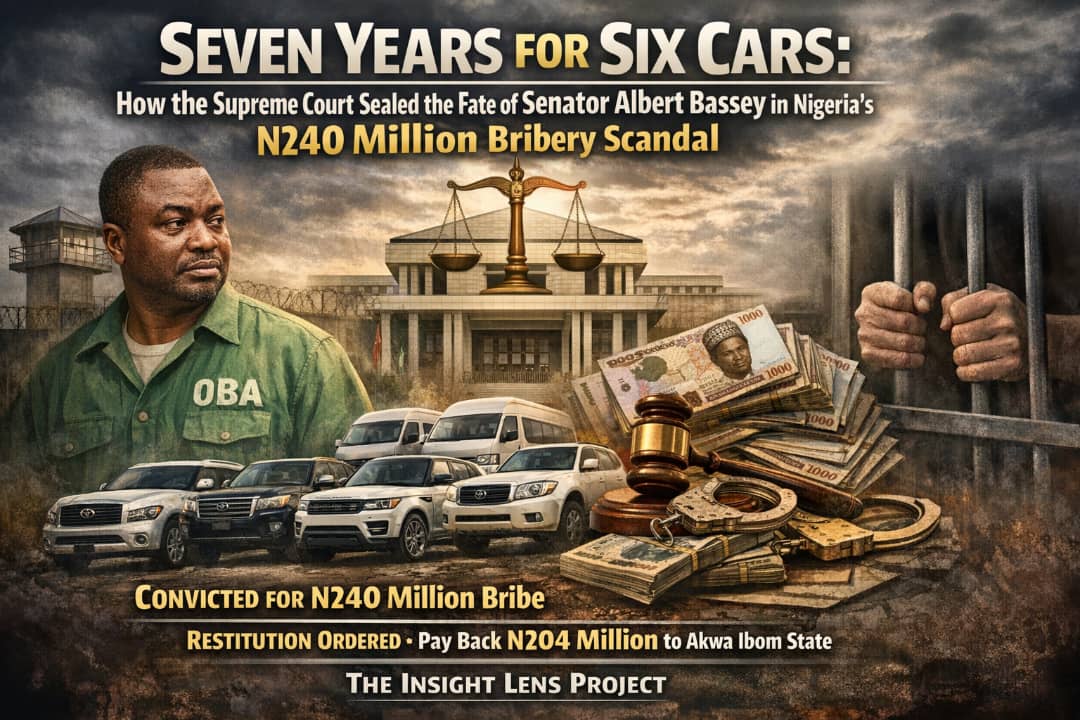
Bassey, who once represented Akwa Ibom North-East in the National Assembly and previously served as the state’s Commissioner for Finance, was convicted for accepting bribes valued at N204 million in the form of six luxury vehicles. The cars, prosecutors argued and the courts ultimately agreed, were not tokens of goodwill but inducements, rewards for facilitating state contracts worth N3 billion in 2012 while he chaired the Inter-Ministerial Direct Labour Coordinating Committee.





The vehicles read like an inventory from an upscale showroom, an Infinity QX 56, a Toyota Land Cruiser V8, a Range Rover, two Toyota Hiace High Roof buses and a Toyota Hilux 4×4. Together, their combined valuation formed the financial spine of the charges. The trial court in Uyo had in December 2022 found Bassey guilty on multiple counts of money laundering. He was sentenced to seven years on each count, a cumulative 42 years on paper, though, as is common in such cases, the terms run concurrently, leaving seven years as the effective custodial period.


What the Supreme Court did this week was not merely to uphold that conviction but to restore an order of restitution that had slipped through the cracks at the appellate stage. Bassey must repay N204 million to the Akwa Ibom State Government, the bench ruled, reinforcing the principle that public corruption is not only a criminal offence but a financial injury to the state that demands recompense.
The bribes were traced to companies linked to oil marketer Olajide Omokore, a figure long associated with Nigeria’s turbulent petroleum sector and with the network surrounding former petroleum minister Diezani Alison-Madueke. Prosecutors from the Economic and Financial Crimes Commission painstakingly followed invoices, bank transfers and corporate records to establish that the vehicles were purchased shortly after Omokore secured lucrative contracts from the state.
Yet the case has not been without its ambiguities. Earlier iterations of the charges referenced a broader fleet of vehicles and higher aggregate sums, figures that shifted as the prosecution refined its case. In the end, the conviction rested squarely on the six vehicles valued at N204 million, a reminder of how sprawling corruption allegations often contract into tighter legal narratives by the time they reach final judgment.
More contentious is the suggestion in some accounts that Omokore volunteered incriminating information against Bassey as part of a plea arrangement. Publicly available court records do not clearly substantiate that claim. Details of the bribery scheme appear instead to have emerged from investigative findings and witness testimony rather than from a formal plea disclosure. The distinction matters. In a country where selective prosecution is a persistent public concern, the perception that one actor cooperates while another serves time can fuel suspicions of uneven justice.
For Nigeria, the ruling lands in a fraught political and social climate. Bassey’s career trajectory, from state finance commissioner to senator and later governorship aspirant underscores the resilience of political ambition even under legal cloud. His conviction marks a fall from elite office, but it also exposes how deeply embedded patronage and kickbacks remain within the architecture of public contracting.
The case is, in one sense, a prosecutorial success for the EFCC, which has long sought high-profile convictions to boost its deterrent credentials. In another sense, it reveals the limitations of the system. A headline figure of 42 years in prison carries rhetorical weight, yet the concurrent nature of sentencing tempers its severity. For ordinary Nigerians facing harsh penalties for far lesser sums, the optics are not insignificant.
Akwa Ibom, like many oil-producing states, sits at the crossroads of wealth and want. The restitution order of N204 million is symbolically potent, but it pales beside the structural losses that corruption inflicts over time, schools unbuilt, hospitals underfunded, roads half-paved. Each luxury vehicle, prosecutors argued, represented not merely a bribe but a diversion of public trust.
Whether this judgment heralds a deeper cleansing or stands as an isolated victory remains to be seen. The anti-corruption battle in Nigeria has often fluctuated between bursts of assertive enforcement and periods of political accommodation. What is clear, however, is that the Supreme Court has spoken with unusual clarity, gifts that follow contracts are not gifts at all.
For Senator Albert Bassey, the road that once carried a convoy of gleaming SUVs now leads to a prison gate. For Nigeria, the ruling is both a milestone and a mirror, reflecting a justice system capable of reaching into the upper tiers of power, yet still grappling with the broader currents that make such cases possible in the first place.
©️ Adebamiwa Olugbenga Michael is a Lagos-based political economy analyst and publisher of The Insight Lens Project.