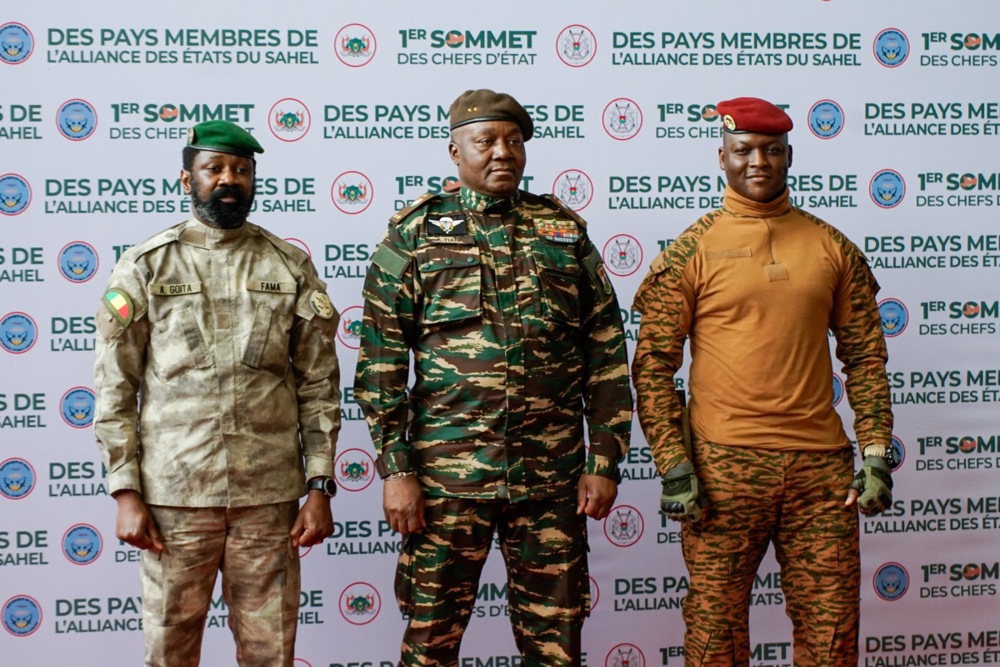
Caption: Interim President of Mali Colonel Assimi Goita (L), head of the military junta in Niger General Abdourahamane Tchiani (C) and Interim leader of Burkina Faso Captain Ibrahim Traore (R) pose for photos at the start of the first ever Alliance of Sahel States summit in Niamey, Niger, July 6, 2024. EPA/ISSIFOU DJIBO
Across the fragile belt of Africa’s Sahel, a quiet war is being waged-not only against insurgents in the scrublands and deserts, but against information itself. In *Mali*, *Niger*, and *Burkina Faso*, military rulers who seized power in a wave of coups are tightening their grip on the press, fostering what analysts describe as a dangerous vacuum of credible information with far-reaching global consequences.
At the heart of this shift is a calculated dismantling of independent journalism. Under the pretext of safeguarding sovereignty and combating terrorism, authorities have deployed cybercrime laws, regulatory bodies, and security decrees to suppress scrutiny-effectively recasting critical reporting as a threat to national stability.
*A Region Retreating from Transparency*





The Sahel’s descent into media repression follows a broader geopolitical realignment. Having distanced themselves from Western allies and regional blocs such as ECOWAS, the three juntas have formed the *Alliance of Sahel States*, consolidating a new axis of cooperation amid deepening insecurity.
Yet this pivot has come at a cost. With diminished international oversight and the growing footprint of actors such as the *Wagner Group*, the information ecosystem has become increasingly opaque. Independent verification of security claims-particularly regarding counterinsurgency operations and alleged human rights abuses-has all but collapsed.


Journalists who attempt to fill that gap face severe reprisals.
*Criminalising Journalism*
In *Niger*, now regarded as one of the region’s most aggressive jailers of journalists, cybercrime legislation has been repurposed into a blunt instrument of control. Reporters covering refugee conditions, military operations, or governance failures have been arrested on charges ranging from “disturbing public order” to “undermining national defence.”
A similar pattern has taken hold in *Mali*, where journalists have faced prosecution for defamation and “false news,” often linked to reporting that challenges official narratives. Even routine coverage of judicial or administrative disputes has triggered legal action, sending a chilling signal across newsrooms.
In *Burkina Faso*, the pressure extends beyond courtrooms. Authorities have detained journalists over leaked interviews and, in more extreme cases, forcibly conscripted critics into military service-an unprecedented escalation that blurs the line between censorship and coercion.
*The Great Media Blackout*
Parallel to these legal tactics is a sweeping effort to control the airwaves. Foreign broadcasters-including *BBC*, *Radio France Internationale*, and *France 24*-have been suspended or blocked across the region, often accused of disseminating “false information” or undermining state authority.
Local outlets have fared no better. In Mali, a dramatic increase in licensing fees-by as much as 900%-has forced smaller media houses to shut down or align with official messaging. In Niger and Burkina Faso, regulatory institutions once designed to safeguard media independence have been restructured into instruments of state control.
The result is an increasingly homogenised media landscape, dominated by official narratives and stripped of dissenting voices.
*Fear, Exile, and Self-Censorship*
Behind the statistics lies a human toll that is harder to quantify. Journalists across the Sahel describe a pervasive climate of fear, where routine reporting decisions carry existential risks.
Many have resorted to self-censorship, carefully avoiding topics such as military casualties, insurgent attacks, or governance failures. Others have fled into exile, continuing their work from abroad at great personal and professional cost.
“We live in a police state,” one Malian journalist confided, capturing the mood of a profession under siege.
*An Expanding Information Vacuum*
The consequences extend far beyond the newsroom. As independent reporting recedes, an information void has emerged-one increasingly filled by propaganda, disinformation, and unverifiable claims.
This vacuum has profound implications. Civilians, already vulnerable to extremist violence, are left without reliable channels for lifesaving information. Human rights organisations struggle to document abuses. Actors, meanwhile, navigate a landscape clouded by uncertainty and competing narratives.
External powers have been quick to exploit this gap. State-backed messaging and coordinated disinformation campaigns-often aligned with geopolitical interests-are gaining traction, further distorting the region’s information environment.
*Cross-Border Repression and Rising Risks*
Notably, the crackdown is no longer confined within national borders. Journalists have been prosecuted for comments about neighbouring regimes, underscoring an emerging pattern of cross-border repression among Sahelian states.
Meanwhile, threats from non-state actors persist. Kidnappings by jihadist groups remain a constant danger, with several journalists abducted or killed in recent years. In such an environment, the risks of reporting are compounded from all sides-state, insurgent, and criminal.
*A Call for Urgent Action*
Media watchdogs warn that the erosion of press freedom in the Sahel is not merely a regional concern but a global one. Without urgent intervention, the suppression of independent journalism risks entrenching authoritarianism, obscuring accountability, and exacerbating an already volatile security crisis.
The prescription is clear: end arbitrary arrests, reform cybercrime laws, restore regulatory independence, and reopen the media space to both local and international actors.
Absent these steps, the Sahel may drift further into what one observer described as “an information dark zone”-where silence, rather than truth, becomes the prevailing currency.