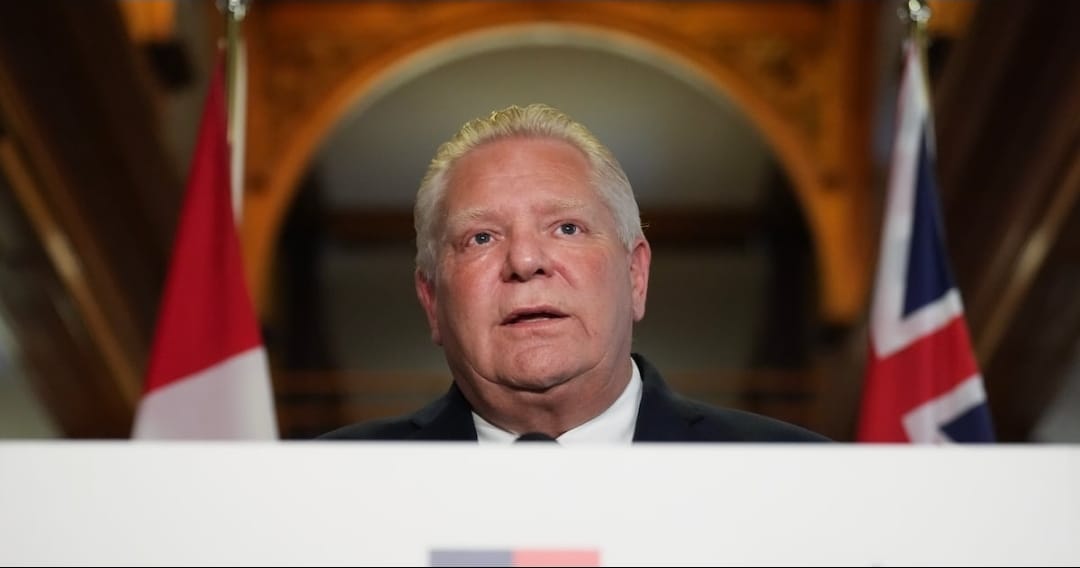

Ontario Premier Doug Ford has said legal and political pressure is increasingly constraining U.S. President Donald Trump following a Supreme Court decision that struck down key aspects of Washington’s sweeping tariff policy.
Ford described the situation as an ongoing economic battle that has injected uncertainty into global markets and strained relationships between the United States and its closest trading partners, including Canada.
According to the Ontario leader, the court ruling significantly limits the president’s ability to rely on emergency powers to impose broad tariffs on foreign goods. While Trump has indicated he may explore alternative legal authorities, the decision narrows the scope of unilateral action available to the White House.

Ford said the tariff policy has disrupted supply chains and raised costs across several industries, particularly steel, aluminum, automobiles, and lumber. Although much of Canada’s trade with the United States remains protected under existing trade agreements, lingering duties continue to weigh on specific sectors.





He also linked the tariffs to inflationary pressures in the United States, arguing that American consumers are increasingly paying higher prices for food and everyday goods as uncertainty persists.
Beyond the court ruling, Ford pointed to growing political resistance within the United States, noting that lawmakers recently voted to challenge the national emergency declaration used to justify the tariffs. While the move is largely symbolic, it reflects rising discomfort with the administration’s trade strategy.


The premier added that upcoming U.S. midterm elections could further limit the president’s leverage on trade policy, especially if political control in Congress shifts.
Ford cautioned against rushing into trade agreements under pressure, saying Canada would remain careful in negotiations with Washington.
“Sometimes no deal is better than a bad deal,” he said.
Tensions between the two countries have intensified in recent weeks following renewed tariff threats tied to Canada’s trade engagements with China, testing one of North America’s most important economic relationships.
Political analysts say Ford’s remarks reflect widespread concern in Canada over the economic impact of prolonged trade uncertainty, while also highlighting the diplomatic risks of openly criticizing a U.S. president known for responding forcefully to public opposition.
Despite those risks, Ford said Canada would continue to defend its economic interests and resist policies it views as harmful to global trade stability.