By Gbenga Adebamiwa


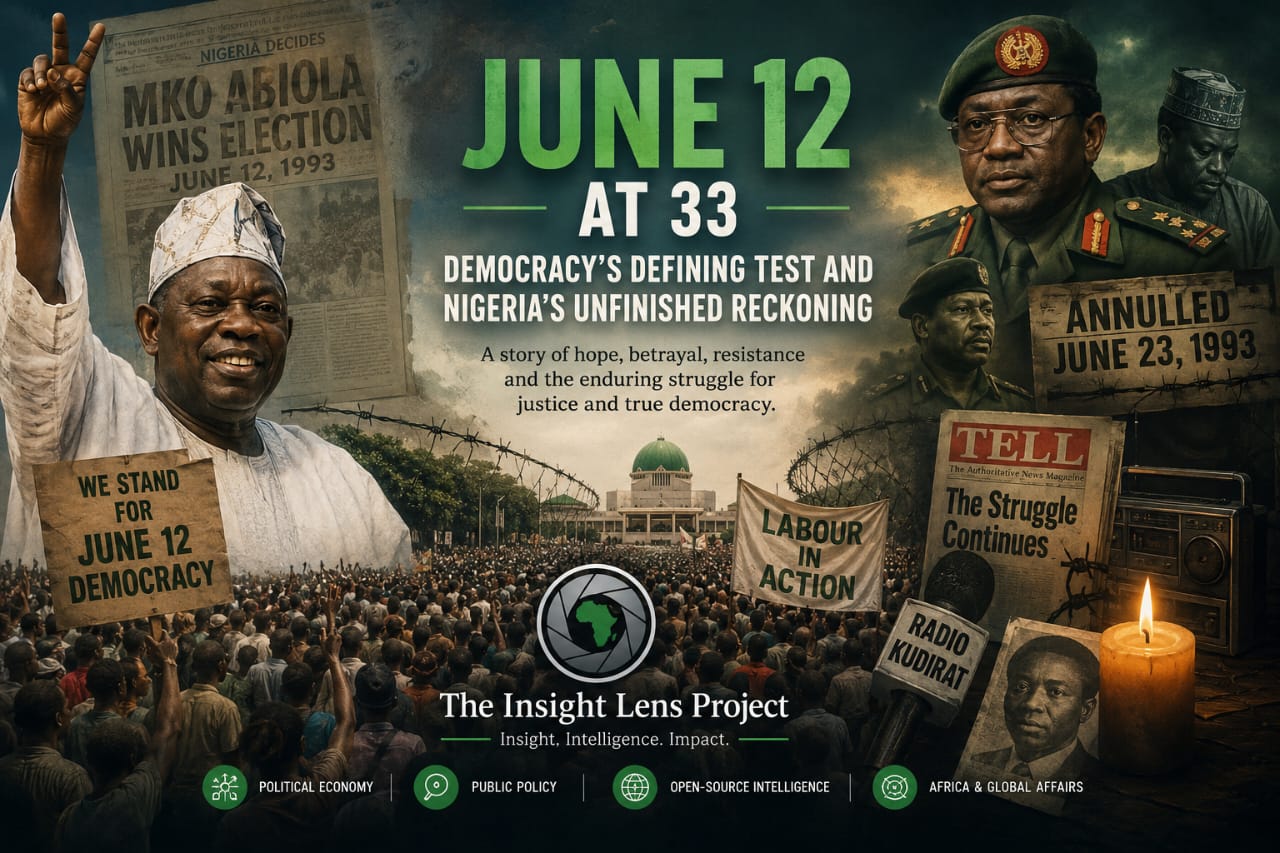
Thirty-three years after the presidential election of June 12, 1993, the date remains one of the most powerful symbols in Nigeria’s political history. What began as a democratic transition ended in one of the country’s most consequential political crises, reshaping debates about elections, accountability, power, and national unity. More than three decades later, June 12 continues to raise difficult questions about how Nigeria remembers its past and how much of its democratic promise has truly been fulfilled.
The election itself occupies a unique place in the national memory. Businessman and politician Moshood Kashimawo Olawale Abiola, candidate of the Social Democratic Party, was widely reported to have secured a broad national mandate before the results process was halted. Unlike many elections shaped by strong regional loyalties, the voting pattern suggested support that crossed ethnic, religious, and geographic lines. For many Nigerians, June 12 represented a rare moment when national identity appeared to rise above traditional political divisions.
The annulment of the election by the military government of Ibrahim Badamasi Babangida triggered widespread shock and anger. While the decision is often associated with Babangida personally, historians and political analysts have long argued that larger institutional interests were involved. The military establishment had dominated national politics for much of the preceding decades, and a transition that transferred authority to a civilian leader with a strong popular mandate carried uncertainties for powerful political actors accustomed to influence and control.

The crisis exposed tensions within Nigeria’s governing structure. Some observers believe concerns over political power, economic interests, and future accountability contributed to resistance against the transfer of authority. Others argue that the annulment reflected deeper weaknesses within Nigeria’s transition process, where competing interests inside the state ultimately overpowered the democratic choice expressed at the ballot box. Whatever the motivations, the decision undermined public confidence and transformed June 12 into a symbol of democratic betrayal.





Resistance to the annulment emerged from multiple sectors of society. Labour unions became particularly influential. Under leaders such as Frank Kokori, petroleum workers organized strikes that disrupted economic activity and increased pressure on the military government. These actions demonstrated the capacity of organized labour to influence national politics beyond workplace concerns. Many scholars argue that labour’s contribution has received less public recognition than it deserves in accounts of the June 12 struggle.
Civil society organizations also played a major role. The National Democratic Coalition emerged as one of the most visible platforms demanding the restoration of Abiola’s mandate. Its members faced arrests, exile, intimidation, and violence. The movement helped sustain domestic and international attention on Nigeria’s democratic crisis. At the same time, analysts note that its leadership reflected particular regional strengths, creating both advantages and limitations in its ability to mobilize nationwide support.


The media became another frontline in the struggle. Independent newspapers and magazines continued reporting despite censorship, raids, and detentions. Publications such as TELL Magazine, TheNews, PM News, and Tempo challenged official narratives during one of the most restrictive periods in modern Nigerian journalism. Their reporting preserved public access to information at a time when political space was rapidly shrinking. Many journalists paid a personal price for that commitment, facing imprisonment, harassment, and threats to their safety.
The crisis deepened further under the rule of Sani Abacha, whose government became associated with severe political repression. The period witnessed the detention of opposition figures, restrictions on civil liberties, and international criticism over human rights concerns. The execution of Ken Saro-Wiwa and eight other Ogoni activists in 1995 drew global condemnation and remains one of the most controversial episodes in Nigeria’s political history. At the same time, later investigations uncovered large-scale corruption that damaged public trust in government institutions.
Abacha’s death in 1998 created an opening for a renewed democratic transition. The administration of Abdulsalami Abubakar moved quickly to organize elections and return the country to civilian rule. Political detainees were released, new political parties emerged, and power was eventually transferred to an elected government in 1999. Yet the transition was also marked by compromises. While it restored civilian governance, it did not establish a comprehensive process to investigate abuses, assign responsibility, or provide accountability for the events surrounding June 12 and the years that followed.
For nearly two decades, many supporters of the June 12 movement argued that the election had not received sufficient official recognition. That changed in 2018 when President Muhammadu Buhari formally recognized Abiola’s victory, awarded him the nation’s highest honour, and moved Democracy Day from May 29 to June 12. The decision was widely welcomed as an important symbolic step. However, some observers maintained that recognition alone could not fully address unresolved questions about responsibility, justice, and institutional reform.
The legacy of June 12 continues to influence discussions about elections and governance today. Concerns about electoral credibility, institutional independence, media freedom, and political accountability remain central to public debate. While Nigeria has maintained uninterrupted civilian rule since 1999, controversies surrounding elections and democratic institutions demonstrate that many of the issues exposed by the 1993 crisis have not disappeared. The country has made significant democratic progress, but challenges persist.
What remains clear is that, June 12 stands as both a milestone and a warning. It revealed the possibility of a broadly inclusive democratic mandate while exposing the vulnerabilities of institutions meant to protect it. The election has been honoured, its winner officially recognized, and its place in history secured. Yet the enduring significance of June 12 lies not only in remembering what happened, but in confronting the deeper questions it raised about power, accountability, and the protection of democratic choice. Thirty-three years on, those questions remain as relevant as ever.
Adebamiwa Olugbenga Michael is a Lagos-based journalist, political economy and policy analyst, and publisher of TheInsightLensProject.com, delivering data-driven open-source intelligence insights on Nigeria, Africa, and global affairs.