By Newspot Nigeria Global Desk
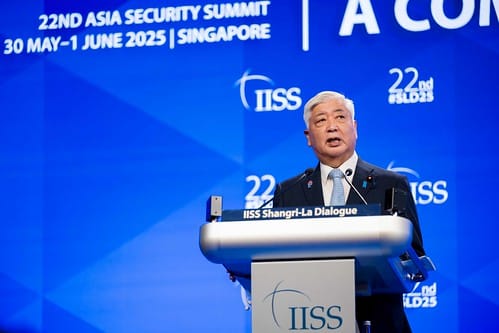
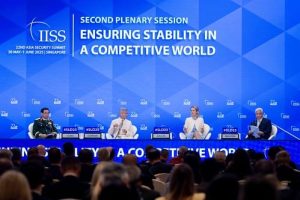
Singapore — At the 22nd Shangri-La Dialogue in Singapore, Japan’s Minister of Defense, Gen Nakatani, introduced a strategic framework titled the “spirit of OCEAN”—One Cooperative Effort Among Nations—which aims to strengthen security collaboration, uphold international law, and prevent escalation across the Indo-Pacific and beyond.
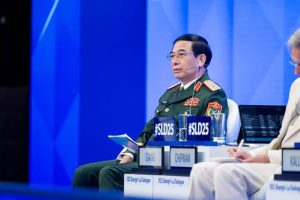
Speaking during the Second Plenary Session alongside Vietnam’s General Phan Van Giang and EU High Representative Kaja Kallas, Nakatani stressed the growing erosion of trust in the global rules-based order, calling for a shift toward “practical, cooperative, and inclusive” multilateralism.
“This spirit signifies that, from an Indo-Pacific perspective, nations with shared values and interests unite to create powerful synergies through cooperative efforts,” he said, describing OCEAN as both a security philosophy and action-oriented doctrine.
Addressing a Competitive and Fragmented World
Nakatani raised serious concerns about escalating global instability, citing Russia’s invasion of Ukraine, the militarisation of disputed features in the South China Sea, and the rise of state-sponsored cyber operations. He warned that these developments threaten to normalize “might makes right” politics, undermining decades of post-war consensus.

“The rules-based international order is being dangerously hollowed out,” he said. “We are witnessing a blatant disregard for accountability and an abdication of responsibility for the international public good.”
In this context, Nakatani laid out five key areas of progress: revitalization of regional frameworks like ASEAN, strengthening of the Japan–US alliance, deepening of quadrilateral partnerships (Japan, US, Australia, Philippines), the push for strategic autonomy from authoritarian dependencies, and increased interregional cooperation with Europe and NATO.





Japan’s Commitment to Maritime Norms and Regional Rules
As part of Japan’s broader Indo-Pacific strategy, Nakatani emphasized renewed support for the Code for Unplanned Encounters at Sea (CUES)—a voluntary framework to reduce naval accidents and conflict escalation during unexpected maritime encounters.
“We will promote the adherence to and strengthening of various rules, including the Code for Unplanned Encounters at Sea (CUES),” he said, underscoring Japan’s intent to uphold maritime safety and legal clarity in contested waters.
With tensions high in the South China Sea, the reinforcement of CUES was welcomed by many delegates as a stabilizing move to maintain communication and avoid miscalculation.


Beyond Defence: Humanitarian Leadership and Civil Aid
Responding to questions about the United States’ declining role in humanitarian assistance, Nakatani detailed Japan’s growing contributions in conflict zones and disaster-struck areas. He cited Japan’s support for Ukrainian refugees, medical evacuation efforts, and landmine removal training provided to Ukrainian personnel in third countries such as Poland.
“If the government cannot do it, Japanese NGOs and youth are stepping in. We are also providing mental health support to Ukrainian mothers and children resettled in Japan,” he noted.
Japan’s humanitarian posture is a key pillar of the OCEAN spirit—offering security support not only through deterrence, but also through relief, development, and civil cooperation.
On Asian NATO and Strategic Autonomy
In response to questions on whether OCEAN is a precursor to a formal “Asian NATO” or collective defence pact, Nakatani emphasized that OCEAN is about cooperation, not confrontation. He confirmed that discussions are ongoing within Japan’s ruling Liberal Democratic Party (LDP) about long-term strategic architectures but reiterated Japan’s focus on inclusive, panoramic cooperation.
“We need to coordinate with other countries to win their understanding. Resiliency and inclusivity are key,” he said, clearly distinguishing OCEAN from rigid military blocs.
The Japanese defence chief also affirmed that OCEAN complements the broader Free and Open Indo-Pacific (FOIP) initiative, offering a more tangible and operational framework for collective regional action.
Shared Vision Across Continents
EU High Representative Kaja Kallas supported Japan’s initiative, warning of a potential collapse of the world order if breaches of sovereignty go unchecked. “We are seeing partnerships built by those who believe the world is turning. If we don’t act, we’ll all be on our own,” she said, describing the EU’s efforts to boost cybersecurity, economic deterrence, and strategic partnerships across Asia.
Kallas emphasized that 42% of global development aid now comes from the EU, and while the bloc cannot fill the void left by the U.S. withdrawal alone, it will remain a “reliable and predictable partner.” She also highlighted the importance of economic alliances as strategic tools to counter coercive dependencies.
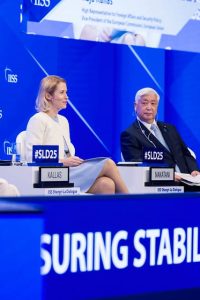
General Phan Van Giang of Vietnam offered a note of caution, citing concerns about the fragmentation of regional security frameworks. He called for consensus-driven cooperation within ASEAN and warned against “unhealthy competition” that could escalate into force.
Implications for Africa and the Global South
While focused on Asia-Pacific security, the OCEAN framework has clear resonance for African countries like Nigeria. With growing threats to Nigeria’s maritime domain, digital infrastructure, and regional peace, observers say OCEAN’s blend of values-based collaboration, legal order, and humanitarian support could provide a model for African-led coalitions.
Nigeria, experts note, could benefit from adapting OCEAN-like frameworks through ECOWAS and the African Union—emphasizing civilian-military coordination, regional transparency, and preventive diplomacy.
Looking Ahead
Nakatani closed with a firm call for nations to rally around shared principles.
“Let us not allow the erosion of the rules-based order, but restore it; not ignore accountability, but uphold it; not undermine the international public good, but advance it,” he said.
Sir John Chipman, Executive Chairman of the International Institute for Strategic Studies (IISS), praised the initiative as a call for “cooperative strategic autonomy,” echoing earlier remarks by French President Emmanuel Macron.
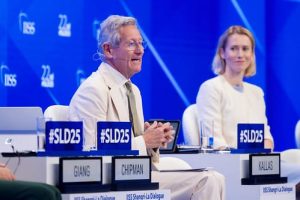
Newspot Nigeria will continue to follow how the OCEAN framework evolves—and how nations like Nigeria can adapt its principles for regional peace, inclusive governance, and sovereign resilience in an increasingly uncertain world.
—
Published by Newspot Nigeria.