There are newspaper pages that merely report events, and there are those that quietly hold a life in motion.
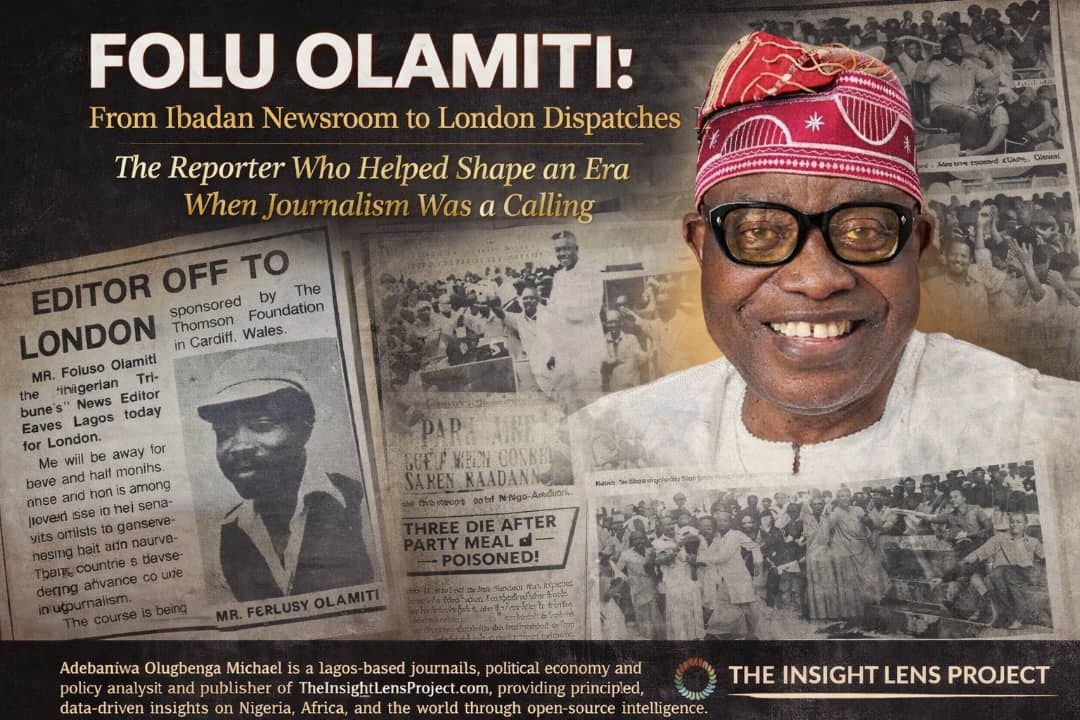
Across brittle clippings from the late 1970s and early 1980s, what survives is more than a record of Nigerian journalism in its formative years. It is a slow, unfolding portrait of an era defined by instinct, discipline, and an almost austere sense of duty. Threaded through these pages is the early career of a reporter whose byline would come to carry quiet authority across the country — Folu Olamiti.
Taken together, the fragments do not read like archives. They read like movement. Like a craft being sharpened in real time. Like a profession revealing itself line by line.

A JOURNEY BEGINS – LAGOS TO LONDON





In one early notice, spare in tone yet rich in implication, a young newsroom editor prepares to leave Lagos for London.
There is no flourish to the announcement. Only fact, a fellowship, a departure, three and a half months abroad.


Sponsored by the Thomson Foundation in Cardiff, he is among a select group of journalists from developing countries chosen for advanced professional training in the United Kingdom. At the time, such opportunities were not merely prestigious. They were rare, competitive, and quietly transformative.
Beneath the brevity lies a turning point.
A reporter formed in the rhythms of a Nigerian newsroom stepping, however briefly, into the wider currents of global journalism. Not as a visitor, but as an apprentice at a larger table.
It is more than travel.
It is expansion.
WHEN NEWS WAS LIFE AND DEATH
Months later, the tone sharpens.
A front page dated February 12, 1980, carries a headline that still startles in its blunt finality:
THREE DIE AFTER PARTY MEAL – POISONED!
As reported by Folu Olamiti alongside colleagues, the story begins in familiarity with a family gathering in Ibadan and ends in irreversible loss. Three children, between six and twelve, are gone. Others slip into unconsciousness. At the University College Hospital, urgency replaces certainty.
The writing is restrained. Almost clinical.
And yet, beneath the measured sentences, the weight of grief presses through, the foam at the mouth, the rush to emergency wards, the unbearable stillness of waiting parents.
This is reportage without insulation. Proximity without protection.
The kind of journalism that does not interpret tragedy but carries it.
THE WORLD THROUGH AN IBADAN NEWSROOM WINDOW
Soon, the byline travels.
From London comes a report on a break-in at the offices of the British Conservative Party, framed, in the language of its time, as a “Watergate-style” intrusion. Allegations of stolen campaign materials ripple through the political atmosphere ahead of a general election.
Here, the register shifts.
The reporting becomes international, investigative, attentive to nuance and implication. Yet the discipline holds: careful attribution, measured quotation, and an instinct for identifying not just what happened, but why it matters.
Across continents, the voice remains steady.
The newsroom travels with the reporter.
THE POLITICS OF A YOUNG NATION
Back home, Nigeria is deep in the work of self-definition.
Pages from the Sunday Tribune and beyond capture a political class negotiating the uncertainties of governance in a young republic still finding its institutional footing.
In one exchange, Governor Bola Ige responds to a question on achievements with a single word:
“None.”
It is not evasion. It is candour.
Elsewhere, conversations with Governors Michael Ajasin and Bisi Onabanjo unfold in similar tones — reflective, unguarded, occasionally uneasy. Development gaps are acknowledged. Expectations are rising. The language of governance is still being shaped.
These are not interviews staged for spectacle. They are inquiries conducted with patience. Journalism not as performance, but as process.
Dialogue, not theatre.
THE REPORTER AND HIS CRAFT
At a certain point, the reporting turns inward.
In an article titled “Journalism and the Journalist Initiative Part II,” Olamiti steps beyond events to interrogate the craft itself. He writes not of routine, but of initiative, of the reporter as observer, thinker, and, at times, quiet disruptor.
The argument is clear, journalism demands more than presence. It demands alertness. The ability to recognise significance in the seemingly ordinary. The discipline to pursue a thread when others might overlook it.
Global reference points, including Watergate, appear not as legend, but as evidence, proof that journalism, when driven by initiative, can alter the trajectory of power.
Yet there is no romantic illusion.
The work is exacting. The margins for error are thin. The rewards, when they come, are earned through endurance as much as talent.
It is a philosophy shaped not in abstraction, but in newsrooms where deadlines close in and truth rarely arrives fully formed.
A PRESS THAT CAPTURED A NATION IN MOTION
Beyond the major stories, the pages widen.
Political rallies pulse with colour and urgency. Social columns mark weddings, anniversaries, and the quiet milestones of ordinary life. Public figures speak with a mixture of optimism and restraint, their words reflecting both ambition and uncertainty.
There is celebration. There is scrutiny.
Together, these fragments form a mosaic of a country in motion, and a press learning, in real time, how to document its contradictions.
BEYOND THE PAGES
What emerges is not a single headline, but a trajectory.
A reporter begins in the crowded newsrooms of Ibadan. He trains in London. He reports tragedy at home and political intrigue abroad. He reflects, critically, on the very profession he inhabits.
This is journalism from a time when newspapers were not peripheral, but central, when public life unfolded daily on ink-stained pages, and the press stood as both witness and participant.
THE WEIGHT OF EARLY CRAFT
In the end, the significance lies not in any one story, but in accumulation.
A fellowship abroad. A tragic household report. A political scandal in Westminster. Interviews with governors. A meditation on journalistic initiative.
Individually, they are assignments.
Together, they become something else, a professional identity taking shape in real time, and a window into an era when journalism was not merely a career, but a calling.
Built patiently. One byline at a time.
©️ Adebamiwa Olugbenga Michael is a Lagos-based journalist, political economy and policy analyst, and publisher of TheInsightLensProject.com, providing principled, data-driven insights on Nigeria, Africa, and the world through open-source intelligence.