
By Newspot Nigeria Editorial Desk

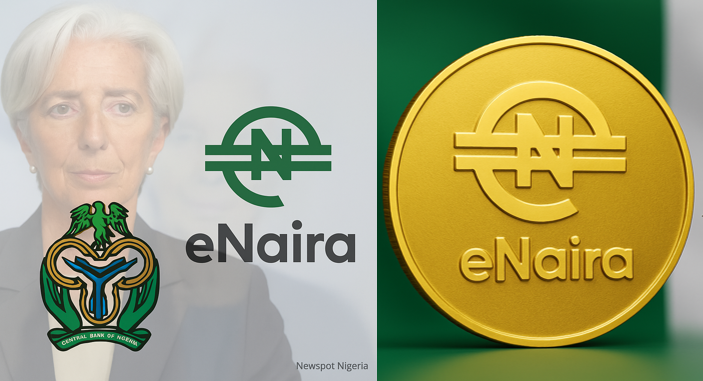
In the rapidly evolving world of finance, a digital storm is brewing. European Central Bank President Christine Lagarde has recently declared that stablecoins—private, blockchain-based digital currencies backed by fiat—pose a serious risk to national sovereignty. In her speech delivered in Portugal, she warned of a future where “money is privatized,” calling it a threat to the “public good” of national currencies.
Her message resonates not just in Europe, but in Nigeria too, where the Central Bank of Nigeria (CBN) was among the first in the world to launch a Central Bank Digital Currency (CBDC) known as the eNaira.
What is the eNaira?
According to the CBN, the eNaira is “a Central Bank Digital Currency (CBDC) backed by law, the full sovereignty of Nigeria, and issued by the Central Bank of Nigeria as a legal tender.” It is the digital form of the naira and operates as a unit of account, store of value, and medium of exchange, just like traditional cash.

Accessible through the eNaira wallet, this digital money allows users to store, send, and receive eNaira electronically. The CBN insists that the eNaira offers all the advantages of physical naira, with added speed and security.





For more information, the CBN directs users to www.enaira.gov.ng, where the official platform hosts wallet registration, merchant onboarding, and educational tools.
But Is Anyone Using It?
While the eNaira was historic in its launch—Africa’s first CBDC—the reality has been more muted. Uptake remains extremely low. According to independent reports, more than 98% of wallets have remained inactive, and the total value of eNaira in circulation remains a fraction of the total currency base. Despite aggressive promotion, adoption has lagged behind expectations.


Why? Because the problem is not the platform. It’s the trust.
Fromy’s Warning: CBDCs vs. Currency Freedom
Ulrich Fromy, writing in Mises Wire (July 31, 2025), warns that central banks’ pushback against stablecoins reflects not genuine economic concern, but fear of free competition. Fromy points out that individuals worldwide—particularly in struggling economies—are increasingly seeking out alternatives like dollar-backed stablecoins, not because they want to break the system, but because they want to survive within it.
In this context, central bank digital currencies like the eNaira or Europe’s proposed digital euro raise red flags. Fromy and other Austrian economists argue that when the state controls the money, it controls the people. As he puts it: “The most powerful monopoly a group of individuals can exert over the masses is a monopoly on currency.”
So, Who’s Afraid of Stablecoins?
Lagarde’s real concern is that people are voting with their wallets—migrating away from national currencies they no longer trust. And Nigeria is a frontline example. With inflation, currency depreciation, and frequent policy U-turns from the CBN, many Nigerians have naturally turned to more stable digital alternatives, like USDT (Tether) or USDC (USD Coin).
These private currencies are already widely used in Nigeria’s informal economy for remittances, digital commerce, and even savings. The state’s response? Push the eNaira harder. But as Fromy notes, monetary trust cannot be legislated—it must be earned.
Between Surveillance and Sovereignty
The eNaira operates on a permissioned blockchain, which means that all transactions are centrally monitored by the CBN. Wallet access is tiered, requiring increasing levels of identification for larger usage. On paper, this supports financial integrity and fraud prevention. In practice, it raises serious privacy and surveillance concerns.
What Lagarde calls the “public good” of money may, in this digital age, evolve into digital control, where programmable money can be restricted, reversed, or even frozen depending on government direction.
Contrast that with stablecoins, which—while not perfect—offer portability, relative stability, and freedom from state control.
Nigeria’s Dilemma
The CBN’s commitment to the eNaira is clear. Its official website (www.cbn.gov.ng) reiterates that the eNaira is sovereign, legal tender, and fully backed by the state. The eNaira, they argue, is no different from the naira—it’s just digital. And yet, public hesitation persists.
The reason is simple: you cannot force adoption through policy alone. Whether in Lagos or Lisbon, trust must precede technology.
Final Thoughts
Christine Lagarde’s speech and Ulrich Fromy’s rebuttal frame a global tug-of-war between monetary freedom and institutional control. The eNaira sits at the center of that battle in Nigeria. While its intent is valid—financial inclusion, innovation, digitization—the execution must go beyond government assurance.
The world is watching: Will Nigeria embrace a future where people can freely choose the currency that works best for them? Or will it double down on centralization, even as confidence in fiat continues to erode?
At Newspot Nigeria, we believe in choice, transparency, and monetary accountability. If eNaira is truly for the people, then let the people decide.
📝 This editorial draws on Ulrich Fromy’s July 31 article “Christine Lagarde and the Privatization of Currency” published in Mises Wire, and incorporates official positions of the Central Bank of Nigeria as published on cbn.gov.ng and enaira.gov.ng.