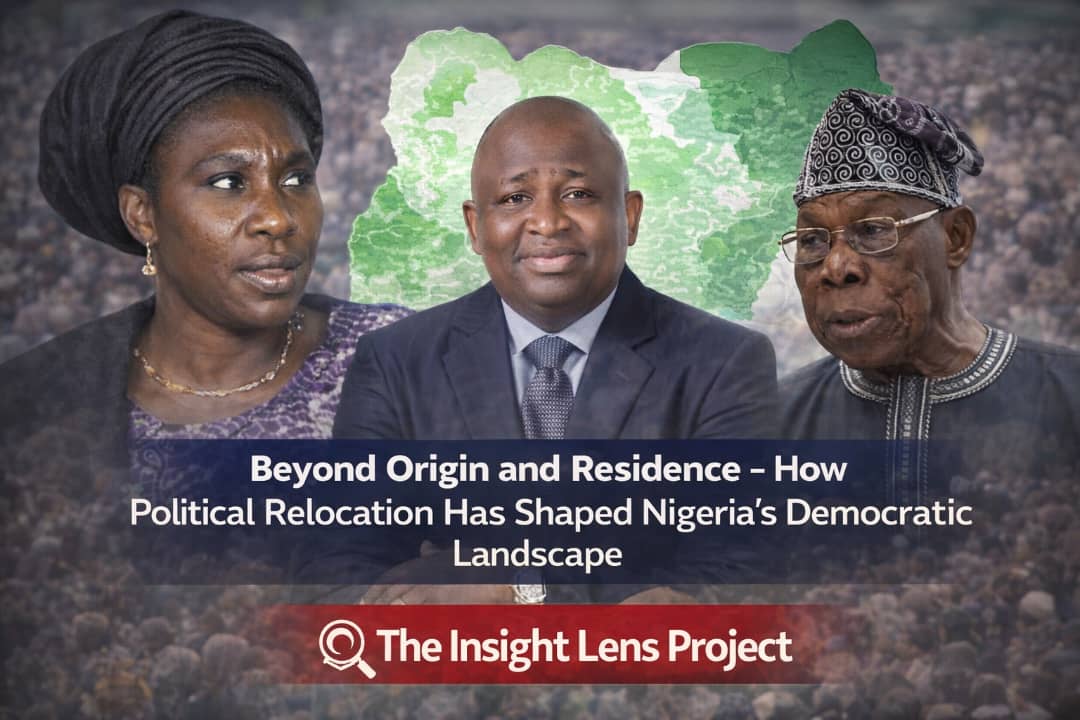
A recent public remark by former President Olusegun Obasanjo about political ambition and identity has sparked renewed public debate in Nigeria. Widely interpreted as a critique of figures who cross state lines to pursue office, the comments came at a time when Senator Solomon Olamilekan Adeola (“Yayi”), born and raised in Lagos but representing Ogun West in the Senate was being discussed as a potential candidate for governor of Ogun State in 2027. Around the same time, Prof. Iyabo Obasanjo-Bello, a seasoned public official and Obasanjo’s daughter, declared her own governorship ambition in Ogun. These public interventions have drawn attention to how political relocation, indigenous identity, and constitutional eligibility interplay in Nigerian politics.
The 1999 Constitution sets out eligibility criteria for elective office, including age, citizenship, and voter registration, but does not prohibit citizens from contesting in states connected to their paternal or maternal heritage even if they were born or lived elsewhere. This legal framework provides room for political “mobility,” but it exists alongside strong cultural expectations around ancestry and community belonging that still influence voter perceptions. Analysts note that while the Constitution protects mobility and political rights, political culture in many states places importance on lineage and local engagement as markers of legitimacy.
Nigeria’s federal system has long accommodated politicians who pursue authority in states linked to their ancestry rather than their place of birth or long-term residence. This reflects patterns that are historical at both local and national levels. As one constitutional scholar observed, the tension between state of origin and state of residence has persisted despite periodic efforts to reform the system. In 2015, Senator Dino Melaye publicly announced that he had submitted a bill to abolish “state of origin” in favour of “state of residence,” arguing that such a change would encourage national unity and broaden participation across state lines. His proposal drew attention to how current arrangements can privilege ancestral origin over civic contribution and long-term community ties. Yet, to date, state of origin remains central to political eligibility, and the bill did not advance into law.
Practical examples from recent electoral cycles illustrate how mobility plays out on the ground. Many Nigerian politicians have traversed multiple constituencies or states during their careers. For instance, Sunny Ofehe, an activist born in Lagos to parents from Delta State, contested the Delta State governorship in 2019 and again in 2023, grounding his bid on ancestral ties to Isoko North in Delta despite long periods of residence outside the state. Though not a direct analogy to Obasanjo-Bello or Adeola, Ofehe’s example shows that ancestral linkage has been used as the basis for contesting local office in states where candidates did not spend most of their professional life.

These patterns reflect broader structural and cultural complexities around ancestral ties and participation. A landmark 2006 report by Human Rights Watch highlighted how Nigerians who live outside their states of origin often face social and political barriers, including resistance when seeking elective office, employment, or local government positions, because “indigene” status remains a powerful marker of belonging in many contexts. The report underscored that despite constitutional guarantees of equality, many state and local practices continue to privilege indigenous identities over residency or contribution.




The debates unfolding in Ogun State echo these national dynamics. Senator Adeola was born in Lagos in 1969 to parents from Pahayi, Ilaro in Yewa, Ogun State and built his early career in Lagos before entering politics. He represented Lagos West in the Senate before winning election in Ogun West in 2023, citing his paternal heritage as the basis for eligibility. His legislative record, including sponsoring bills and constituency development initiatives, demonstrates active engagement with his Ogun constituents. At the same time, Prof. Iyabo Obasanjo-Bello’s candidacy underscores how individual histories and public service experience shape expectations of local stakeholders.
Public commentary on both sides underscores a common concern among voters and analysts, the need for policy‑centered debates that prioritise outcomes over identity. While heritage and local connection matter to many communities, an overemphasis on origin risks overshadowing assessments of governance competence, development planning, and accountability. In societies as diverse as Nigeria, discussions of ethnic roots and political mobility must be balanced with clear understanding of constitutional rights. If debates centre on whether someone lives in a place or merely belongs to its lineage, they can divert attention from measurable contributions to public welfare.


For Nigeria’s democratic system, several lessons emerge from this ongoing conversation. The electorate and political actors benefit when debates focus on candidates’ demonstrated records, policy proposals, and plans for inclusive development rather than solely on ancestral or residence status. Legal and civic education can help clarify how constitutional provisions protect political rights across states without undermining local expectations. Civil society platforms and independent media can further support voters in evaluating leadership choices on the basis of competence and public impact.
As Ogun State approaches its 2027 governorship election, the unfolding debate, sparked by comments from high‑profile figures offers an opportunity for broader reflection on the nature of political legitimacy in a multicultural federation. Reconciling the values of unity, performance, fairness, and cultural identity remains a central challenge for Nigerian public life. How politicians like Senator Adeola and others respond will not only shape their individual political futures but also contribute to the ongoing discussion on federalism, mobility, and democratic choice across the country.
©️ Adebamiwa Olugbenga Michael is a Lagos-based political economy and policy intelligence analyst and publisher of The Insight Lens Project, providing data-driven insights across Nigeria and West Africa using open-source data.