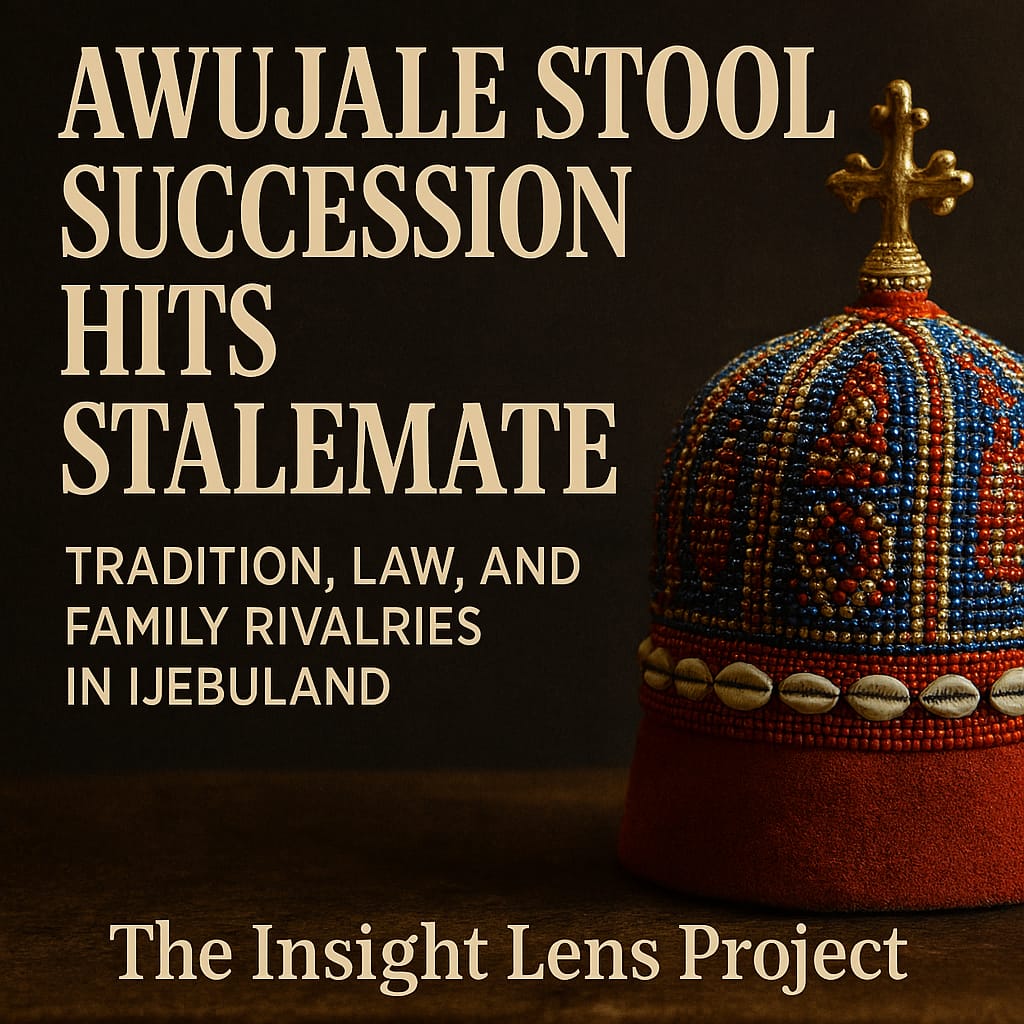

The mission to fill the vacant Awujale stool of Ijebuland has become a flashpoint of tension, exposing the delicate interplay between tradition, law, and modern governance. Following the death of Oba Sikiru Kayode Adetona in July 2025, the process to select his successor has been marked by delays, internal rivalries, and allegations of financial inducement, raising questions about procedural integrity and the preservation of cultural legitimacy.


The succession process has been complicated by conflicting administrative directives. In early January 2026, the Ijebu-Ode Local Government granted the Fusengbuwa ruling house approval to commence nominations within the 14-day window stipulated by law. However, the Ogun State Government soon intervened, halting the process on grounds of non-compliance with the 2021 Obas and Chiefs Law and the 1957 Chieftaincy Declaration.
This back-and-forth highlights the tension between local administrative approvals and codified state-level chieftaincy laws. It underscores the need for clarity and consistency in governance frameworks that regulate traditional institutions particularly those, like the Awujale stool, that carry immense cultural and political weight.
The Fusengbuwa ruling house, next in line to produce the Awujale, has faced internal divisions. Allegations of exclusion from the nomination process have surfaced, and the involvement of prominent individuals outside the family, such as musician Wasiu Ayinde Marshal (KWAM1) of the Fidipote ruling house, has intensified disputes. KWAM1, through his lawyer, Dr. Wahab Shittu, SAN, wrote to Governor Dapo Abiodun in early January 2026, claiming sidelining by Fusengbuwa. Although he had previously sought a court injunction, he later withdrew the suit without explanation.

While intra-family rivalries are not uncommon in hereditary systems, they must be managed carefully to maintain legitimacy, public confidence, and the cultural integrity of the Awujale institution.





Reports though unverified that monetary gifts and vehicles were offered to influence kingmakers risk undermining public trust. The late Oba Adetona himself had warned against allowing “money bags” to determine succession, stressing that the Awujale stool should be filled in accordance with tradition rather than material inducements.
Governor Dapo Abiodun, through his Special Adviser on Information and Strategy, Kayode Akinmade, has consistently reiterated the administration’s commitment to due process and respect for traditional institutions. “No, Afobaje will attest to such an occurrence, as it never happened. This is once again the fabrication of falsehoods by mischief makers,” Akinmade stated. He emphasized that the government seeks to balance procedural oversight with cultural preservation, promoting dialogue and harmony rather than interference.


The Awujale stool is central to Ijebu identity and communal bond. Delays, disputes, and allegations of impropriety threaten both the stool’s cultural legitimacy and public trust in traditional authority. The stalemate demonstrates the delicate balance required to honor customs while adhering to contemporary legal frameworks.
Given the sensitivity of the succession process, several measures could help restore confidence and ensure a smooth transition:-
● Legal and Procedural Audit – Establish an independent committee of legal experts, traditional historians, and ruling house representatives to review the nomination process for compliance with the 1957 Chieftaincy Declaration, the 2021 Obas and Chiefs Law, and family statutes.
● Transparent Communication – Both the state government and ruling houses should clarify steps, timelines, and eligibility criteria to dispel rumors of favoritism or inducement.
● Internal Mediation – Neutral elders or respected traditional leaders could facilitate reconciliation within Fusengbuwa, preventing further intra-family conflict.
● Stakeholder Inclusion – All eligible members of ruling houses should participate meaningfully in the process, reinforcing legitimacy and cultural credibility.
● Clear Oversight and Security – Government directives should provide specific guidance, rather than open-ended halts, to minimize uncertainty and potential legal disputes.
The Awujale succession crisis is more than a dispute over a throne, it is a test of how Nigeria’s governance structures interact with deeply rooted traditional institutions. Success will depend on strict adherence to customary law, transparent communication, internal dialogue, and respect for cultural norms. Without these measures, the process risks prolonged uncertainty, erosion of public trust, and lasting divisions within Ijebuland.
©️ Adebamiwa Olugbenga Michael is a Lagos-based political economy and policy intelligence analyst and publisher of The Insight Lens Project, focused on data-driven insights across Nigeria and West Africa.