

By Newspot Nigeria Editorial Desk


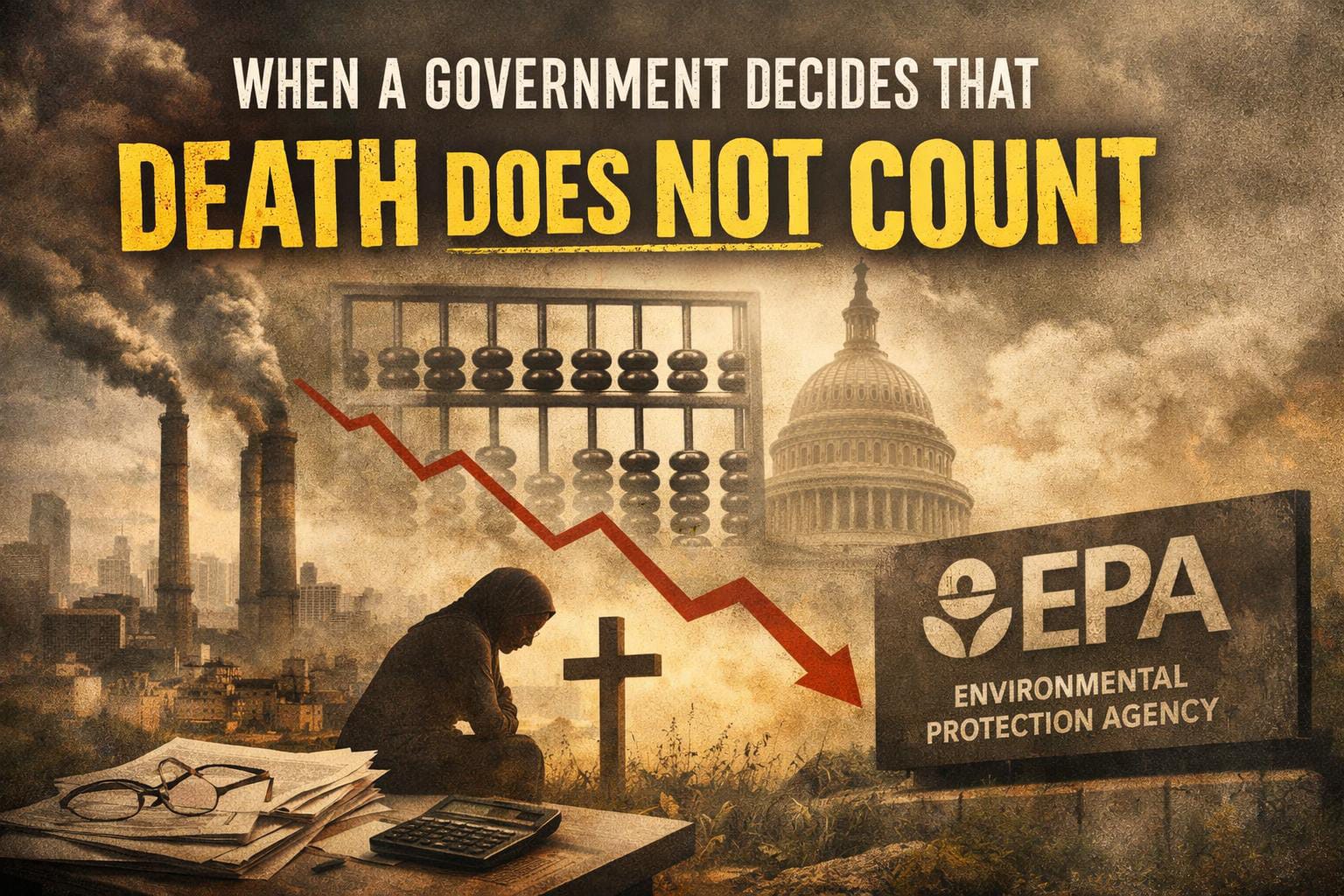
Sometimes policy changes tell you exactly what a government thinks, without ever saying it out loud. The reported decision by the United States Environmental Protection Agency to stop counting lives saved when evaluating clean air regulations is one of those moments.
This is not a technical adjustment. It is a value judgment.
For decades, U.S. regulators have operated with a simple understanding: If a rule reduces the risk that people will die prematurely, that benefit must be counted. Not rhetorically, not morally, but concretely. That understanding is what gave rise to the concept known as the value of a statistical life, a tool used across federal agencies to weigh whether regulations are worth their cost.

It was never about placing a price tag on an individual human being. It was about refusing to pretend that preventing death has no value.





That refusal is now being tested.
Recent reporting indicates that the Environmental Protection Agency is moving toward regulatory analyses that focus almost entirely on what pollution controls cost businesses, while stripping out estimates of deaths avoided by cleaner air. In effect, the single largest benefit of air quality regulation would disappear from the ledger.


Once lives are removed from the calculation, the outcome is pre-decided.
Why Life Was Put Into the Equation
The modern framework that forces government to confront this question owes much to the work of economist W. Kip Viscusi, whose research in the 1980s challenged the earlier federal habit of treating death as little more than lost income plus medical bills. Under that old logic, a human life could be “worth” a few hundred thousand dollars, an approach that conveniently made many safety rules look unjustifiable.
That research shifted the conversation by looking at how people actually behave. Workers demand higher wages to accept risk. Consumers pay more for safer products. Home prices reflect environmental hazards. These are not abstract theories. They are everyday decisions that reveal how much people value reductions in the risk of dying.
Once regulators began to take that reality seriously, many rules that had previously failed cost benefit tests suddenly passed. Not because regulators became sentimental, but because the analysis stopped pretending that death was a minor inconvenience.
What Happens When Zero Replaces Reality
Assigning a value of zero to mortality risk reduction is not neutral. It is extreme.
Air pollution rules, especially those dealing with fine particulate matter, derive most of their benefits from preventing premature death. Remove that benefit and the analysis becomes meaningless. You could save thousands of lives and still be told the rule is not worth it, because the deaths never enter the equation.
This is why legal scholars warn that such an approach risks being overturned as arbitrary. Regulatory law does not permit agencies to ignore the central consequences of their actions. You cannot count the costs of compliance while pretending the benefit of people not dying does not exist.
More importantly, you cannot do that and still claim to be governing in the public interest.
The Real Question Being Asked
Strip away the technical language and the question becomes brutally simple. Should government regulation acknowledge that preventing death matters, or should it behave as though lives are an accounting inconvenience?
If pollution kills people, and if regulation reduces that risk, then excluding death from the analysis is not objectivity. It is denial.
When a government reaches the point where it can say, implicitly, that saving lives does not count as a benefit, the problem is no longer regulatory methodology. It is a collapse of purpose.
That shift deserves scrutiny, not because it affects everyone everywhere, but because it tells us exactly how power is being used right now, and whose losses are being quietly written out of the story.
—Newspot Nigeria
Works Cited:
- Merrefield, Clark. “Q&A: W. Kip Viscusi on How the U.S. Government Assigns Monetary Value to Human Life.” The Journalist’s Resource, January 14, 2026. Harvard Kennedy School, Shorenstein Center on Media, Politics and Public Policy.
- Viscusi, W. Kip. Pricing Lives: Guideposts for a Safer Society. Princeton University Press, 2018.
- U.S. Environmental Protection Agency. Regulatory Impact Analyses and Cost–Benefit Frameworks for Air Quality Standards. EPA policy documents and historical regulatory guidance.
- Office of Management and Budget. Circular A-4: Regulatory Analysis. Executive Office of the President, United States Government.