
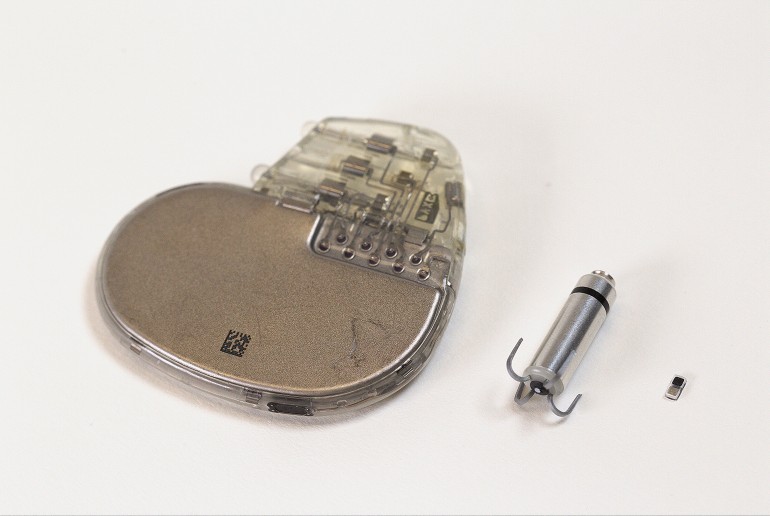

By Newspot Nigeria Editorial Desk


In a remarkable leap for medical science, engineers at Northwestern University have unveiled what they describe as the world’s smallest pacemaker — a groundbreaking device so tiny it can fit into the tip of a syringe, be injected into the human body, and dissolve after use. This innovation, published in Nature, could revolutionize cardiac care, especially for newborns with congenital heart defects who only need temporary pacing support.
The pacemaker, smaller than a grain of rice, operates without traditional wires or bulky batteries. Instead, it communicates wirelessly with a soft, wearable patch placed on the patient’s chest. This patch uses pulses of infrared light to activate the pacemaker whenever an irregular heartbeat is detected. The light penetrates safely through skin and bone, triggering the device to stabilize the heart’s rhythm — a process as elegant as it is life-saving.
What makes this development so transformative is not just its size, but its biodegradability. Traditional pacemakers often require surgical extraction, exposing patients — particularly fragile infants — to risks of infection, tissue damage, and bleeding. By contrast, Northwestern’s new device simply dissolves into the body’s biofluids after its job is done, leaving behind no trace. It’s a paradigm shift toward what bioelectronics pioneer Prof. John A. Rogers calls “bioresorbable electronic medicine” — devices that heal and then harmlessly disappear.

The implications go far beyond cardiology. Imagine a world where implantable devices for pain management, wound healing, or nerve repair could perform their function and then dissolve without additional surgery. That’s the frontier this research opens.





Perhaps most striking is how this innovation exemplifies the power of interdisciplinary collaboration. Rogers’ expertise in materials science, combined with Prof. Igor Efimov’s pioneering work in cardiac engineering, produced a technology that unites medicine, engineering, and human-centered design. It’s a lesson for global health innovators — that real progress lies in merging compassion with cutting-edge science.
For developing countries like Nigeria, where the cost and logistics of post-surgical care can be prohibitive, such biodegradable technologies could be game changers. Imagine rural hospitals implanting temporary life-saving devices without worrying about complex removals or follow-up surgeries. It’s a glimpse of how equitable healthcare might look when innovation meets access.


From the heart of Evanston to the rest of the world, Northwestern’s light-powered pacemaker signals not just a medical milestone, but a philosophical one: healing can now happen gently, efficiently, and sustainably — even at the size of a grain of rice.
— Newspot Nigeria