By Newspot Nigeria Global Desk
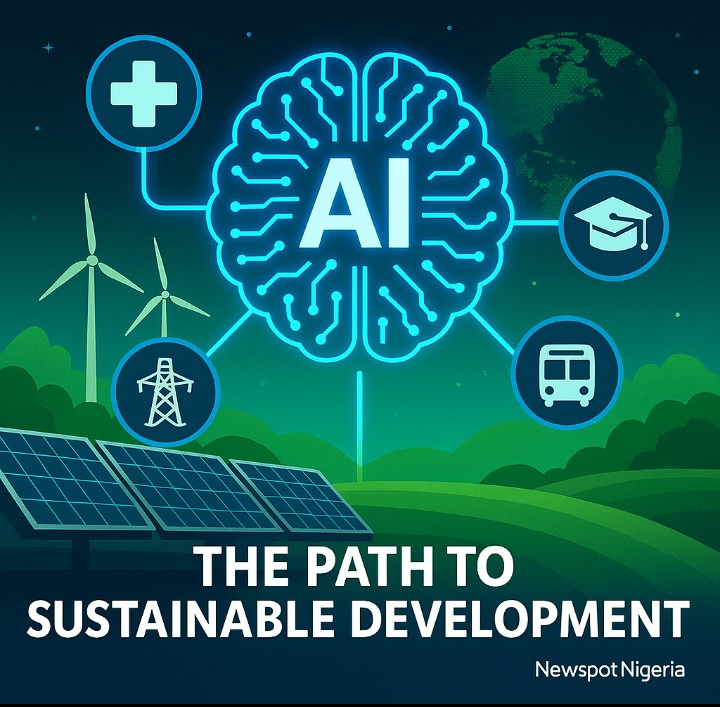
Artificial Intelligence (AI) is no longer a distant future—it is the present reality reshaping economies, societies, and even the way we think about sustainable development. In a recent conversation with the Hitachi Research Institute, Prof. Tshilidzi Marwala, Rector of the United Nations University (UNU) and UN Under-Secretary-General, underscored both the promise and peril of AI in solving global challenges. His insights are particularly timely for countries like Nigeria, where questions of development, governance, and innovation remain pressing.
Japan’s Model and the UNU’s Strategic Location
Prof. Marwala reflected on his impressions of Tokyo, a city of 37 million people that somehow avoids the chaos often associated with megacities. He credits Japan’s exceptional transport infrastructure, including the Shinkansen rail network, as a symbol of how technology can enhance quality of life. For Nigeria, where urban congestion and weak infrastructure remain obstacles, this lesson is powerful: smart investment in systems that prioritize efficiency can transform entire societies. The UNU’s presence in Tokyo, he argued, is also strategic—placing an academic and research hub of the UN in Asia where few UN agencies are headquartered.
The Evolution of AI: Opportunity and Risk
Generative AI has brought unprecedented attention to the field, but Prof. Marwala cautioned that these systems are limited by the data on which they are trained. While AI can revolutionize sectors from healthcare to education, it must be managed responsibly to prevent inaccuracies and biases. In Nigeria, where health costs are high and education quality uneven, the careful adoption of AI could lower costs, improve diagnostics, and expand access to learning. Yet without governance, the same technology risks deepening inequality and displacing jobs.

Governing AI: Balancing Innovation with Human Dignity
The question of AI governance is central to Prof. Marwala’s reflections. He outlined four key domains requiring oversight: data, algorithms, infrastructure, and applications. Governance, he stressed, must be grounded in universal values such as human rights, ensuring that AI protects rather than harms. He cited global frameworks like the European Union’s AI Act and Japan’s Data Free Flow with Trust initiative as examples of balancing innovation with responsibility. For Nigeria, where regulatory gaps are often exploited, this approach is critical. The nation must not only consume AI technologies but also set ethical rules for their use.





Emerging Technologies and the SDG Challenge
The world is falling behind on the UN’s Sustainable Development Goals (SDGs). Conflicts, climate change, and economic disruptions—including those triggered by COVID-19—have slowed progress, and many targets may not be met until 2060. Prof. Marwala stressed the role of companies like Hitachi in deploying technologies for food production, healthcare, energy, and grid optimization. For Nigeria, the message is clear: adopting emerging technologies is not optional if we are to close the gap between ambition and reality. Yet we must also remain mindful of AI’s environmental footprint—its vast energy and water demands must not worsen our climate crisis.
Hybrid Talent and the Future of Work
Perhaps the most practical takeaway for Nigeria is Prof. Marwala’s call for “hybrid talent.” In an AI-augmented world, managers will supervise not just people but machines. That requires multidisciplinary education—engineers who understand social dynamics, and social scientists who grasp STEM fundamentals. Nigerian universities, long trapped in outdated silos, need urgent reform to prepare graduates for this new reality. Education must shift from rote learning to creativity, collaboration, and critical thinking in partnership with AI.


Final Reflections
Prof. Marwala’s insights carry both optimism and caution. AI can accelerate sustainable development, reduce inequality, and expand opportunity. But without ethical governance, inclusive education, and responsible innovation, it can just as easily deepen existing divides. For Nigeria, the choice is stark: embrace AI with foresight and values, or be left behind in the unfolding technological revolution.
Editorial Desk, Newspot Nigeria
Credit: United Nations University (UNU)