
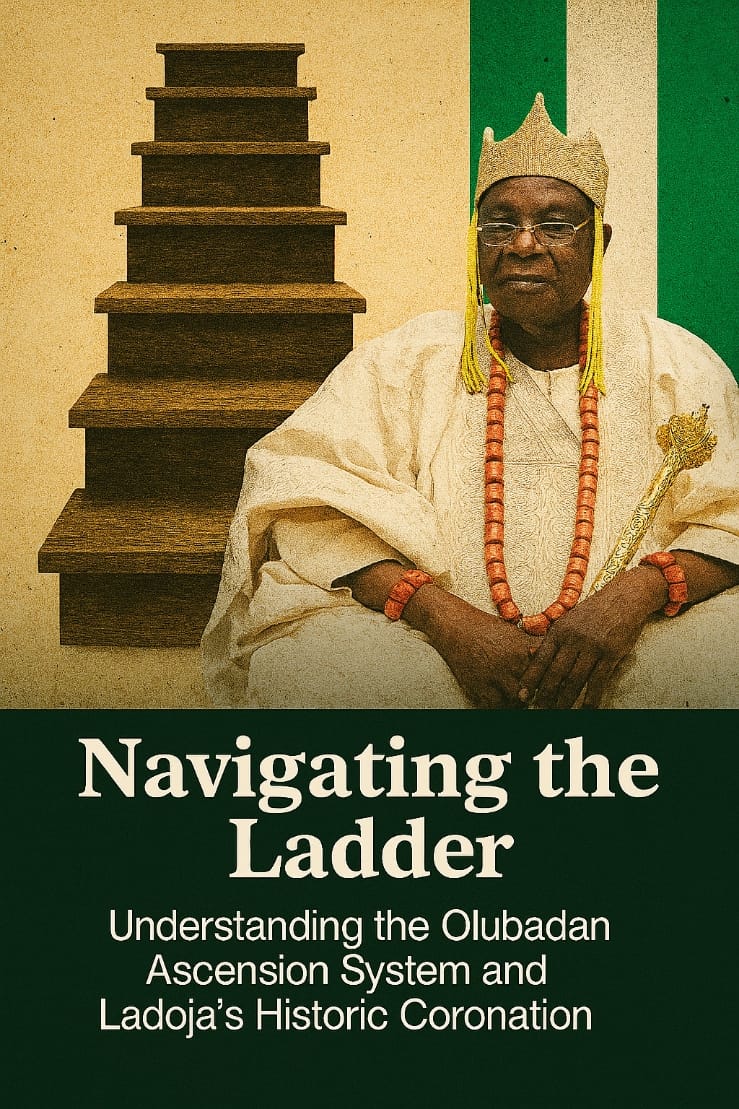

By Olugbenga Adebamiwa ( Newspot Political and Social Analyst)

The Olubadan of Ibadanland is a revered position that embodies the rich cultural heritage and intricate chieftaincy traditions of Ibadan, Nigeria. Unlike many monarchies where succession is hereditary, the path to the Olubadan throne is governed by a unique and structured system that emphasizes merit, seniority, and service. This system ensures that only those who have demonstrated unwavering commitment to the community ascend to the throne.
At the heart of this system are two primary lines, the Otun (civil) line and the Balogun (military) line. Each line comprises a series of chieftaincy titles that individuals must ascend through in a specific order. The Otun line has 22 stages, while the Balogun line has 23. This dual-line structure means that every potential Olubadan has undergone rigorous training and has been tested in various capacities, ensuring that the throne is occupied by someone with profound experience and understanding of Ibadan’s traditions and needs.
Rashidi Ladoja’s journey to the throne is emblematic of this meticulous process. His ascent began over three decades ago, and in 2022, he was elevated to the position of Otun Olubadan, the second-in-command and the highest-ranking chief on the Otun line. This promotion placed him next in line to become the Olubadan, a position he officially assumed on September 26, 2025, following the passing of Oba Owolabi Olakulehin.

The coronation ceremony, held at the historic Mapo Hall, was a blend of tradition and modernity. Dignitaries from across Nigeria gathered to witness the event, underscoring the significance of the Olubadan title not only to Ibadan but to the entire nation. The presence of various stakeholders highlighted the deep-rooted respect and reverence the Olubadan institution commands.





One of the unique aspects of Ibadan’s chieftaincy system is its non-hereditary nature. While many traditional monarchies pass down the throne through bloodlines, Ibadan’s system is based on merit, service, and seniority. This approach ensures that the throne remains in the hands of individuals who have earned their place through dedication and service to the community.
However, this system has not been without its challenges. In the past, attempts to alter the traditional structure have met with resistance. For instance, the administration of former Governor Abiola Ajimobi faced criticism for attempting to introduce new chieftaincy titles, which many believed could disrupt the established order. Such interventions have sparked debates about the balance between tradition and modernization in the chieftaincy system.


Despite these challenges, the core principles of the Olubadan succession system have remained intact. The emphasis on seniority, service, and a structured ascension process has ensured that the Olubadan title continues to be a symbol of unity and continuity for the people of Ibadan. This resilience speaks to the strength and adaptability of Ibadan’s traditions in the face of changing times.
The coronation of Oba Rashidi Ladoja is not just a personal achievement but a reflection of the enduring nature of Ibadan’s chieftaincy system. It underscores the importance of patience, service, and adherence to tradition in leadership. As Ibadan moves forward, the lessons from this system can serve as a model for other communities seeking to balance tradition with progress.
All things considered, the Olubadan throne represents more than just a position of power, it embodies the collective history, values, and aspirations of the people of Ibadan. The structured and deliberate ascension process ensures that only those truly deserving occupy this esteemed position. As Ibadan continues to evolve, the Olubadan institution remains a steadfast guardian of its rich cultural heritage.
©️ Adebamiwa Olugbenga Michael