
By Newspot Nigeria Editorial Desk


In the aftermath of the brutal terrorist attack in Pahalgam on April 22, 2025, which left 26 civilians dead — including Hindus, a Christian, and a Kashmiri Muslim — India has drawn unmistakable new red lines. Prime Minister Narendra Modi’s national address days after the four-day conflict with Pakistan not only framed the attack as a watershed moment but also declared a seismic shift in India’s approach to cross-border terrorism.
But this isn’t just a policy change. It’s a strategic gamble — one that could redefine regional dynamics for years to come, or plunge South Asia into sustained instability.
🔴 The Message Behind the Missiles

India’s unprecedented retaliation on May 7–10 — targeting militant infrastructure not just in Pakistan-administered Kashmir but deep within Pakistan’s Punjab province — marked the most significant escalation between the two nuclear powers in decades. The use of smart bombs, drones, and air-to-surface missiles reflected not just technological confidence, but political resolve.





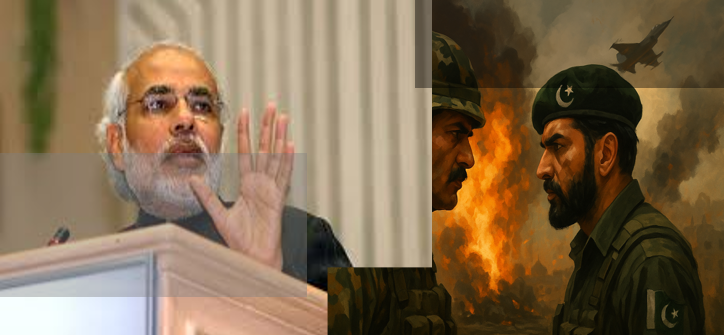
Modi’s “no talks until terrorism stops” doctrine has now replaced years of cautious engagement with open coercion. By declaring that any future attack would be treated as an act of war, New Delhi has raised the cost of inaction by Pakistan — or its inability to rein in the militant groups long seen as state proxies.
🔁 Pakistan’s Dilemma: A Crisis of Denial or a Crisis of Control?


For Pakistan, the dilemma is as old as the conflict itself. It has historically walked the tightrope of plausible deniability while leveraging semi-state actors like Lashkar-e-Taiba and Jaish-e-Mohammed as tools of asymmetrical warfare. But this strategy is now being met with full-spectrum retaliation, as India no longer accepts any distinction between terrorists and their protectors.
In the recent conflict, Pakistani missiles and drones targeted India’s air bases and civilian sites — a move that suggests Islamabad won’t be passive in future escalations. With the Pakistan military riding a wave of post-conflict popularity and led by Field Marshal Asim Muni, domestic political constraints on de-escalation may harden as well.
💧 Weaponizing Water: India’s Most Provocative Move Yet?
Perhaps the most consequential fallout from this crisis lies not in missiles, but in water. By suspending the 64-year-old Indus Waters Treaty — brokered by the World Bank and long seen as a model of transboundary cooperation — India has touched a nerve that could provoke a humanitarian and agricultural crisis in Pakistan.
In the short term, dam closures on the Chenab River could devastate Pakistan’s sowing cycles. In the longer term, India’s acceleration of upstream hydropower projects could choke irrigation and power for millions. While legally questionable under treaty terms that prohibit unilateral withdrawal, the move signals that India is now willing to punish Pakistan’s civilians to pressure its state.
And therein lies the real danger: when strategy turns to collective punishment, retaliation is rarely rational. Pakistan has already called such moves an “act of war,” and its response doctrine now includes “the complete spectrum of national power” — a thinly veiled reference to nuclear capability.
🌐 Diplomatic Fallout: Global Support, Selective Sympathy
International reactions have been predictable. Most condemned the Pahalgam attack and affirmed India’s right to self-defense. But none — including the U.S. — formally blamed Pakistan. India’s narrative, emphasizing surgical precision and restraint, has been eclipsed in global media by reports of Pakistani resilience and claims of downed Indian aircraft.
The effort to return Pakistan to the FATF grey list, meanwhile, competes with Islamabad’s own diplomatic push to revive Kashmir at the UN level — a prospect India has long resisted. Ironically, New Delhi’s aggressive posture could achieve what Islamabad has long sought: the internationalization of Kashmir.
🕊️ Between Red Lines and Thin Ice
India’s hardened posture sends a clear message: the old rules no longer apply. But for a country seeking global power status, there’s a fine line between strength and stubbornness. If India’s actions lead to mass civilian suffering in Pakistan — through economic sanctions or water restrictions — global perception could swing, not in India’s favor, but against it.
The same applies to Pakistan: as long as militant leaders remain untouched and celebrated within its borders, Islamabad will struggle to present itself as a credible victim or partner for peace.
🤝 What Next?
Real diplomacy now lies in the shadows — in backchannels, not broadcasts. Private dialogues between retired officials, expert forums in third countries, and even informal military-to-military contacts could hold the key to defusing what is fast becoming an unsustainable standoff.
For both sides, the question is this: Can they escape their own narratives long enough to avert a second — and potentially deadlier — round of conflict?
As South Asia’s most volatile border hardens further, Newspot Nigeria will continue to follow this developing story and provide critical insight into what the “new normal” really means — not just for India and Pakistan, but for a fragile world order teetering on old rivalries and new weapons.
🔎 Commentary by Newspot Nigeria. For deeper international insights, follow us daily.