By Newspot Nigeria Editorial Desk
As Nigeria marked 26 years of democracy on June 12, 2025, the occasion prompted both celebration and reflection. One story, however, stood out against the backdrop of official speeches and commemorations: the case of Lance Corporal Festus Igenkhai—a soldier declared wanted after sharing troubling allegations about operational misconduct within the military.
Rather than igniting a formal inquiry or institutional response, Igenkhai’s claims have been met with disciplinary action and silence. Yet the core of what he raised—matters involving national security, public trust, and accountability—merits attention beyond military protocol.
The timing is noteworthy. On the same day, the heads of mission from the United States, United Kingdom, Canada, Finland, and Norway jointly published an op-ed titled:

“Preventing Misuse of the Cybercrimes Act: Protecting Free Speech and Unlocking Economic Growth.”
In it, they highlighted growing concerns about the Cybercrime Act (2015)—particularly how its vague provisions can be misapplied to silence criticism and discourage civic engagement. The op-ed referenced not only public concerns raised by Nigeria’s National Human Rights Commission, but also a 2022 ECOWAS Court ruling that found elements of the Act to be inconsistent with international free expression standards.





Among the examples cited was that of Dele Farotimi, who was detained and charged under the Cybercrime Act for sharing opinions on alleged corruption—before the case was quietly dropped. These stories, diplomats warned, reflect how a law meant to fight cyber fraud can be stretched to target public dissent, whether from civilians or uniformed voices.
Yet in Igenkhai’s case, what is equally troubling is not just the military’s reaction—but the institutional silence that followed.


Where are Nigeria’s statutory watchdogs?
-
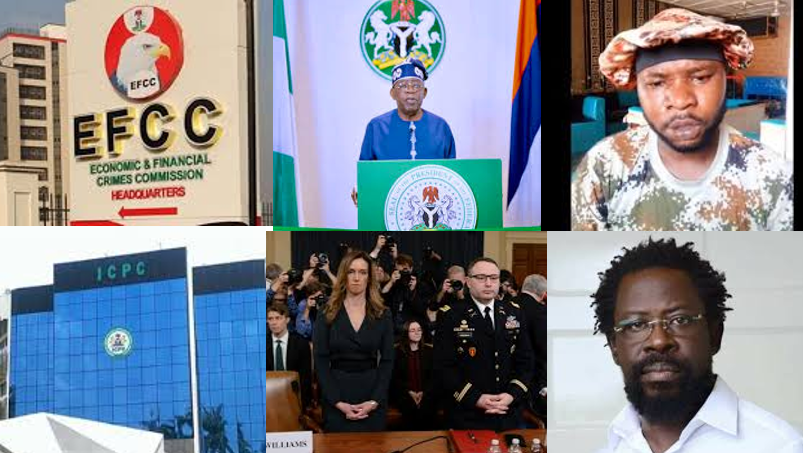
If financial misconduct was alleged, should the EFCC not take a preliminary interest?
-
If abuse of office is possible, does the ICPC have no mandate here?
-
Shouldn’t the National Assembly Committees on Defence or Ethics and Public Petitions at least seek clarification or initiate oversight?
These bodies exist not just to fight corruption, but to signal that no part of government is above public scrutiny.
And beyond these agencies lies an even more central figure in this democratic equation: Where is the Commander-in-Chief of the Armed Forces in all of this?
In a democracy, the military is subject to civilian oversight. If a soldier raises allegations—no matter how uncomfortable—the nation looks to its highest leadership not to prejudge, but to instruct an independent, lawful inquiry. That leadership includes the President himself. His voice, even if brief, carries the authority to ensure that integrity is preserved both within the armed forces and in the eyes of the public.
There is precedent elsewhere. In the United States, Lt. Col. Alexander Vindman, a serving military officer, publicly testified before Congress in 2019 after raising concerns about a phone call involving the President. Though he later faced professional retaliation, Vindman was not criminalized or declared a fugitive. His testimony triggered formal investigations, and the principle of civilian oversight of the military was upheld. That’s what accountability looks like in a functioning democracy.
To be clear, no one is calling for trial by media or excusing procedural breaches. Institutions must uphold discipline. But when serious claims are raised—especially on issues tied to national security and public welfare—Nigeria’s democracy is best served when such claims are examined, not ignored.
As global partners rightly note, Nigeria’s digital laws must protect both security and freedom, not one at the expense of the other. Reform of the Cybercrime Act—especially narrowing terms like “cyberstalking” and “false information”—remains a crucial step. So too is the long-overdue passage of a comprehensive whistleblower protection law.
Lance Corporal Igenkhai’s case, whatever the facts may ultimately reveal, offers a critical test of our institutions’ capacity to balance discipline with transparency, and security with justice.
A democracy’s strength lies not just in elections or constitutions—but in how it handles dissent, especially when that dissent comes from within.
🗞️ Newspot Nigeria
For truth. For the people. For Nigeria.