Sponsored Advert
🔴 Breaking News:
.
By Anayochukwu Agbo
Goodluck Jonathan, a former president of Nigeria, has called for a hall of shame in Nigeria where the pictures of those who ruined the country through wrong doing will be displayed for present and future generations to see
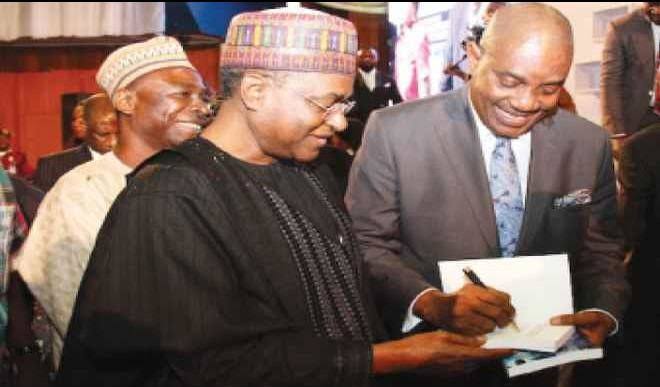
He advocated for this in his opening remarks as chairman at the presentation of two books written by Solomon Arase, a former Inspector General of Police, on Tuesday, February 18, at the Musa Yard’ua Centre, Abuja.
The books, Readings on Election Security Management and Selected Readings in Internal Security Management edited by Arase, encompasses his knowledge and experience as inspector general of police, a lawyer and political scientist, as well as that of other stakeholders in election and internal security management who contributed to the books.
Jonathan, held as an icon of democracy for not rigging the 2015 presidential election and willing conceding defeat to Gen Muhammadu Buhari of the All Progressives Congress, APC, expressed frustration at the Nigerian dystopia that defies solutions that work in other countries. “We are in a society where people accept and celebrate what is wrong. I hope we will get to the stage whre people will not celebrate what is wrong.”
He said he recently witnessed elections in Botswana and Senegal were the security and technology were not close to Nigeria’s but they got the results right. “Here, we talk about technology but still with technology we get it wrong! There, no police, no military to monitor election, only the electoral officers. The Police are the gate; they are only called if there is any incident. I hope that one day Nigeria will get to the level where people will reject wrong doing.”
He lamented that in Nigeria “Corps members will conduct elections and do the right thing at the polling stations but professors who trained them at the university will change the results!
“I hope that one day we’ll have a building or two in Abuja where the pictures of those who ruined this country will be displayed for their children and grandchildren and the public to see.””
Arase had in his address, appreciated Jonathan, “Let me sincerely thank you most sincerely for making me inspector general of Police, the first from Edo State. I’m particularly inspired by your presence. Your presence is symbolic. You are widely recognized as the symbol of our democracy and a peace advocate. You have devoted your post presidency to preaching and promoting peace; building bridges to democracy.”
He said he decided to publish the books for two major reasons: “to open up the intellectual space and equip the Police and other security operatives with the knowledge to act as a framework to hold law enforcement accountable.”
He revealed that it took him five years to put the books he described as “intellectual masterpieces” together. They were informed by his experience and engagements as IG and a lawyer.
“These books share a unified vision. This is our contribution to the advancement of our democracy.”
He said the proceeds from the launching will go to the Arase Scholarship Foundation.
Ogbonnaya Onovo, a retired IG who spoke on behalf of the Body of Retired IGs, said that people like Arase have made it clear that policemen are not illiterates. “As Police officers, we have not found over the years the right way to handle election and security. We have come to the conclusion that community policing is the best approach to policing. We have all the cutting edge technology but what about the human factor? Men that have character and integrity should be the ones chosen to manage elections.”
Like Jonathan he lamented the shameful role university professors are playing in election rigging. “I’m amazed that professors who rusticate students for exam malpractices should be the ones manipulating figures after election. Our efforts should not be in vain; we should not stand in the sun to vote and after that someone will make nonsense of that.”
Ameze Guobadiya, a professor of law who reviewed Readings on Election Security Management, said, “This is a good book; the contents are rich.” She noted that the book has 25 chapters and structured in nine sections, adopts a multidisciplinary approach and identifies pitfalls in past elections. she further described it as “the outcome of deliberate effort at election management.” The book also identifies the synergy that must exist in election security management.
Guobadiya admonished policemen to be conscious of their obligation to the country. “This book should be a sacred reminder to the police that they have a sacred duty in election security management.”
Mike Ikhariale, also a professor of Law, reviewed Selected Readings on Internal Security Management. He said the book presentation was “an occasion to celebrate scholarship.” He described it as “a compendium of 26 chapters and 800 pages, written by someone all round qualified to write it.” The Book places internal security right at the core of security and nation building, and maintains that “as a state, Nigeria must be able to maintain internal security within her borders.”
According to Ikhariale. “The author is saying that every country gets the type of Police it deserves and that the country should equip the Police to give the level of security it needs. These are the central themes in the book.”
Peter Obi, presidential candidate of Labour Party in the 2023 presidential election, put it more bluntly as a leadership issue. “I can’t comment on election policing, but I will say it depends on who is in charge at the time. I have experienced a free and fair election. During my second tenure as governor under President Jonathan, I approached him and said, ‘Mr. President, I don’t want a single vote that doesn’t belong to me. Let the election be free and fair.’
“I had many people with me. Even when PDP members came to my state, I called the president and said, ‘Mr. President, I’m in my village. I don’t want people wandering around my state.’ Within minutes, he called them, and they left.
“When we talk about elections, it all comes down to the people involved. If the right person is in charge, we’ll have free and fair elections. But if we continue in a system where electoral malpractice is the norm, crime will persist, starting with politicians failing to do the right thing.”
On security, Obi argued that tackling corruption among public officials would significantly reduce crime rates. “If we want to talk about security, we must first stop stealing as public officers. Criminals learn from those in power. Even the police will perform their duties better when there is accountability. Election policing is simple if we have leaders who are committed to fairness rather than manipulation.”


Sponsored


Advertisement