
By Newspot Nigeria Maritime News

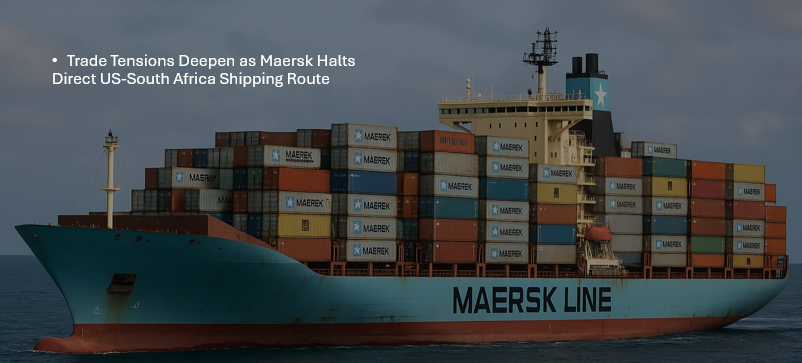
In a decision reverberating across the continent, Danish shipping giant Maersk has announced that it will end its direct cargo shipping route between South Africa and the United States starting October 1, 2025—a move expected to disrupt logistics, drive up costs, and strain trade flows across Africa.
While Maersk cites global supply chain realignments for the change, many analysts point to the backdrop of souring diplomatic ties between Pretoria and Washington—including recent threats by the Trump administration to review South Africa’s access to the African Growth and Opportunity Act (AGOA).
This shift means South African exports to the US will now transit through European ports, extending shipment times from 4–6 weeks to up to 8 weeks, and incurring transshipment fees of $200–$250 per container, on top of Maersk’s peak season surcharges of up to $1,000.
Implications for Nigeria and Africa
The fallout won’t be limited to South Africa. Nigeria, already working to position itself as a regional trade hub under the African Continental Free Trade Area (AfCFTA), could face both opportunities and threats.





1. Increased pressure on Nigerian ports:
With South Africa losing direct US shipping access, there is a chance Nigeria’s ports—especially Lagos, Onne, and Lekki Deep Sea Port—may be seen as viable alternatives for US-bound African cargo. But this is only possible if Nigeria urgently upgrades port infrastructure, reduces corruption, and improves cargo clearance speed.
2. Risk of regional trade bottlenecks:
Countries in the Southern African Development Community (SADC) that depend on South Africa as a maritime conduit (e.g., Botswana, Zimbabwe, Lesotho) may face delays and reroute through West African corridors like Nigeria, Ghana, or Côte d’Ivoire. If unprepared, these corridors could become clogged, costly, and inefficient.


3. Commodities and raw material trade hit:
South Africa is a key exporter of minerals, wine, and citrus to the US. Disruption in this supply may raise demand and prices, benefiting Nigerian exporters—if they can seize the gap. But it also risks creating instability in regional value chains.
4. Highlighting Africa’s strategic vulnerability:
According to Dr. Ernst van Biljon of IMM Graduate School, this decision exposes Africa’s over-dependence on a handful of foreign logistics providers. It sends a wake-up call to Nigeria and other African countries to invest in national shipping lines, inland dry ports, and regional rail networks to buffer against external shocks.
5. Impact on AfCFTA goals:
The AGOA uncertainty and Maersk’s route cancellation may force African governments to prioritize intra-African trade over US exports, but the lack of continental shipping autonomy could hamper AfCFTA implementation. For Nigeria, this could either catalyze deeper regional integration or widen the trade gap if unaddressed.
This development, while originating in South Africa, is a continental inflection point. It underscores how diplomatic strains and logistical reshuffles can trigger economic consequences far beyond the initial flashpoint—and how Nigeria’s proactive or passive response will shape its regional standing.
— For in-depth trade, logistics, and policy analysis across Africa, stay with Newspot Nigeria.