
By Abdullahi Idris Muhammed (AIM), Abuja

The Noise, the Nerves, and the Necessary Truth
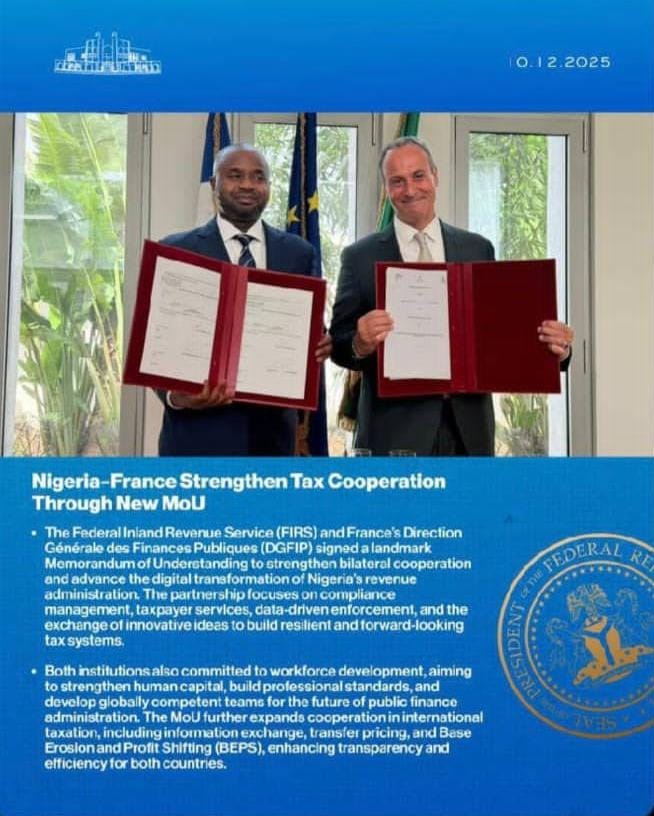
A routine administrative partnership between Nigeria’s Federal Inland Revenue Service (FIRS) and France’s Direction Générale des Finances Publiques (DGFIP) has somehow ignited a level of public anxiety that feels entirely disproportionate to the facts. The memorandum of understanding, structured to support Nigeria’s tax modernisation agenda, has been interpreted by a few commentators with an alarmism that suggests geopolitical intrigue rather than a standard professional collaboration between two sovereign tax authorities.
The dissonance between what the agreement actually represents and how it has been portrayed underscores a broader misunderstanding of how modern tax systems evolve. When examined closely, the partnership is neither unusual nor risky. What is unusual is the attempt to sensationalise it.
A Partnership Built on Global Administrative Norms
The FIRS–DGFIP MoU reflects a widely embraced model of cooperation within the international tax community. Its purpose is clear: to accelerate Nigeria’s transition to a more efficient, digital, and transparent tax administration.

The pillars of the agreement can be understood in straightforward terms. They include improving tax collection through tested modern tools, enhancing taxpayer services via simplified digital processes, strengthening compliance through smarter data use, encouraging institutional knowledge exchange, building capacity through structured training for Nigerian tax officers, and reinforcing cross-border cooperation in line with global anti-evasion standards.





None of these objectives transfers control, responsibility, or authority to France. The arrangement is advisory, not supervisory.
The Manufactured Controversy
The commentary that triggered public debate attempted to frame a routine cooperation agreement as an infringement on Nigeria’s sovereignty. That argument collapses upon scrutiny.


Tax authorities across the world maintain similar bilateral partnerships. The United States Internal Revenue Service collaborates with counterparts from Canada to Japan. The United Kingdom’s HMRC works extensively with European and Commonwealth tax agencies. South Africa partners with OECD and ATAF members. This ecosystem of cooperation is the backbone of modern tax administration.
To suggest that Nigeria’s engagement with France is improper is to ignore the basic architecture of global tax governance.
The Sovereignty Question: Fiction Disguised as Fear
Among the most dramatic claims circulating is the suggestion that Nigeria risks handing over sensitive tax data or compromising sovereign authority. These assertions are unfounded.
Taxpayer information is protected by strict domestic confidentiality laws. No foreign authority can access Nigerian tax data unless Nigeria explicitly authorises such access through a legally binding framework. The FIRS–DGFIP MoU contains no such provisions, nor does it contemplate them.
Furthermore, Dr Zacch Adedeji, Executive Chairman of FIRS, is a meticulous professional whose leadership is widely recognised as one of the institutional strengths of the current administration. His reform agenda has prioritised system integrity, transparency, and modernisation. The notion that he would compromise Nigeria’s fiscal sovereignty is not just implausible; it contradicts his public record.
A Misreading Masquerading as Analysis
The critique that cast the partnership in a suspicious light presents cooperation as something inappropriate, even taboo. But the argument lacks depth and context.
It conflates cooperation with capitulation.
It exaggerates risks while ignoring clear benefits.
It misunderstands both the purpose and mechanics of bilateral administrative partnerships.
It diminishes the professionalism of Nigeria’s tax managers by implying they cannot safeguard national interests.
These flaws weaken the critique and reveal it to be more rhetorical than analytical.
Situating the Partnership in Nigeria’s Fiscal Future
Nigeria’s tax administration is undergoing a structural shift toward digitisation, automation, improved compliance systems, and data-driven decision-making. These reforms align with global best practices and require strategic collaboration.
The FIRS–DGFIP agreement positions Nigeria to benefit from advanced systems already operational in Europe. It is not a dependency but a catalyst. It enables Nigeria to accelerate reform without reinventing the wheel, conserving time, cost, and institutional energy.
This is precisely how successful tax systems evolve: through adaptation, learning, and targeted cooperation.
Stripping Away the Noise
Once the surrounding commentary is stripped away, the reality becomes clear. The FIRS–France cooperation is a responsible, strategic, and necessary step toward a more modern Nigerian tax administration.
No sovereignty is lost.
No data is compromised.
No control is ceded.
What Nigeria gains is capacity, competence, and clarity. Under the stewardship of a leader like Zacch Adedeji, institutional integrity remains non-negotiable.
The controversy is not in the agreement. It is in the misinterpretation.
In truth, the MoU stands as a reminder that collaboration is a hallmark of strong institutions, not a weakness. It signals a Nigeria willing to embrace global standards, invest in digital transformation, and reinforce the backbone of its fiscal governance.
By all measures, that is progress.
Copyright © AIM
Abdullahi Idris Muhammed (AIM) is a policy and good governance expert and advocate.