
By Newspot Nigeria Editorial Desk
A fresh Newspot Nigeria Osun voter survey suggests that Governor Ademola Adeleke remains the leading figure in the 2026 governorship race despite the legal uncertainty surrounding the Accord Party.
The poll, which recorded 264 responses from across multiple local government areas of Osun State, shows Adeleke enjoying a significant advantage in both public approval and electoral preference. While opinion polls are not election results, they often provide an important snapshot of voter sentiment and the issues shaping political calculations ahead of a campaign season.
The survey found that a majority of respondents either strongly approve or approve of Adeleke’s performance as governor. While there remains a notable minority of respondents who disapprove or strongly disapprove, the overall balance of opinion favours the incumbent.

GRAPH 1: Approval Rating of Governor Ademola Adeleke





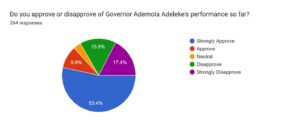
Caption: A majority of respondents either strongly approve or approve of Governor Ademola Adeleke’s performance.


Credit: Newspot Nigeria Poll, June 2026.
The approval chart also reveals a more nuanced political environment than headline figures alone might suggest. The presence of neutral respondents and a sizeable bloc of critics indicates that the governor’s support is substantial but not universal. This means there remains room for opponents to make electoral gains if they can present a compelling alternative vision.
Perhaps the most consequential finding emerged when respondents were asked who they would vote for if the governorship election were held today. Governor Ademola Adeleke of the Accord Party secured 62.5 percent support among respondents. His closest challenger was Oyebamiji Bola of the APC with 36 percent.
The remaining candidates, Olanrewaju Farinloye of AA, Esan Olajide of AAC, Salaam Najeem Folasayo of ADC, and Adegabo Opawoye Yemisi of ADP, collectively attracted only a marginal share of responses. The survey also included an undecided option, but the results suggest that, among respondents, the race is presently viewed largely as a contest between Adeleke and Bola.
GRAPH 2: Voting Preference if the Election Were Held Today
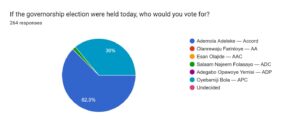
Caption: Governor Ademola Adeleke of Accord recorded 62.5 percent support, while Oyebamiji Bola of APC placed second with 36 percent. Other listed candidates attracted only marginal support.
Credit: Newspot Nigeria Poll, June 2026.
The survey further found that 63.3 percent of respondents believe Adeleke will ultimately win the election regardless of their personal voting preference. Oyebamiji Bola of the APC again placed second with 36 percent, while no other candidate registered a significant share of responses in the winner-projection question.
Political analysts often regard this type of question as a measure of perceived momentum. In many elections, voters are influenced not only by who they support but also by who they believe is most likely to prevail.
GRAPH 3: Who Respondents Believe Will Win the Election
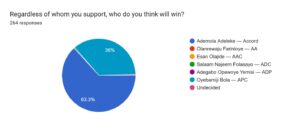
Caption: Nearly two-thirds of respondents believe Adeleke will win the 2026 governorship election, while Oyebamiji Bola of APC placed second.
Credit: Newspot Nigeria Poll, June 2026.
One of the most revealing sections of the survey focused on the issues driving voter decisions. Infrastructure emerged as the most important issue influencing respondents, followed by jobs and employment, economy and cost of living, and local government development. Security, healthcare, and agriculture were also identified as important concerns, though they ranked below the leading issues.
GRAPH 4: Most Important Issue Influencing Voter Choice
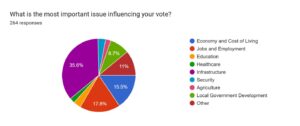
Caption: Infrastructure, jobs and employment, and cost-of-living concerns ranked among the top issues influencing voter decisions.
Credit: Newspot Nigeria Poll, June 2026.
The issue ranking may explain why the governor continues to enjoy strong support among respondents. The poll contains an interesting contrast. While infrastructure emerged as the dominant concern, respondents still gave Adeleke strong approval ratings and substantial voting support. This may indicate that many participants believe the administration is making progress on the issues they consider most important, even as they continue to demand further improvements.
The survey also provides insight into the geographical spread of respondents. After standardising duplicate spellings and descriptions, Osogbo recorded the largest number of identifiable responses. Ife East and Irepodun followed closely behind, while Olorunda, Ede North, Orolu, Irewole, Ilesa East, Ayedaade, Atakumosa West, Boripe, Ejigbo, Obokun, Ifedayo and several other local government areas were also represented.
GRAPH 5: Distribution of Respondents by Local Government Area

Caption: Responses were received from a broad range of local government areas, with Osogbo recording the highest identifiable participation.
Credit: Newspot Nigeria Poll, June 2026.
Another notable finding is the high level of voter registration among respondents. Approximately 95.8 percent indicated that they are registered to vote in Osun State, suggesting that the survey reached a politically engaged audience likely to participate in the election.
GRAPH 6: Voter Registration Status

Caption: Nearly all respondents indicated they are registered voters in Osun State.
Credit: Newspot Nigeria Poll, June 2026.
The demographic profile of respondents also provides useful context. The survey was overwhelmingly male, while the largest concentration of respondents fell within the 35–44 and 45–54 age brackets. Younger adults and senior citizens were represented but in smaller numbers.
GRAPH 7: Gender and Age Distribution of Respondents

Caption: The survey sample was dominated by male respondents, with the largest age groups falling between 35 and 54 years.
Credit: Newspot Nigeria Poll, June 2026.
These demographic characteristics should be considered when interpreting the results. The survey reflects the views of those who chose to participate and may not perfectly mirror the broader Osun electorate. Nevertheless, it provides a useful snapshot of current political sentiment and voter priorities.
The Accord Party deregistration controversy has undoubtedly introduced a legal dimension to the race. However, the poll suggests that, among respondents, voter attention remains focused primarily on governance performance, infrastructure delivery, economic conditions, and employment opportunities rather than courtroom disputes.
For opposition candidates, especially Oyebamiji Bola of the APC, the message is straightforward. The challenge is not simply to benefit from legal uncertainty surrounding the governor’s political platform. It is to persuade voters that they can deliver better outcomes on the issues respondents consider most important.
For now, the Newspot Nigeria poll points to a clear conclusion. Governor Ademola Adeleke enters the next phase of the Osun governorship contest from a position of considerable strength. Whether that advantage endures will depend on campaign dynamics, legal developments, voter turnout, and, above all, the ability of candidates to address the concerns that matter most to Osun voters.