As Nigeria moves closer to the 2027 political season, a familiar class of actors has once again emerged across social media and the public space. They thrive on outrage, feed on crisis, and treat every tragedy as an opportunity for political mobilization. In Yoruba, there is a fitting description for such people, “Agbọtikuyọ,” those who gather around death and disaster, not necessarily to seek justice, but to profit from the attention that follows. Their platforms may differ, but their methods are often the same.
The recent Ogbomoso abduction is a heartbreaking incident that deserves national attention and urgent action from security agencies. The victims and their families deserve solidarity, and citizens have every right to demand accountability from government. No reasonable person should object to public pressure aimed at securing justice. The problem begins when tragedy stops being about victims and becomes a tool for political messaging, engagement farming, and partisan warfare.

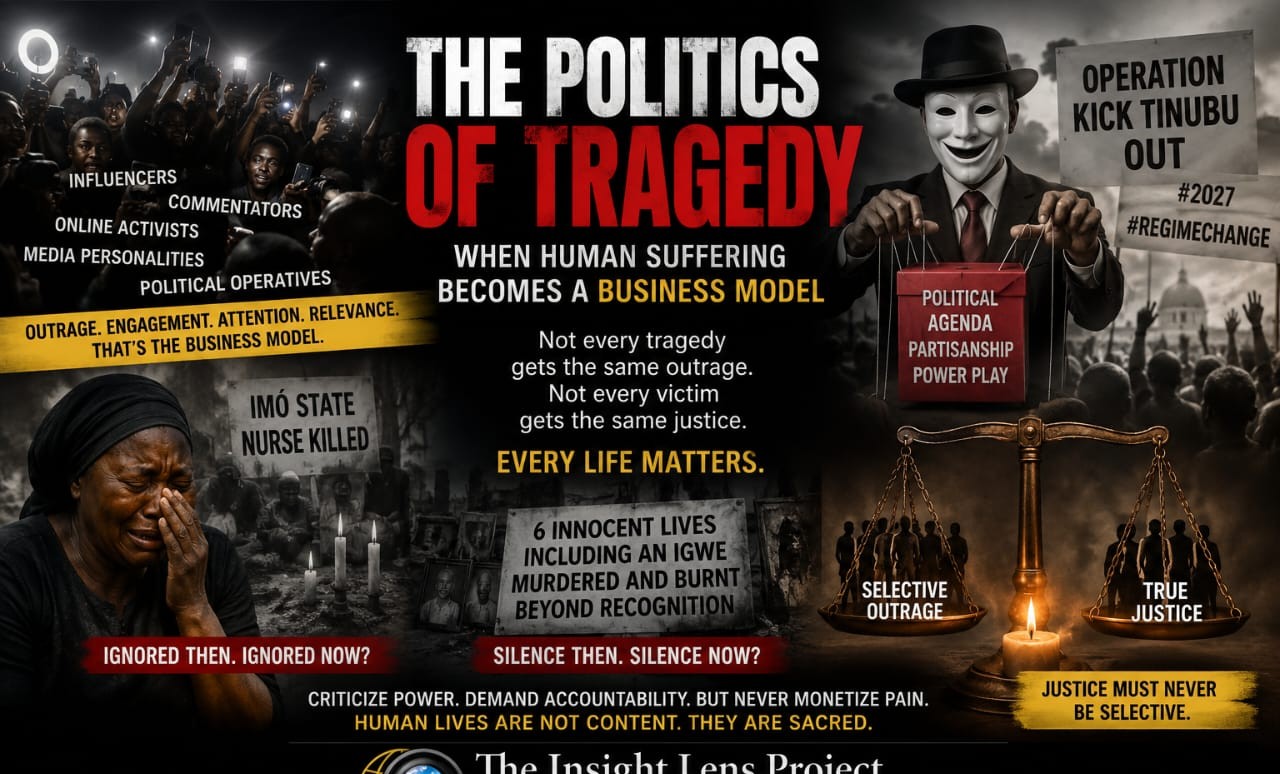
What is particularly striking is how some of the loudest voices today were either silent or barely audible when other Nigerians suffered similar or worse fates. Where were the daily countdowns, hashtags, emotional broadcasts, and coordinated campaigns when a nurse was brutally killed in Imo State? Where was the sustained outrage when six innocent people, including a traditional ruler, were murdered and burnt beyond recognition? The question is not whether Ogbomoso deserves attention, it clearly does. The question is why some tragedies are elevated while others are conveniently ignored.




The answer is uncomfortable but increasingly obvious. For a growing number of activists, influencers, commentators, and political operatives, outrage is no longer driven solely by compassion. It is driven by usefulness. If a tragedy can be linked to a political objective, it is amplified relentlessly. If it cannot be weaponized against a preferred target, it often receives little attention. The victim’s identity, location, or circumstances become secondary to the political value of the story.


This selective activism is dangerous because it gradually dehumanizes victims. Instead of seeing Nigerians whose lives have been shattered, some people see content opportunities, engagement statistics, political ammunition, or pathways to relevance. Human suffering becomes a product to be packaged, distributed, and monetized. The louder the outrage, the greater the visibility. The more emotionally charged the narrative, the greater the political impact. In such an environment, genuine empathy is often replaced by performance.
Even more troubling is the role played by those who should know better. Some media personalities, influencers, entertainers, and self-appointed public intellectuals have become specialists in magnifying tragedies that fit their preferred narratives while overlooking those that do not. They present themselves as defenders of justice, yet their commitment frequently appears conditional. Their outrage has geographical boundaries, political calculations, and ideological filters.
A truly principled position would demand justice for every victim, regardless of where the crime occurred or which political side benefits from the conversation. A kidnapped victim in Ogbomoso deserves concern. A murdered nurse in Imo deserves concern. The six innocent people killed in Imo deserve concern. Victims of banditry in Zamfara, terrorism in Borno, communal violence in Benue, and kidnappings in Kaduna deserve the same concern. Anything less turns justice into a selective enterprise.
As the country approaches another election cycle, Nigerians should be wary of professional outrage merchants and political “Agbọtikuyọ” who gather around every tragedy with cameras, hashtags, talking points, and partisan agendas already prepared. Criticizing government failures is legitimate and necessary in a democracy. Exploiting human suffering for political gain is not. The dead cannot speak for themselves, and the grieving should not be used as props in anyone’s campaign. If justice is truly the goal, then every Nigerian life must matter equally, not only when it serves a political purpose.
Adebamiwa Olugbenga Michael is a Lagos-based journalist, political economy and policy analyst, and publisher of TheInsightLensProject.com, delivering data-driven open-source intelligence insights on Nigeria, Africa, and global affairs.