

By Managing Editor


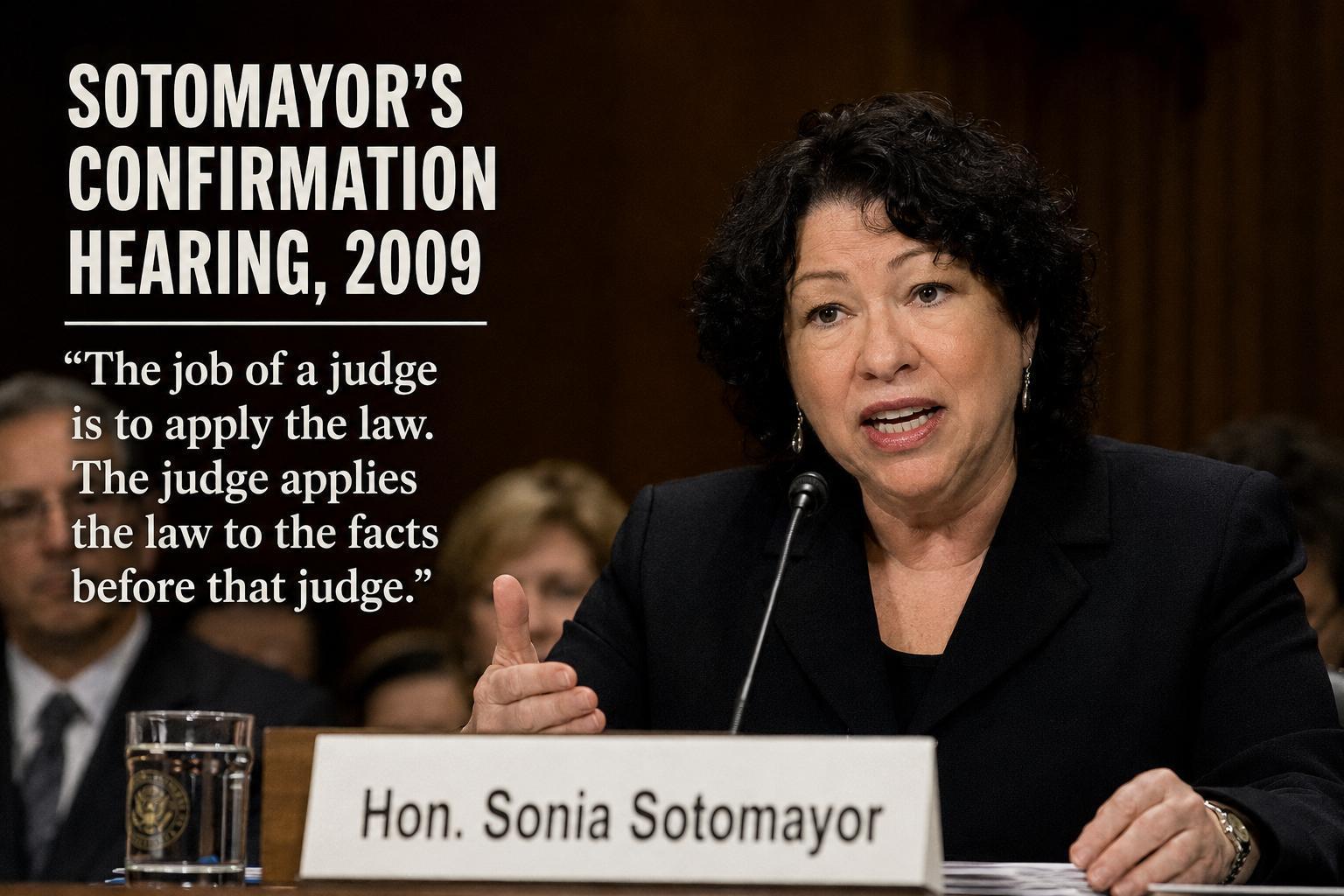
By the time Sonia Sotomayor sat before the Senate in 2009, many progressives expected a moment of celebration. Barack Obama had spoken openly about empathy as a quality he wanted in judges. Sotomayor’s personal story, legal career, and symbolic importance seemed to offer the Left a rare chance to defend its view of constitutional interpretation. Instead, her testimony sounded far more cautious than many of her supporters expected.
Ed Whelan’s latest essay revisits that moment with a clear conservative argument. He presents Sotomayor’s hearing as proof that even a liberal nominee felt compelled to speak the language of judicial restraint. Again and again, she said the role of a judge was to apply the law, not make it. The official Senate confirmation record confirms that this was not a passing phrase but the central theme of her testimony.
The sharpest criticism came not from the Right, but from liberal law professor Louis Michael Seidman. In his published critique, Seidman argued that Sotomayor’s description of judging was either intellectually inadequate or politically dishonest. His point was not that judges should ignore the law, but that hard cases often involve ambiguity, judgment, competing principles, and moral assumptions. That criticism captured the frustration of progressives who wanted a more candid account of what judging actually requires.

That is what makes Whelan’s piece worth reading beyond its partisan edge. It shows how confirmation hearings often reward caution over candor. Nominees know that one loose sentence can be turned into an attack ad, a Senate floor speech, or a permanent ideological label. So, they speak in safe formulas, even when those formulas do not fully describe how hard cases are actually decided.





At the center of the debate is an old question about the courts: Do judges simply apply fixed legal commands, or do they inevitably make choices when text, precedent, facts, and social change collide? Sotomayor’s testimony leaned heavily toward the first answer, including when she rejected the idea that judging should be driven by what is in a judge’s heart. Her critics on the Left believed that answer was too simple to be serious.Whelan sees something larger in that simplicity.
In his view, conservatives had already won the public argument over the language of judging by 2009. “Judicial activism” had become a damaging accusation, while restraint sounded neutral, disciplined, and respectable. Even a Democratic nominee, backed by a Democratic Senate, had reason to avoid sounding like a living constitutionalist.The irony is hard to miss.


A nominee celebrated by many progressives ended up using language that conservatives had spent decades popularizing. That does not mean she became a conservative. It means the political vocabulary of confirmation had narrowed. Certain ideas could still influence judging, but they had become risky to say out loud.The result is a strange kind of public theater.
Senators ask questions they know nominees will not answer directly. Nominees give responses designed to reveal as little as possible. Advocacy groups then interpret every phrase as either proof of moderation or evidence of concealment. The public is left watching a ritual that feels important but often says less than it promises.
This is not a problem created by Sotomayor alone. It is now built into the structure of Supreme Court confirmations. The Court decides questions that shape elections, executive power, civil rights, abortion, religion, guns, immigration, and business regulation. With stakes that high, every nomination becomes a political battlefield.Whelan’s essay, therefore, lands on a troubling point.
The real question is not whether Sotomayor meant every word she said in 2009. The harder question is whether any nominee can speak honestly about judging and still survive the process. When the safest path is to sound neutral, careful, and almost empty, the hearing becomes less of a search for truth and more of a test of discipline.That is the deeper lesson of the Sotomayor episode.
Confirmation hearings are supposed to help the public understand the people who will interpret the Constitution for a generation. Too often, they teach nominees how not to be understood. And when that happens, the gap between the Court’s power and the public’s trust only grows wider.
— Newspot Nigeria