

From Dispatch Room
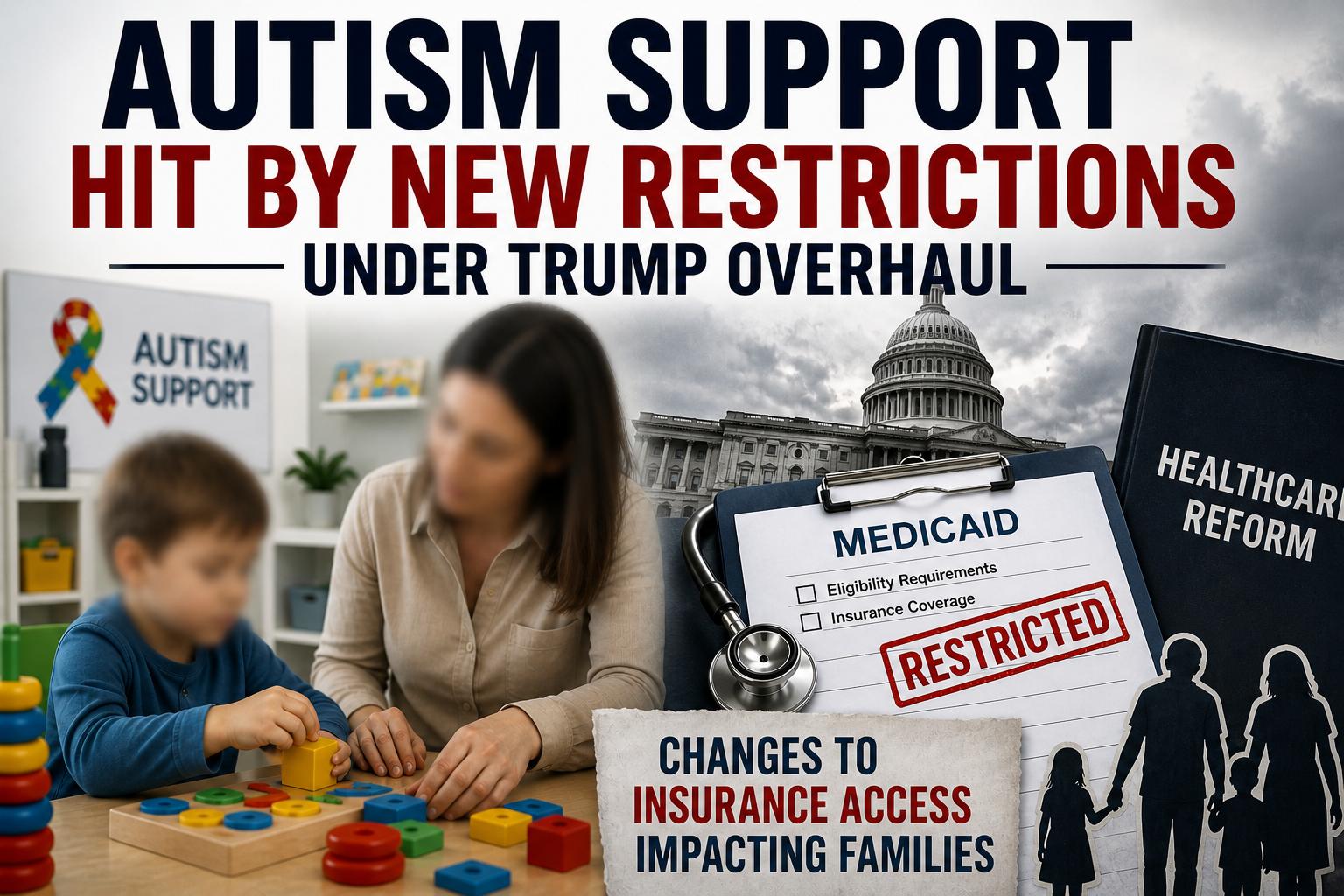
Families seeking autism-related support in the United States are facing fresh difficulties following changes to healthcare and insurance qualification rules under President Donald Trump’s broader health and federal cost-cutting overhaul.


According to Newsweek, advocacy groups and care providers say the changes have made it harder for some autism service providers to secure the funding needed to deliver therapy and support to children and families who rely heavily on Medicaid.
The report said the Trump administration’s policy changes were tied to the One Big Beautiful Bill, which introduced major changes across federal departments and agencies, including Medicaid qualification rules.
Medicaid remains a major source of healthcare coverage for low-income families in the United States, including many households with children who require autism-related support services.

Pinny Berger, president of the Autism Families Alliance, told Newsweek that many provider groups depend heavily on Medicaid because a large number of children who need autism support services have Medicaid as their primary insurance.





“A lot of provider groups rely heavily on Medicaid funding because there are so many of the children that need the services that we provide that have Medicaid as their primary insurance holder,” Berger said.
Kate Koble, regional clinical director at Golden Steps ABA, said providers have seen insurance requirements become stricter over time, making it more difficult to qualify for the funding needed to provide therapy and support.


She said providers now face more documentation demands, tighter timelines and additional restrictions when submitting reports to insurance companies.
“So as time’s gone by, there’s just more and more hoops to jump through in restrictions that we have to prove,” Koble told Newsweek.
The report noted that the pressure is also being felt at the state level, where different reimbursement rules and restrictions can affect access to care.
In Oklahoma, for example, a restriction was reportedly introduced limiting how far residents may go beyond the state’s borders to seek certain medical resources, including Applied Behavior Analysis therapy.
Providers also warned that uneven reimbursement rates across states may affect where clinicians choose to work, creating shortages in some areas and making it harder for families to find services.
Koble cited the example of clinicians travelling from Ohio into Indiana because of differences in reimbursement rates, leaving some families in Ohio struggling to access qualified providers.
Golden Steps ABA reportedly operates in several states, including Indiana, Oklahoma, Nebraska, North Carolina, Virginia, Arizona, Utah, Massachusetts and Maryland, while seeking expansion into other locations.
Berger said shortages of behavior analysts remain a major challenge in certain parts of the country, urging parents and families affected by autism to become more involved in advocacy at the local political level.
The issue comes as the Trump administration has placed autism at the center of its wider health policy agenda.
Health and Human Services Secretary Robert F. Kennedy Jr. has launched efforts to investigate what he has described as an “autism epidemic,” while also making controversial claims about possible causes.
Kennedy has previously repeated claims linking vaccines to autism, a connection that has been widely discredited by scientific research.
He also announced that the administration had linked autism to acetaminophen use during pregnancy, though researchers cited in relation to the claim cautioned that more definitive studies are needed.
The Centers for Disease Control and Prevention has reported that about 1 in 36 children has been identified with autism spectrum disorder, while experts have noted that rising diagnosis rates may also reflect broader diagnostic criteria and improved awareness.
For families and providers, however, the immediate concern remains access to care, especially for children who depend on Medicaid-funded services and specialized therapy.
The debate is expected to continue as providers, advocacy groups and affected families push for clearer rules, fairer reimbursement and wider access to autism support services across the United States.
— Newspot Nigeria