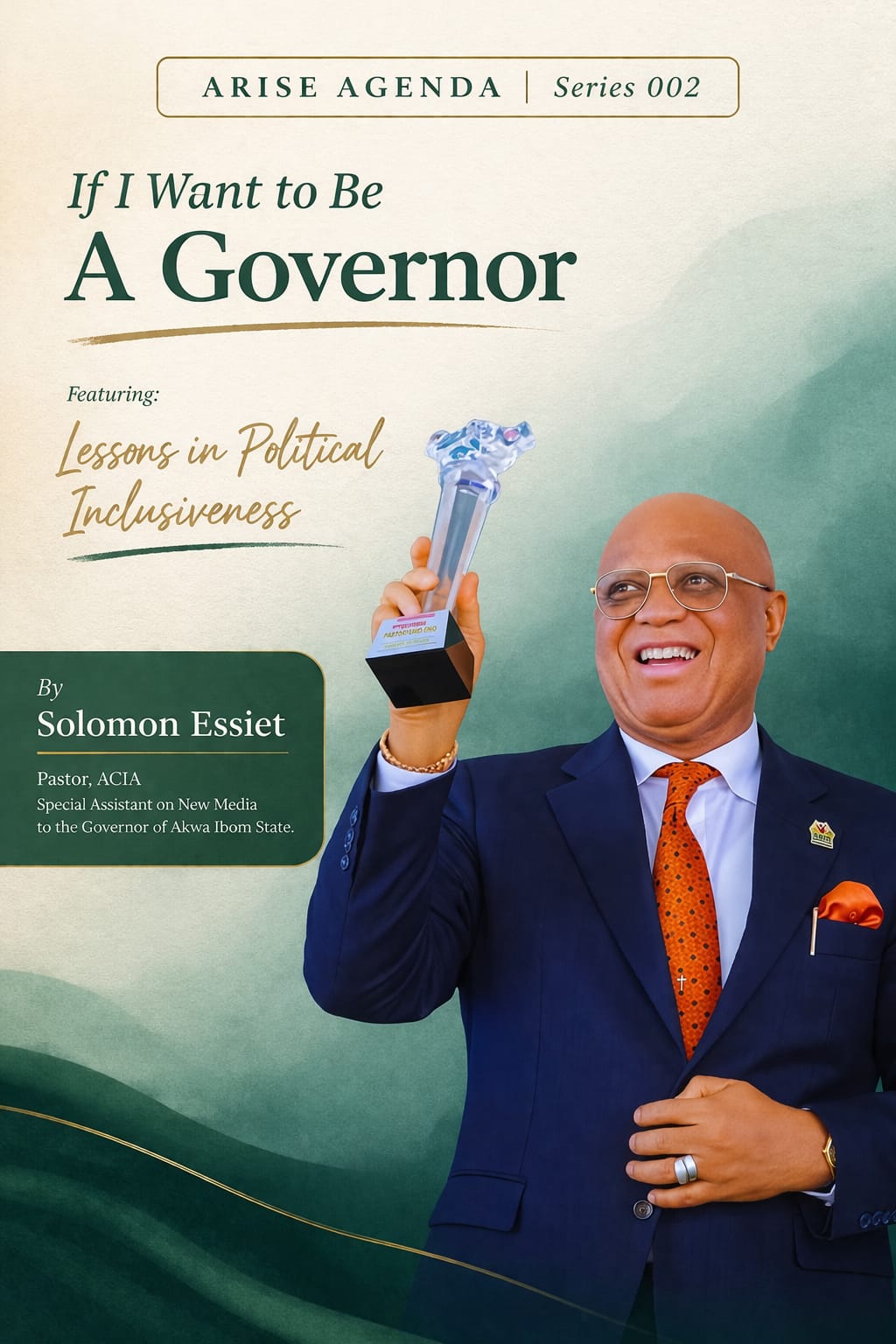
By Solomon Essiet
The word inclusiveness did not mean much to me until Pastor Umo Eno became Governor of Akwa Ibom State.
One of his earliest signals of what that would mean in practice came barely two months after he assumed office in 2023. Governor Eno came prepared. As our people would say, a palm tree that will bear good fruit shows signs from its early days.
He gave what many saw as an unprecedented demonstration of inclusive leadership when he convened professionals from different walks of life at a gathering he called Ibom Dialogue, held from July 24 to 27, 2023. It was a meeting of minds, a gathering of thinkers and stakeholders brought together to help shape the direction of his administration. Soon after, at the same Ibom Icon and Golf Resort venue, the ARISE Agenda, the blueprint of the Golden Era administration, was formally unveiled.

Before then, it was not easy to bring people from different political parties together in Akwa Ibom State under one roof. But I can say confidently that many of the prominent figures at that event were men we had long watched from a distance, and many of them did not belong to the Peoples Democratic Party, which was the ruling party at the time. Names such as Dr. Udoma Udo Udoma, Obong Donald Etiebet, and Arc. Nya Etok, who for decades were hardly seen at political gatherings linked to the PDP because of their affiliations elsewhere, were all present.




At a time in Akwa Ibom politics, it was almost taboo to sit side by side with someone from another political camp. You could lose your job, your business opportunities, or even your standing in certain circles. That was how tense things were. So when Governor Eno came in preaching inclusiveness, many people, including my humble self, did not fully understand the direction he was taking.
I was privileged to attend the Ibom Dialogue from the very first day. The atmosphere was a mixture of emotion and nostalgia. Influential men who had once stood on opposing sides were now shaking hands, speaking freely, and engaging one another. Some may have done so at first for appearance’s sake, but that moment marked the beginning of the unity we celebrate today.


Governor Eno was clearly intentional about bringing Akwa Ibom leaders together. At the time, many of us could not fully grasp what he was trying to build because it was still too early in his administration. We were only looking at the surface. He, however, appeared to be seeing much further ahead.
Looking back now, one cannot help but conclude that he understood his assignment from the beginning. It was as though he knew that one of the main reasons he was entrusted with leadership was to heal divisions and reunite the state. Many people may not have predicted that he would become governor after Udom Emmanuel. But God, who sees beyond man, had a different plan.
Akwa Ibom had suffered deeply from division, bitterness, and the absence of genuine love among many of its leaders. At such a time, Pastor Umo Eno emerged with a message of reconciliation. He himself has often spoken about being blessed with the spirit of peace and reconciliation, and from what we have seen, that was not just political language. It has reflected in the way he has governed.
That same spirit showed itself again during his first term when Governor Eno led a broad spectrum of Akwa Ibom leaders to meet with President Bola Ahmed Tinubu, GCFR, in the first quarter of 2025. Among those present was his political father, Mr. Udom Gabriel Emmanuel. That visit remains one of the most remarkable moments in the history of political engagement in Akwa Ibom State. I personally wondered how Governor Eno was able to assemble such a team across divides. Without even speaking to him directly, I knew that move must have required sacrifice, patience, and unusual political maturity.
If Governor Eno had not studied Political Science, one might still marvel at how naturally he has handled political complexity. But even formal study alone does not explain such calm, strategic, and unifying leadership, especially from someone many once described as politically inexperienced. That is why some of us can only say there is something deeper at work here.
Yes, the Governor went to school. He holds an academic doctorate degree in Political Science, not an honorary one. Yet he has carried that knowledge quietly, without noise or self-advertisement, focusing instead on governance and service delivery. That is what the people voted for. This is the same man some once claimed had no educational background. But that is a discussion for another day. The point here is his style of inclusive governance.
What I cannot say for certain is whether Governor Eno knew from the very beginning that he would one day move to another political party while still in office. But one thing is clear: without the inclusive approach he built into governance from the start, such a move would have been far more difficult. Many forces could have risen against him. Resistance would likely have come from several quarters. Yet, long before that moment came, many political leaders across party lines had already come to see him as a rallying point for Akwa Ibom.
It became easier for people to trust his intentions because he had already opened the doors of government wider than many expected. He had already made space for dialogue, engagement, and relationships across political boundaries. That did not happen by accident. It was built step by step.
It is common knowledge that the instability and internal tensions within the Peoples Democratic Party influenced Governor Eno’s decision to join the All Progressives Congress. I first came to understand the full meaning of political dynamism during my consultations to become Chairman of my Local Government Council in Ikot Ekpene in 2024. During one of those visits, my political leader in the PDP, Senator Emmanuel Ibok Essien, told my team and me something I have never forgotten: politics is dynamic. He was preparing me for whatever outcome might come from the primaries.
That lesson has stayed with me. Political dynamism is real. As Governor Eno himself has said, no two elections are the same. A seasoned politician understands not only the moment, but also the movement beneath the moment. That is what some call reading the political temperature. It requires patience, timing, and composure. Politics can be unpredictable, but those who endure are usually those who stay calm and clear-headed.
So when Governor Eno made the dramatic but calculated decision on June 8, 2025, to leave the PDP for the APC, it came as a shock to many. Yet it was also a move he was able to carry through with unusual ease. Many of his political appointees, elected office holders, and even members of the National Assembly moved with him. In recent Akwa Ibom political history, that kind of shift was extraordinary. But it did not happen in a vacuum. It was made possible, in large part, by the broad acceptability he had already built through inclusive politics.
Since then, Akwa Ibom State has functioned more like a united front. There is a greater sense of political harmony than many had seen in years. This has also strengthened the working relationship among Governor Eno, Senate President Godswill Obot Akpabio, GCON, and President Bola Ahmed Tinubu, GCFR. Many political observers believe that, with this alignment and atmosphere, Akwa Ibom stands to benefit even more from the dividends of democracy in the days ahead.
For me, the lesson is simple. If I want to be a governor, I must learn this lesson of political inclusiveness. A state has enough burdens already without a leader creating fresh enemies at every turn. Governance becomes stronger when people feel seen, respected, and carried along. It is wiser to build bridges than to spend public resources fighting needless battles.
That is one lesson Pastor Umo Eno has taught clearly.
Arise, that same God.
Pastor Solomon Essiet, ACIA
Special Assistant on New Media to the Governor of Akwa Ibom State
— Newspot Nigeria