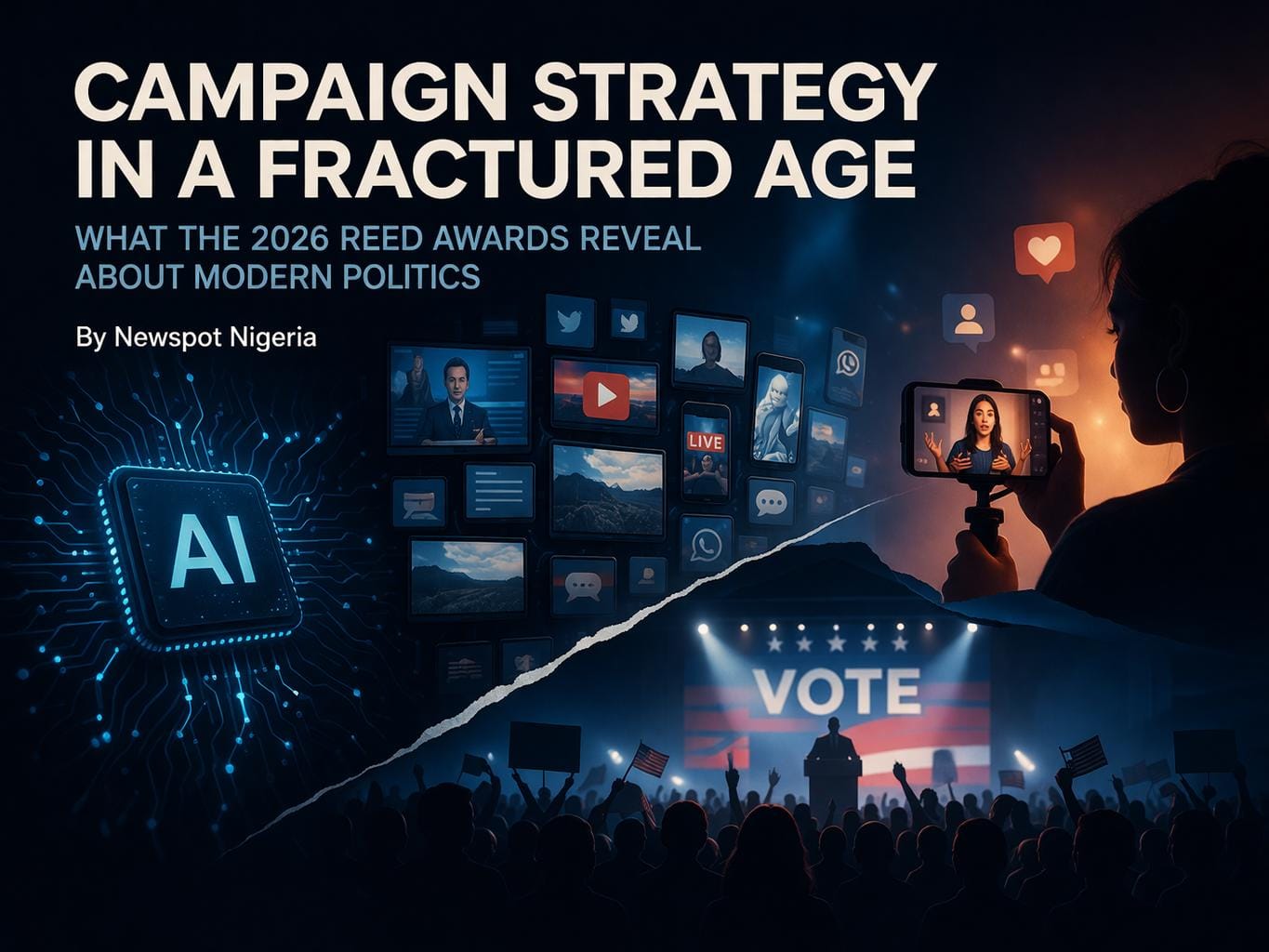

By Newspot Nigeria Editorial Desk


The early conversations at the 2026 Reed Awards Conference in Charleston did not revolve around novelty. They revolved around discipline. Beneath the noise of artificial intelligence, influencer culture, and platform expansion, one theme stood out clearly: campaigns are not being transformed by tools alone, they are being tested by how well strategists think.
Three patterns emerging from the conference provide a sharp lens into how modern political communication is evolving.
AI Is an Efficiency Engine, Not a Strategic Brain
Artificial intelligence continues to dominate campaign discussions, but its most practical value remains operational. Across panels, practitioners emphasized that AI is accelerating production cycles, improving data parsing, and reducing the time required to test messaging variants. What it is not doing is replacing judgment.






Campaigns that treat AI as a decision-maker risk flattening their messaging into generic outputs. The advantage lies in using AI to solve defined problems, not in deploying it as a catch-all solution. Early adopters are gaining compounding benefits, not because the technology is perfect, but because they are integrating it into structured workflows.
The distinction is simple: AI scales execution, but strategy still determines direction.


Fragmentation Has Rewritten the Rules of Reach
The idea of a unified media ecosystem has collapsed. Voters no longer consume information through predictable channels, and the implication for campaigns is not just logistical, it is conceptual.
Fragmentation is not merely about spreading content across more platforms. It is about recognizing that each platform represents a different behavioral environment. The same voter behaves differently on television, on short-form video, in messaging apps, and in long-form digital spaces.
This forces campaigns to move beyond replication toward adaptation. Messaging must be native to the medium, not transplanted across it. The strategist’s role is no longer just to allocate budget, but to interpret attention.
In this environment, coherence is achieved not through uniformity, but through alignment across diverse channels.
Influencers Are Useful, but Not Controllable
The rise of influencers as political messengers has introduced both opportunity and risk. Conference discussions made it clear that influencers can be effective when used with precision, particularly in reaching niche or hard-to-access audiences.
However, their value is inseparable from their independence. The very quality that makes influencers credible, their autonomy, also limits their predictability. Campaigns that attempt to script or tightly control influencer messaging often undermine the authenticity that gives these voices their impact.
As a result, influencers function best as supplemental assets rather than central pillars of communication strategy. Their deployment requires careful alignment with campaign values and tone, rather than a simple calculation of audience size.
Reach without credibility delivers diminishing returns.
The Real Divide Is Not Technology, It Is Judgment
Taken together, these insights point to a broader conclusion. The competitive edge in modern campaigns is no longer defined by access to tools. Most campaigns now have access to similar technologies, platforms, and data streams. What separates effective campaigns is how they think.
Strategic clarity, message discipline, and contextual awareness have become more valuable as the communication environment becomes more complex. The temptation to chase every new tool or trend remains strong, but the campaigns that succeed are those that anchor innovation in purpose.
The Reed Awards discussions did not suggest that the future belongs to technology. They suggest that the future belongs to those who can use technology without being distracted by it.
— Newspot Nigeria