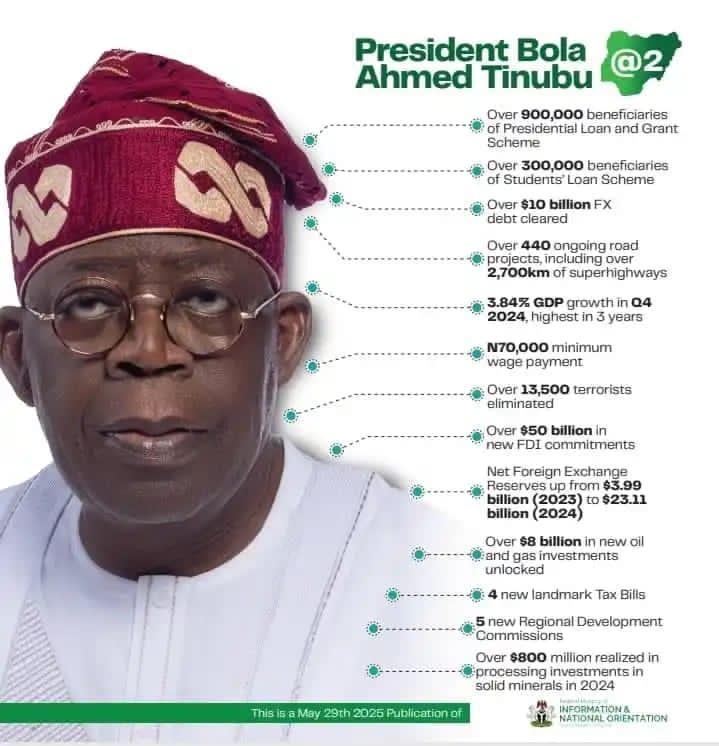
By the time campaigns officially begin on August 19, President Bola Tinubu will have spent 1,178 days as the country’s Commander in Chief.
For the majority of that period, he has shown an unmatched desire to tackle insecurity in progressive ways that even his predecessors, who failed to be proactive when the problem was developing, could never have imagined.
While there have been notable setbacks, one thing that cannot be contested is the fact that Tinubu has remained committed to his promise to the electorate ever since his inaugural address.
Let me rewind.
On the day of his inauguration, he promised to defend the nation from terror and all forms of criminality that threaten its peace and stability, specifically saying security shall be the top priority of its administration because prosperity or justice cannot prevail amid insecurity and violence.

Eager to immediately transform the situation, he said more investment shall be made in the country’s security personnel, meaning there would be more than an increase in the number of those manning the country’s security architecture.





No wonder then that in the 2024 budget titled: ‘Budget of Renewed Hope,’ Tinubu, out of a total expenditure of N28.7 trillion, allocated at least N3.25 trillion to security, which was much more than education (N2.18 trillion), health (N1.33 trillion) and infrastructure (N1.32 trillion).
Likewise in the 2025 budget titled: ‘Budget of Restoration: Securing Peace, Rebuilding Prosperity’, approximately N4.91 trillion out of the N54.9 trillion was earmarked for defense.


In the proposed 2026 budget, N5.41tn has been allocated to national security, making it the single largest allocation.
It marked the third consecutive year that defense and security spending has taken priority since the administration began presenting national budgets in November 2023, suggesting that Tinubu’s security agenda is designed not just for the present, but with a longer-term horizon in mind.
These proactive moves and long-term actions are in agreement with the words of the longest-serving first lady of the United States, Eleanor Roosevelt, who urged individuals to do what they believe is right, even though they will face condemnation.
And as Mahatma Gandhi once opined, critics often oppose reformers before eventually recognising their impact.
For much of Tinubu’s presidency, critics who have offered few workable solutions to one of the country’s biggest challenges have turned a blind eye to his efforts, thereby criticising, dismissing and resisting, while overlooking the long-term nature of his reforms, especially in tackling the country’s vulnerability.
But why has insecurity become such a persistent, almost intractable problem? Tinubu alone cannot be blamed. The crisis predates his administration. Insecurity became a national issue in Nigeria long before the demise of Musa Yar’adua and took an unprecedented dimension under the Peoples Democratic Party, PDP’s, Goodluck Jonathan.
Under Jonathan, Nigeria’s porous borders facilitated the easy trafficking of arms and movement of criminals or terrorists, as they are now being called.
More so, the high rates of youth unemployment, extreme poverty and illiteracy worsened by Jonathan and his successor fueled massive recruitment into extremist groups like Boko Haram, kidnapping gangs and banditry networks, all of which the current administration now battles.
The proliferation of illegal arms and ethno-religious tensions, which also assumed a frightening dimension under Jonathan, resulted in conflicts between farmers and herdsmen, coupled with ethnic agitation and political instability.
This partly explains why, under Tinubu, a range of policies has been introduced to address both the security crisis and its underlying socio-economic drivers. Why I would not be able to start listing them all, I must remind readers that just seven days ago, Minister of Defense, Gen Christopher Musa, retd, disclosed that Tinubu further approved the procurement of new equipment for the armed forces and other security agencies to enhance the fight against terrorism and banditry across the country.
Before now, the President had reportedly purchased four attack helicopters from the United States of America to improve aerial surveillance and combat capabilities.
Also, the President Tinubu had engaged with Turkey for further support in enhancing Nigeria’s military capabilities.
To help Nigeria tackle insecurity, the Turkish President, Recep Erdoğa, pledged support for Nigeria’s fight against terrorism, offering to share his country’s experience in tackling insurgency.
Erdoğa said terrorist organisations emerging, particularly in Africa’s Sahel region, unfortunately, pose a threat to the peace of the entire continent.
He said: “We stand by the friendly people of Nigeria in their fight against terrorism under the leadership of President Tinubu.
“Today, we addressed opportunities for closer cooperation in the fields of military training and intelligence. We stated that we are ready to share our country’s significant experience in the fight against terrorism.”
On December 10, Tinubu, in his bid to decentralise policing as some very notable groups and individuals have always canvassed, authorised the arming of forest guards nationwide as part of a renewed strategy to confront rising insecurity, particularly in rural communities affected by banditry, kidnapping and illegal mining.
Like that move, the President has also called on the National Assembly to initiate a constitutional amendment to establish State Police, describing the move as a critical necessity to dismantle Nigeria’s persistent security challenges.
If this is actualised, Nigeria would join countries with state-level police including the United States of America, Canada, India, Australia and Germany, where these forces operate and successfully handle regional security, highway patrol and crimes that cross municipal lines.
As the President promised during his inaugural address, all of these long-term measures are being ensured to “mend and heal this nation, not tear and injure it.”
Oyatomi Esq., Former Editor, (Sunday Vanguard 1999-2010), Author (FINGERPRINTS: Nigeria’s Tangled Transition to Nationhood 2008) and a current member of the Board of Independent Media and Policy Initiative (IMPI), a Think Tank based in Abuja.