
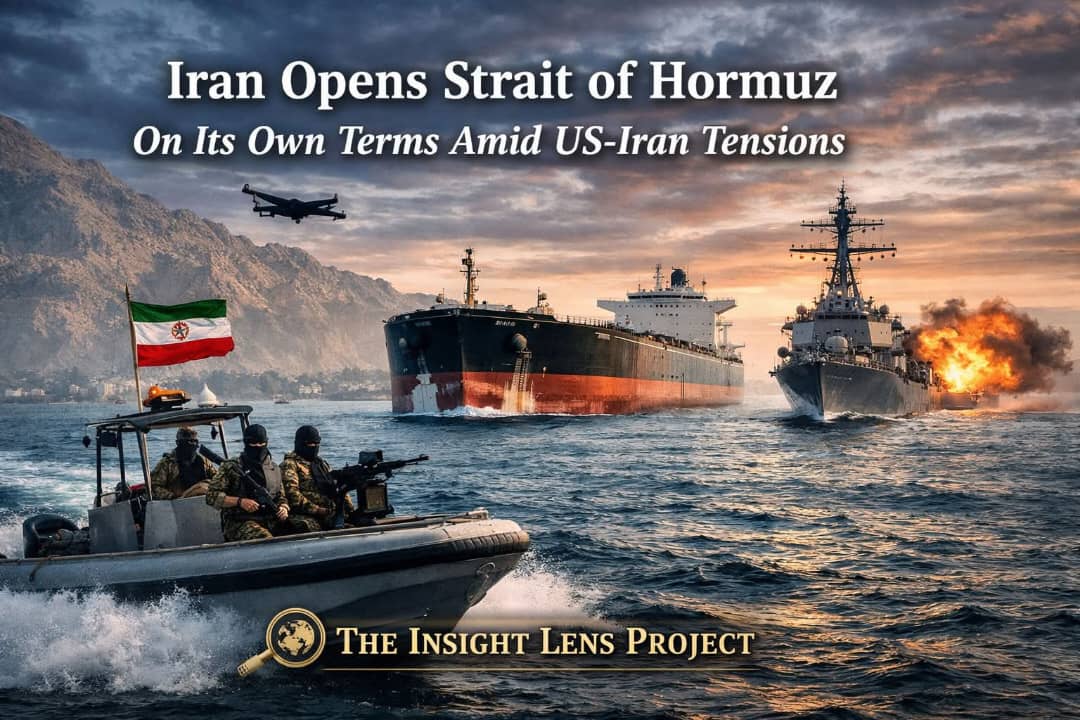
Iran has confirmed that the Strait of Hormuz remains open to international shipping, but under conditions that reinforce Tehran’s control over one of the world’s most strategically vital waterways. The announcement came from Ali Mousavi, Iran’s Ambassador to the United Kingdom and permanent representative to the International Maritime Organization (IMO), in interviews with the semi-official Mehr news agency and outlets including Xinhua.
Mousavi emphasised that while the strait is technically accessible, vessels must coordinate security and safety arrangements with Iranian authorities and respect the country’s sovereignty. Notably, he explicitly excluded “vessels linked to enemy nations,” a clear reference to the United States, Israel, and their allies. He described the ongoing tensions in the region as rooted in “US-Israeli aggression” and said diplomacy remains Iran’s priority, though he stressed that building mutual trust is more crucial than technical cooperation.
The timing of the statement is significant. It came in the wake of US President Donald Trump’s 48-hour ultimatum, issued on 21st of March, threatening to strike Iranian power plants unless the strait was “fully reopened.” In recent weeks, commercial passage had become effectively impossible for many vessels due to heightened security risks arising from the US-Israeli confrontation with Iran.
While the announcement signals a partial concession, it stops short of full normalisation. Shipping companies and insurers remain cautious. War-risk insurance premiums, already up 200–300% since early March, continue to make transit costly, and many operators are likely to treat the strait as high-risk or off-limits until credible de-escalation occurs. Some vessels are expected to anchor off Oman or the UAE, or reroute around the Persian Gulf where feasible.

Global oil markets are responding with caution. Brent and WTI crude prices, which recently hovered around $108 and $95–98 per barrel respectively, may see a modest dip on headlines suggesting “reopening.” Yet the exclusion of “enemy” vessels and the continued risk of confrontation maintain a significant geopolitical premium. Analysts warn that even a partial flow cannot restore the pre-crisis volumes of roughly 20 million barrels per day, leaving prices for the foreseeable months in the $90–120 range. The situation could directly affect global inflation, supply chains for petrochemicals, fertilizers, and energy costs, particularly for Asian economies heavily dependent on Gulf exports.





The broader geopolitical stakes remain high. Iran has demonstrated its ability to leverage geography to control a significant share of global oil transit, reinforcing the strategic importance of chokepoints worldwide. While diplomatic efforts continue, the next 48–72 hours, marked by the first test transits and the US response will be critical in determining whether tensions de-escalate or spiral further.
In Tehran’s framing, the strait is not closed but “open on Iranian terms,” with the country maintaining a defensive posture while holding the US and its allies responsible for the crisis. Some Iranian lawmakers have even suggested imposing transit fees as a potential mechanism once the immediate standoff concludes, signalling that Iran intends to retain a long-term measure of control over the waterway.


The Strait of Hormuz remains central to the world’s energy security. Approximately 20% of global oil and liquefied natural gas passes through the narrow channel daily, and any disruption or conditional control has far-reaching implications for shipping, energy markets, and international diplomacy.
©️ Adebamiwa Olugbenga Michael is a Lagos-based journalist and policy analyst, and publisher of The Insight Lens Project, offering principled, data-driven insights on Nigeria and West Africa.