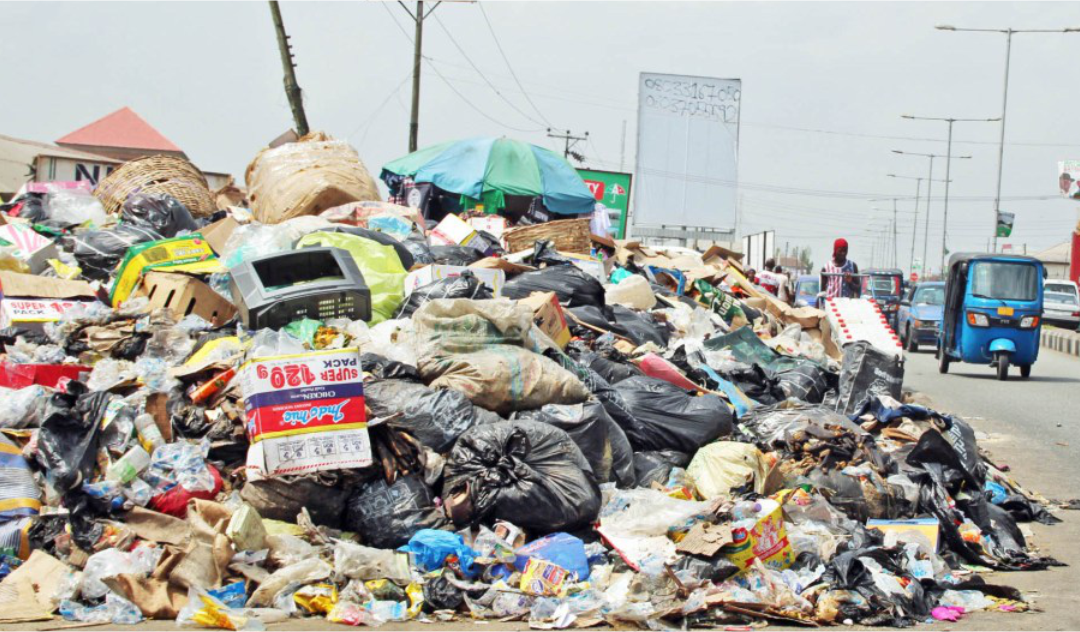


Refuse dump, perhaps by the culture of all Africans in the years of yore, used to belong to the nearest bush.
Our forebears, in Nigeria, could have grown up to imbibe such and be wired to mirror the nearby bush around them anywhere they find themselves with a thrash…; don’t laugh!
In the brain of an average Nigerian, the refuse dump or dustbin is always close by, even as it is now obsolete and invisible; he would imagine it and put it to use without qualms till today and even tomorrow, if you don’t effectively check him or her.

The fact that we now have some sanitary rules and regulations to check us or the sanitary inspectors to harass us doesn’t deter us.





That was why we embraced the idea of the administrative glorification called Environmental Day, observed on the first Saturday of every month in some states of the federation, including Lagos State as if it was to work magic.
Recall that the Lagos State had to suspend the monthly rigours for a while for some unknown reasons, indeed long enough to soon be reminded of the consequences of the suspension.


Heaps of refuse had demanded a reversal of the suspension sooner than later in the Lagos State where Governor Babajide Sanwo-Olu calls the shots.
The all-important Sanitation Day had been badly missed for the period, of course, and its stench had been felt everywhere.
There had been uproar in Makoko, in Oko Baba and some other parts of Lagos, an uproar which resounded beyond Lagos and, indeed, beyond national boundaries, perhaps because the stench was in Lagos, of all places!!
“…Should Lagos yet be fixing refuse issues in the 20th century?” “Why won’t Lagos know refuse is health hazard?” “Refuse that’s now industry elsewhere?”
Such was the wagging of tongues even outside Nigeria when Lagos was planning to return to observing the monthly Sanitation Day, thanks to the social media!
But, indeed, not only Lagos State had deserved the jest; the whole of the nation, Nigeria, probably did; every State, every Local Government, to be fair!
Anywhere you go in Nigeria, people are seen disposing their wastes carelessly, gleefully, throwing wastes into the gutters, from the stores, from the stalls, through the car windows; from their pockets, from their market kits, into the gutters and empty spaces.
Rainfalls, in particular, usually offer great opportunities during which women and children discard wastes into flowing erosions hilariously, hysterically, not caring where such wastes would end up!
Dirty Nigerians, we all are, compared with the neatness that our leaders witness in the advanced nations on their very frequent visits.
Refuse is convertible to an enviable industry and has been so converted in the advanced climes to achieve constant hygiene in homes and serve some auxiliary industrial and agricultural needs.
In such climes, sanitation is seen as everyone’s business, on a daily basis; with governments providing customized plastic containers at every home for refuse collection.
Governments would arrange to collect such refuse containers on regular basis, discharge the contents and replace them with reasonable fees conveniently charged.
You won’t see loafers around in such a circumstance for no one would search for what to pick in non-existing waste dumps anyway.
Unemployment rate would reduce naturally as jobs would have been further created in the States, in the LGs, while roles would also have been assigned, to drivers, to mechanics, also to sundry hands.
Two or three refuse-bins per house are usually required, supplied by the authorities at reasonable costs with regular charges made per household, enough to make such ventures viable without necessarily exploiting the citizenry.
Indeed, refuse management should be an important role of our governments, at State or LG levels.
To prevent vandalization, the supplied refuse bins are built strong and made durable.
The sooner the process becomes a habit and a law, the sooner would be the moment to heal Nigerians of taking everywhere for the obsolete nearby bush for refuse dumping.