

By Newspot Nigeria Editorial Desk


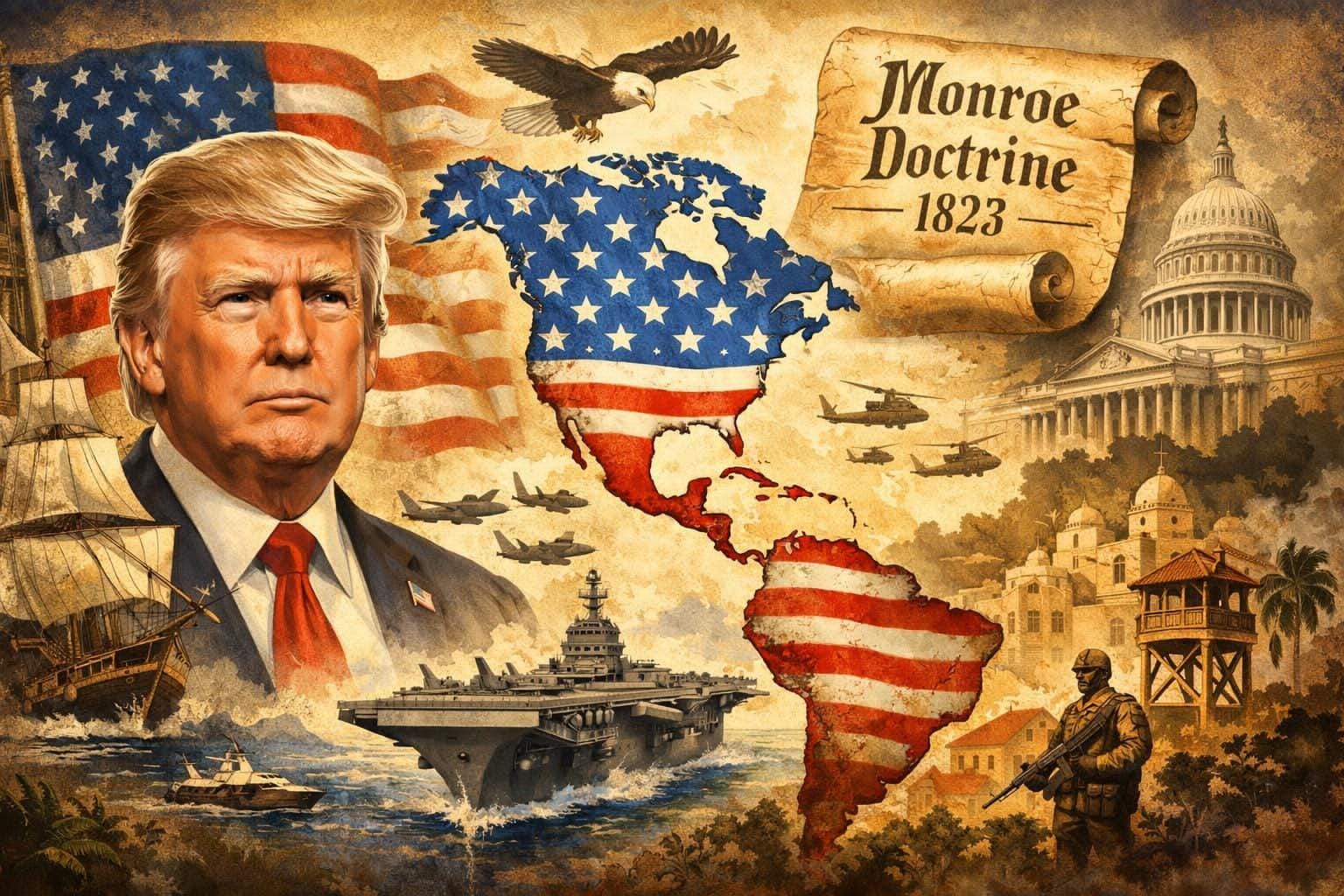
The United States has unveiled a major shift in its global strategy. In two documents released between December 2025 and January 2026, the new National Security Strategy (NSS) and National Defense Strategy (NDS), Washington signals that its foremost strategic priority is no longer Asia, Europe, or the Middle East. Instead, the focus is returning to the Western Hemisphere.
For decades, American strategic planning concentrated on distant theaters: countering Soviet influence during the Cold War, fighting terrorism after September 11, and more recently balancing China’s rise. The new doctrine represents a striking pivot. The Trump administration now frames the Americas, from the Arctic to South America—as the central arena for U.S. security and geopolitical influence.
This shift reflects an effort to consolidate American power closer to home. Yet the strategy raises an important question: can Washington narrow its strategic perimeter without creating instability elsewhere?

The Return of Hemispheric Strategy





The new strategy revives a concept deeply embedded in American history: hemispheric primacy. Since the early nineteenth century, the United States has treated the Western Hemisphere as a special strategic space where external powers should not dominate.
The modern version of that logic goes beyond territorial defense. In the new strategy documents, homeland security is defined broadly. It includes border security, migration control, combating drug cartels described as “narco-terrorists,” and securing strategic infrastructure across the Americas.


The administration argues that strengthening influence across the hemisphere will protect the United States from cross-border threats while reinforcing economic security. Supply chains, energy routes, and critical minerals are now treated as components of national defense.
The strategy also emphasizes military access to “key terrain” across the hemisphere. This phrase refers to geographically important locations that provide operational advantages, including Arctic routes, maritime corridors, and critical canals. The language suggests that the United States intends to ensure uninterrupted military and commercial mobility throughout the region.
“Peace Through Strength” Revisited
Both strategy documents repeatedly invoke a familiar phrase: peace through strength.
In practice, that concept translates into a renewed emphasis on military power. The administration highlights several priorities:
- Modernization of the nuclear arsenal
- Development of a proposed missile-defense system known as the “Golden Dome”
- Expansion of the defense industrial base
- Increased defense spending
President Donald Trump has suggested raising annual defense expenditures from roughly $900 billion to as much as $1.5 trillion. While such an increase faces political and fiscal hurdles, the proposal underscores the administration’s ambition to sustain overwhelming military capabilities.
The strategy also places unusual emphasis on presidential authority. References to the president appear frequently throughout the documents, while traditional inter-agency processes receive little attention. This reinforces the perception that strategic decision-making is increasingly centralized in the executive branch.
China as an Economic Rival
One of the most notable aspects of the new strategy is how it frames China.
Rather than treating Beijing primarily as a military adversary, the documents portray China mainly as an economic competitor. The United States intends to counter Chinese influence through tariffs, trade restrictions, and efforts to reduce dependence on Chinese supply chains.
At the same time, the strategy still envisions a military balance in the Indo-Pacific. The Pentagon plans to maintain a defensive posture along the so-called First Island Chain—a network of allied territories and maritime chokepoints stretching from Japan through Taiwan and Southeast Asia.
The goal is deterrence without direct confrontation. Military planners emphasize communication channels with China’s armed forces to prevent accidental escalation.
A More Transactional Alliance System
Another defining feature of the new strategy is its approach to alliances.
The administration argues that many partners have relied too heavily on American military power. As a result, allies are now expected to assume greater responsibility for their own security.
Europe, in particular, is encouraged to expand its defense capabilities. The strategy notes that European members of NATO collectively possess the economic strength and population needed to deter aggression. In this view, the United States should support the alliance but not carry the primary burden.
Similar expectations apply to partners in Asia. Countries such as Japan, South Korea, and Australia are encouraged to increase defense spending and take a larger role in maintaining regional stability.
A Narrower Security Perimeter
The broader philosophy underlying the strategy is straightforward: the United States should stop acting as the guarantor of global order.
According to the National Security Strategy, the era in which Washington attempted to uphold the entire international system is coming to an end. Instead, the United States intends to concentrate its security commitments closer to home while maintaining economic engagement elsewhere.
This approach effectively contracts America’s core security perimeter to the Western Hemisphere.
However, the strategy also assumes that the United States can still shape outcomes in other regions through economic pressure, diplomacy, and limited military presence.
The Simultaneity Problem
Critics of the strategy point to what defense planners call the “simultaneity problem.”
Global security crises rarely occur one at a time. Conflicts can erupt in multiple regions simultaneously, forcing the United States to divide attention and resources.
Even as the administration prioritizes the Americas, events elsewhere continue to demand military engagement. Recent tensions with Iran illustrate the dilemma. Naval forces that had been operating in the Caribbean were redeployed to the Middle East as regional tensions escalated.
Such situations demonstrate the challenge of maintaining a hemispheric focus while still responding to global contingencies.
Risks of Strategic Overconfidence
Another concern is that reducing U.S. engagement abroad could invite opportunistic moves by rival powers.
If Washington appears less committed to Europe, the Indo-Pacific, or the Middle East, adversaries might test the limits of American resolve. Strategic vacuums can emerge quickly in international politics, and other powers are often eager to fill them.
At the same time, a heavier American military presence in the Americas could generate its own tensions. History shows that interventions in the hemisphere often produce political backlash and long-term instability.
Balancing these dynamics will be one of the administration’s most difficult tasks.
A Strategy Still in Motion
The new National Security Strategy and National Defense Strategy outline an ambitious vision but leave many operational details unresolved. The defense bureaucracy will likely spend years translating these principles into concrete military plans and deployments.
For now, the documents signal a fundamental shift in how Washington views its role in the world. The United States is attempting to re-center its strategic identity around its own hemisphere while maintaining influence across the globe.
Whether that balance can be sustained remains uncertain. The practical challenge for American policymakers will be managing global crises without abandoning a strategy that places the Americas at the heart of national security.
— Newspot Nigeria