
By Newspot Nigeria Editorial Desk

The United States and Canada are often described as the model of what close international relationships should look like, enormous trade volumes, deeply integrated supply chains, a shared border economy, and aligned security interests. That description is well earned and long documented. Yet in 2025 and 2026, the relationship has begun to sound less like quiet coordination and more like a series of overlapping disputes, each one feeding uncertainty into the next.
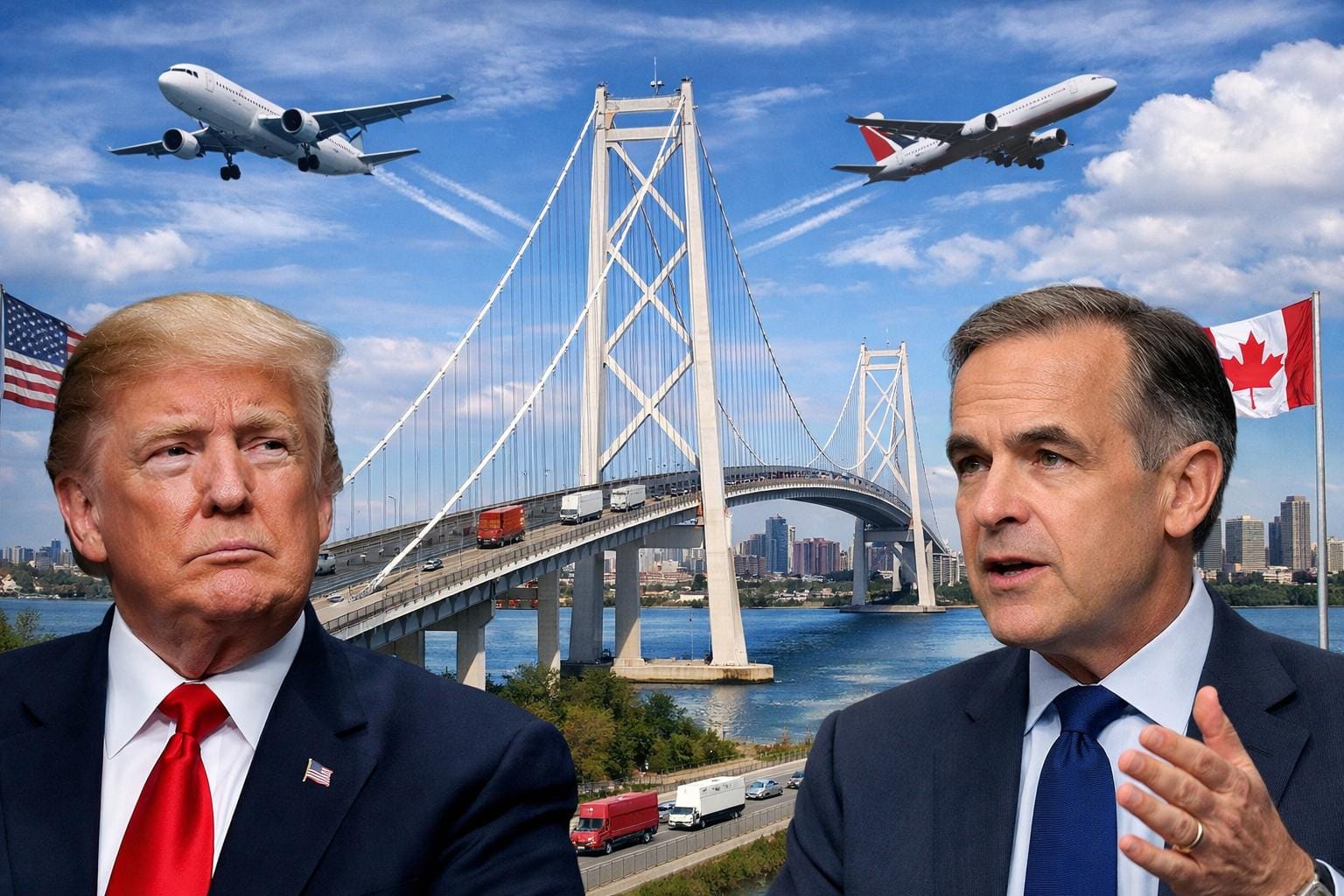
Start with the Gordie Howe International Bridge. This is not a symbolic project or a political vanity build. It is a critical trade artery designed to ease congestion between Windsor, Ontario and Detroit, Michigan. In February 2026, however, the bridge became political leverage. President Donald Trump publicly suggested delaying or blocking its opening as part of broader grievances with Canada. Prime Minister Mark Carney later confirmed he spoke directly with Trump and emphasized that Canada financed the project, pushing back against the idea that it could be treated as a bargaining chip.
Trade tensions tell a similar story. Tariffs have returned as a central feature of Washington’s negotiating posture, including duties applied to Canadian imports not covered by USMCA rules. When a Supreme Court setback disrupted one legal pathway for tariffs in February 2026, the administration pivoted to a different authority to impose a temporary global tariff. The signal was unmistakable, tariffs are no longer a last resort. They are a preferred tool.

Aviation adds another layer, one that has been clouded by rumor. Canadian airlines are, in fact, cutting back U.S. routes. Air Transat is exiting U.S. flying by mid 2026, and WestJet has suspended multiple transborder services. These decisions are largely commercial, shaped by demand conditions and broader uncertainty rather than government directive.





What has not happened is equally important. Canada has not closed its airspace to U.S. carriers. There has been no official action restricting American overflights, and routine aeronautical notices continue without disruption. The airspace closure narrative circulating online has no verified basis. But its persistence matters. When airline schedule changes are quickly interpreted as political retaliation, it suggests trust is thinning.
This is how relationships erode, not through dramatic breaks, but through accumulation. Infrastructure becomes leverage. Tariffs become habit. Routine commercial decisions become political signals. Information fog fills the gaps between facts.


Carney’s approach so far has been one of diversification rather than confrontation, emphasizing expanded trade relationships beyond the United States while avoiding escalation. Trump’s approach has leaned in the opposite direction, public pressure, visible threats, and transactional bargaining. Neither approach has broken the relationship. But together, they are reshaping it.
The relationship is not on the verge of collapse. What matters more is the gradual acceptance of leverage politics as normal. When this becomes the default posture in a deeply integrated relationship, every bridge risks becoming a hostage, every tariff a precedent, and every rumor a multiplier.
The remedy is not rhetorical. It is practical. Keep core infrastructure out of personal politics. Reduce tariff brinkmanship that unsettles integrated supply chains. Protect cross-border systems, aviation safety, trade corridors, certification frameworks, from being pulled into short-term pressure campaigns.
The United States and Canada can disagree and still function. They have done so many times before. What they cannot afford is to keep turning the mechanics of cooperation, bridges, tariffs, and travel, into instruments of pressure without paying a long-term price in trust.
That cost may not show up immediately. But it will compound.
— Newspot Nigeria