By Olugbenga Adebamiwa
In the tense aftermath of the February 21, 2026 Area Council elections in Nigeria’s Federal Capital Territory, a single social media post attempted to drag the nation’s political discourse toward a dangerous precipice.
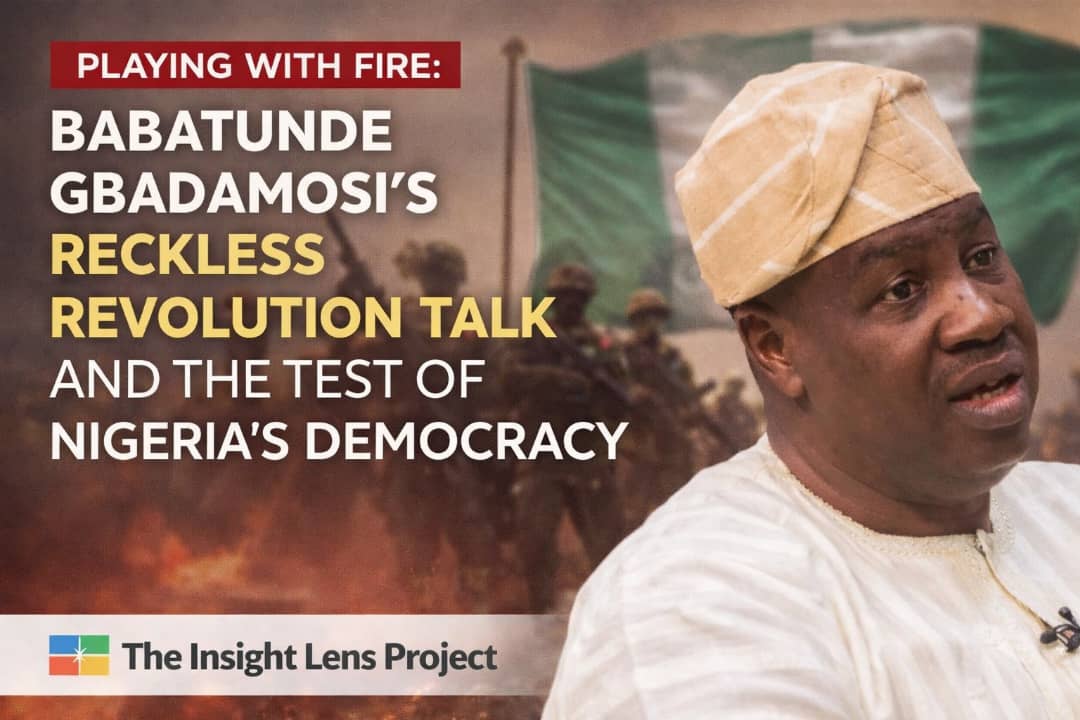
Its author, Babatunde Gbadamosi, lawyer, real estate developer, and perennial government critic, declared that Nigeria had moved “beyond reform.” According to him, peaceful democratic pathways had failed. What remained, he suggested, was “violent revolution.”





It was an extraordinary claim, and dangerously radical remedy.


The post gained wider attention after being amplified by Parallel Facts, drawing applause from a vocal minority and swift condemnation from many who viewed the rhetoric as reckless and provocative. What might have dismissed rhetorical excess quickly developed into a serious national debate, when does dissent cease to be democratic and begin to flirt with anarchy?
Gbadamosi’s argument rests on the assertion that Nigeria’s democratic framework under President Bola Ahmed Tinubu and the governing All Progressives Congress is irredeemably broken. He framed the FCT elections as proof of systemic decay, implying that ballots have lost their meaning.
Critics, however, argue that such sweeping conclusions distort reality. Low voter turnout, widely reported in the FCT polls, signals civic disengagement, not democratic extinction. Apathy is a problem. It is not a mandate for insurrection.
Nigeria’s democratic project, though imperfect, has endured since 1999. It has survived contentious transitions, courtroom battles, opposition victories at various levels, and relentless public scrutiny. To declare it “beyond reform” is to disregard the constitutional mechanisms that remain firmly intact, the courts, electoral tribunals, civil society activism, investigative media, and ultimately, the ballot itself.
Gbadamosi ventured into particularly dangerous terrain by invoking the Alliance of Sahel States, formed by Mali, Burkina Faso, and Niger following military takeovers. Those states did not undergo orderly democratic resets. They experienced coups, sanctions, economic strain, diplomatic isolation, and deep uncertainty.
To present military-driven upheaval as an aspirational template for Africa’s largest democracy is, critics contend, historically shallow and politically dangerous.
Nigeria’s scale, diversity, and economic centrality mean that stability is not optional, it is existential. Revolutionary rhetoric may trend online, its real-world consequences are rarely predictable and seldom .
The Constitution guarantees freedom of expression under Section 39. Yet no democracy treats speech advocating violent overthrow as sacrosanct. Sedition laws and treasonable felony provisions, however controversial, their colonial roots remain embedded in Nigeria’s legal architecture.
Legal analysts note that while criticism of government policy is constitutionally protected, explicit calls for violent revolution tread perilously close to criminal thresholds. Whether authorities pursue charges is a matter of prosecutorial discretion. But the very possibility underscores how high the stakes become when public figures choose words that inflame rather than illuminate.
Government officials have reiterated calls for peaceful civic engagement, emphasizing that grievances must be addressed through lawful and constitutional channels.
Nigeria has weathered storms before, from prolonged military rule to economic shocks to nationwide protests such as #EndSARS. Yet even amid turbulence, the constitutional order has held.
History shows that calls for violent revolution rarely mobilize broad consensus. More often, they divide society, invite heightened security responses, and distract from substantive reform. They risk undermining the very freedoms that make dissent possible in the first place.
The true test of democratic maturity is not the absence of anger, but the discipline to channel it constructively.
In the digital age, a single post can generate national shockwaves within minutes. But governance is not shaped by hashtags alone. It is shaped by institutions, laws, civic participation, and patient reform.
Nigeria’s challenges are real. So are its democratic foundations. The choice before the nation is not between complacency and chaos, but between reform within the system and a dangerous drift toward institutional fracture.
For now, the loudest revolution is rhetorical. The deeper responsibility rests with leaders, commentators, and citizens alike to strengthen democracy, not set it ablaze.
©️ Adebamiwa Olugbenga Michael is a Lagos-based political economy and policy intelligence analyst and publisher of The Insight Lens Project, providing data-driven insights across Nigeria and West Africa using open-source intelligence.