

By Ọládélé Ọmọlúàbí


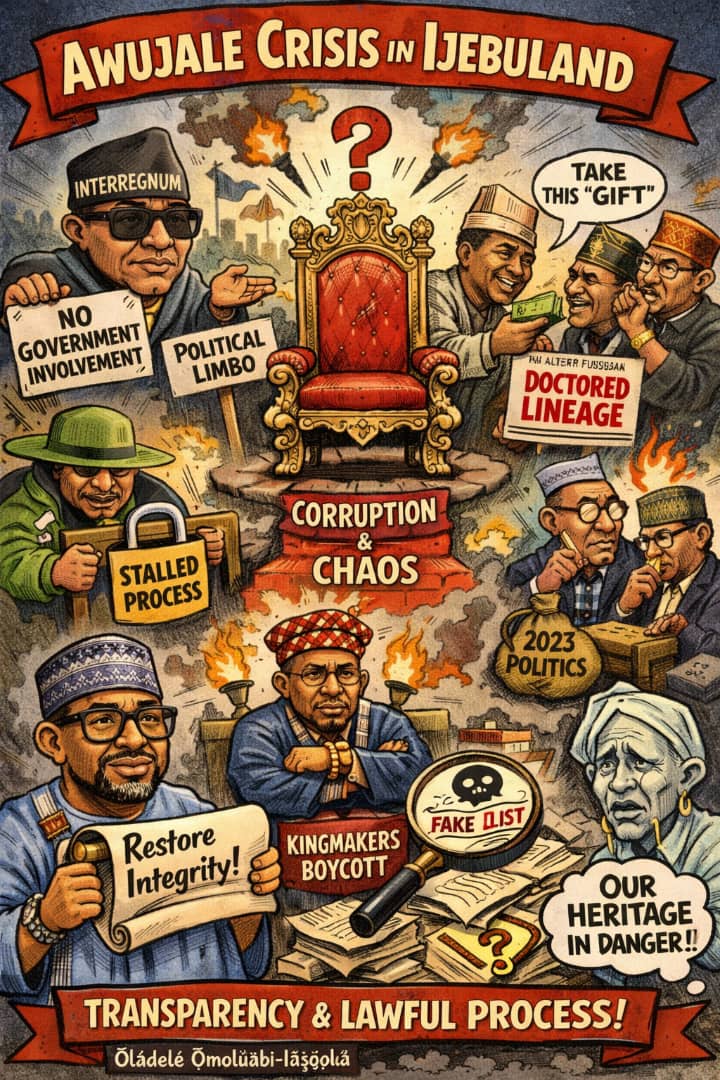
Ijebu is not merely witnessing a royal succession dispute. It is watching a slow-motion institutional ambush.
At the center is the vacant throne of the Awujale — one of Yorubaland’s most revered stools. What should have been a dignified, lawful and customary transition is now entangled in factional defiance, political maneuvering and troubling allegations of document manipulation.
Let us speak plainly.

A group identifying itself as “Interegnum” has effectively positioned itself as gatekeeper of the process. The group insists there must be no government involvement in the selection and has reportedly signaled it is prepared to stall the emergence of a new Awujale until Governor Dapo Abiodun leaves office.





That is not tradition. That is strategy.
Chiefs have boycotted Olisa meetings. Customary rites connected to the Olisa chieftaincy are being disrupted. The symbolism is unmistakable: apply pressure, weaken institutional checks, consolidate influence.


Meanwhile, politicians are quietly pitching tents around the crisis. Ogun East is politically strategic terrain. Whoever influences the Awujale process influences loyalty networks, traditional legitimacy and grassroots structures. In this climate, culture becomes currency.
The Ogun State government, sensing public suspicion, has issued statements distancing itself from any perceived endorsement of aspirants. But the damage is already done. In matters of traditional authority, perception is power.
Then comes the most troubling revelation — the so-called Fusengbuwa ruling family list.
Multiple sources allege glaring irregularities. Most explosive among them: a leading contender reportedly had his lineage altered from female descent to male descent — a fundamental breach of customary qualification rules. In Yoruba monarchy, lineage is not clerical detail. It is destiny. If lineage is doctored, legitimacy collapses.
There are growing calls for outright cancellation of the list. If it is flawed, it cannot stand. If it is manipulated, it must be independently investigated.
There are also allegations — unproven but persistent — that financial inducements are being disguised as “gifts from a son to a father,” even where no biological relationship exists. Cultural language, critics argue, is being weaponized to sanitize influence-buying. Security screenings some aspirants reportedly underwent have not silenced these concerns.
More disturbing still is the constitutional question: who authorized the Interegnum to act as final arbiter? The recognized kingmakers — the Afobajes — are not constitutionally constituted by the state government at this time. So on what legal footing does this faction stand? Tradition without structure becomes chaos. Authority without legitimacy becomes imposition.
Politically, this crisis is combustible. Ogun East sits within the broader national chessboard of President Bola Tinubu’s political landscape. A mishandled royal succession could ignite resentments that outlive any single administration. Governor Abiodun’s cautious — some say lukewarm — posture is widely interpreted as political risk management, particularly in the shadow of forces aligned with Ibikunle Amosun and other entrenched actors.
But fear is not governance. Silence is not neutrality.
If threats to stall the process are real, Ijebu could face an unprecedented vacuum — a throne deliberately delayed for political timing. That would mark a dangerous precedent: royal legitimacy tied to electoral cycles.
This is no longer a palace matter. It is a test of whether Yoruba customary systems can withstand partisan infiltration.
The Way Forward: A Solution-Seeking Path
Ijebu deserves transparency. And transparency demands action.
First, the Ogun State Government must act wisely and decisively. The Interegnum structure, now widely perceived as partisan and controversial, should be dissolved. In its place, a new, broadly respected transitional body must be convened — one that commands moral authority across all ruling houses, kingmakers and stakeholders.
Second, the Fusengbuwa ruling house list must undergo an independent forensic and customary review. If irregularities are confirmed, the list should be nullified and reconstituted through a transparent verification process involving credible historians, genealogists and lawful custodians of tradition.
Third, the Afobajes (lawful kingmakers) must be properly constituted in accordance with extant chieftaincy laws. No selection process can command legitimacy without legally recognized kingmakers.
Fourth, all aspirants must be subjected to uniform, documented criteria rooted in custom — not discretion. Disqualifications must be explained in writing. Silence breeds suspicion.
Fifth, any allegation of financial inducement must be investigated transparently. Culture must not be used as camouflage for corruption.
Finally, Governor Abiodun must provide clear institutional leadership — not political positioning. Neutrality does not mean passivity. The state has a constitutional responsibility to ensure lawful process in chieftaincy matters. To allow paralysis is to permit erosion.
Ijebu deserves a clean list.
Ijebu deserves lawful kingmakers.
Ijebu deserves a process that honors ancestry — not ambition.
If tradition is bent to serve politics, the throne may stand — but its moral authority will not.
And once moral authority is lost, no crown can restore it.
Ọládélé Ọmọlúàbí-Ifáṣọ̀lá is a US-based Yoruba cultural observer committed to tradition and lawful process.