By Olugbenga Adebamiwa


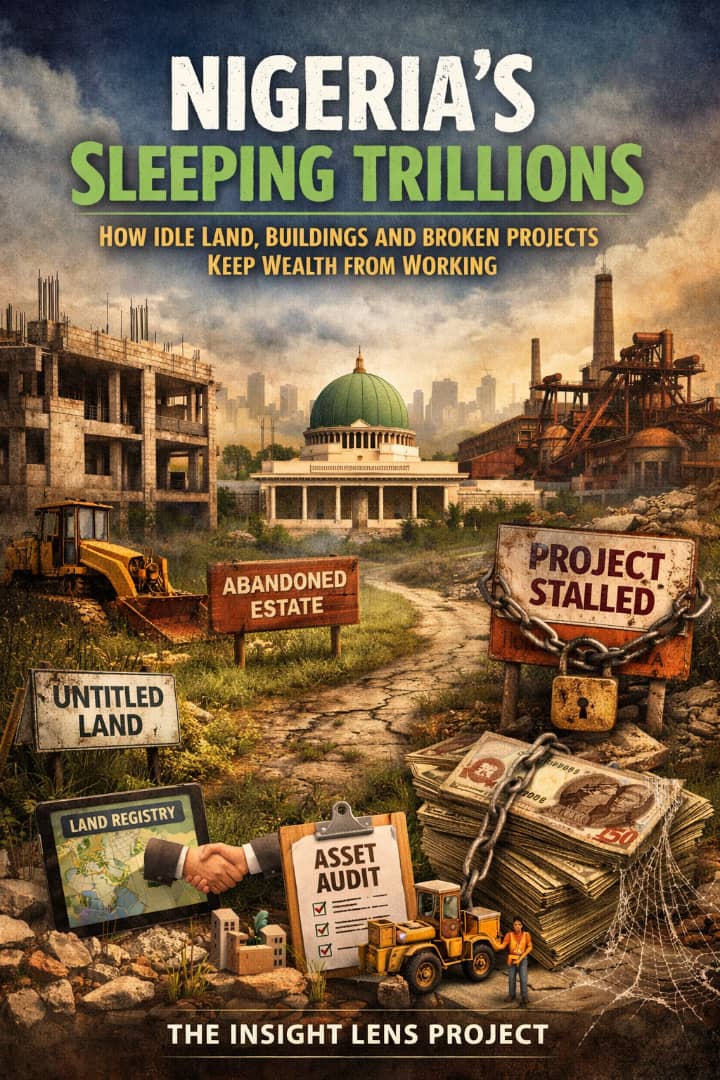
Nigeria is awash with assets that cannot be used, not because they do not exist, but because they are immobilized. Conservative estimates place the value of dormant wealth, untitled land, unfinished estates, abandoned government buildings and half-completed infrastructure in the order of hundreds of billions to more than a trillion dollars. The consequence is not merely wasted capital, it is an economic drag that widens unemployment, deepens public indebtedness and blunts growth.
The core of the problem is what economists call “dead capital”, property and resources that cannot be leveraged for credit or investment because they lack formal recognition. That idea was popularized by Hernando de Soto in his influential book The Mystery of Capital, which argued that formal property rights are the key to converting static assets into productive wealth. In Nigeria, vast tracts of residential land and agricultural plots remain outside effective titling systems, estimates commonly cited by analysts put the notional value of such dead capital at roughly $900 billion.






Beyond untitled land, the landscape is littered with tangible signs of fiscal dysfunction. Government buildings lie unused while entire housing estates and roadworks stall at half height. Aggregated figures point to trillions of naira trapped in abandoned structures and over fifty thousand stalled projects, numbers that translate into billions of dollars in lost or underutilized investment. One long-running symbol of this malaise is the Ajaokuta Steel Company, a multi-decade saga of investment without industrial return.


Why do assets sit idle? The causes are structural and political. Complex and obscure land administration systems make titling costly and uncertain. Projects fail for lack of continuity and oversight, or because funds are disbursed without realistic delivery plans. Regulatory ambiguity, politicized procurement and weak enforcement of contracts create an environment where assets decay faster than they are put to use. Professional bodies such as the Nigerian Institute of Quantity Surveyors and the Chartered Institute of Project Managers of Nigeria have cataloged the scale of abandoned works and rework costs that plague public investment.
The economic arithmetic is stark. Nigeria’s nominal annual output measures in hundreds of billions of dollars, when idle assets are measured against that baseline, even partial activation could equal years of incremental GDP. At the same time, public debt has climbed to staggering levels, and every naira poured into unfinished projects that never deliver is a missed opportunity to create jobs, expand manufacturing and generate taxable activity.
Yet the premise that stranded capital can be unlocked is not a fantasy, it is a policy challenge. Steps that would materially change the picture are well known, comprehensive asset audits, digital land registries that make property rights transparent, legal reforms to simplify transfers and reduce disputes, and calibrated public-private partnerships that combine private capital and capacity with public oversight. Importantly, bringing abandoned projects back to life requires ranking, prioritizing schemes with immediate economic multipliers and social returns.
There are, however, important caveats. Estimates of total dormant value are aggregates built from different data sources and assumptions, currency shifts, depreciation and overlapping valuations can inflate headline numbers. Formalizing informal land markets carries political risks, including the potential for elite capture if safeguards are weak. And while digitization and fiscal reforms are underway in parts of the country, implementation has been uneven, success ultimately depends on sustained political will, transparent governance and institutional capacity.
The human stakes are plain. Idle factories mean unemployed workers. Half-built schools mean children without classrooms. Abandoned hospitals mean communities without care. Reactivating assets is therefore as much a social imperative as an economic one, the difference between a lost decade and a generation of opportunity.
To move from analysis to impact, policymakers must treat immobilized capital as a national priority. That means audits that name and quantify assets, legal reforms that put property and project data online, and procurement disciplines that hold implementers to measurable outcomes. It also requires a shift in political calculus, incentives for completion, penalties for abandonment, and clear channels for private capital to rehabilitate and operate infrastructure in the public interest.
Nigeria’s abundance of land, of buildings, of potential industrial capacity is not the problem. The problem is that abundance is too often stillborn. Unlocking the value trapped in physical assets will not be easy, but the alternative is worse, letting the country’s wealth remain dormant while unmet needs multiply. The task ahead is to convert stillness into motion, and idle promise into tangible progress.
©️ Adebamiwa Olugbenga Michael is a Lagos-based political economy and policy intelligence analyst and publisher of The Insight Lens Project, providing data-driven insights across Nigeria and West Africa using open-source data.