By Olugbenga Adebamiwa
Nigeria is a nation where only those in government and their supporters are labeled unrighteous, while everyone else is treated as saints. What a glaring hypocrisy.
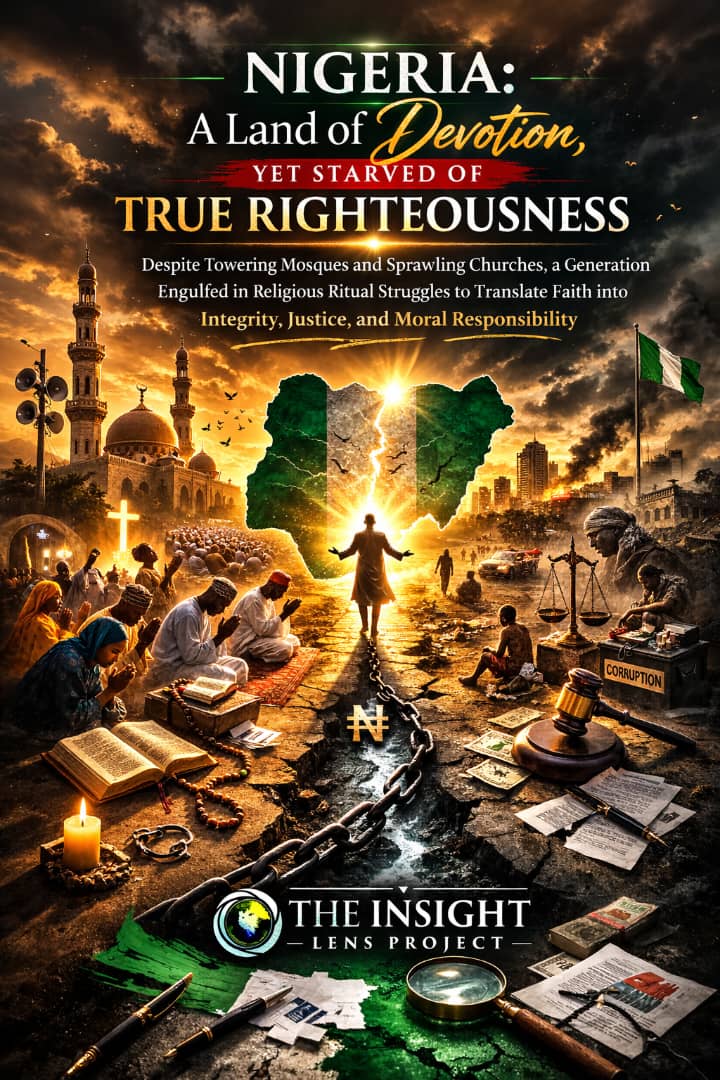
Despite towering mosques and sprawling churches, a generation engulfed in ritual struggles to translate faith into integrity, justice, and moral responsibility.





Before dawn breaks over Lagos, loudspeakers hum with devotion. In the ancient city of Kano, worshippers line up in solemn rows. Across Enugu and Port Harcourt, sanctuaries swell with songs of surrender, sermons of salvation, and declarations of divine favor. By every visible measure, Nigeria is profoundly religious.


Yet beneath the chorus of “Amen” lies a troubling contradiction.
For a country so saturated with prayer, Nigeria groans under corruption, injustice, violence, and moral decay. The contradiction is stark, a generation intensely devoted to religion, yet increasingly distant from the ethical demands of the God it professes to serve.
Nigeria does not lack houses of worship. Churches and mosques dominate highways, crowd residential streets, and shape city skylines. Radio and television overflow with religious programming. Prayer vigils stretch into the early hours, and fasting seasons are observed with precision.
But faith, when reduced to ritual performance, risks becoming spectacle rather than substance.
Public displays of devotion have not translated into public accountability. Leaders swear oaths on sacred texts, yet governance often mocks their sanctity. Contracts are inflated. Justice is delayed or denied. The vulnerable are exploited. Hands lifted in worship on Sunday or Friday sometimes sign off on systems that perpetuate suffering by Monday.
The issue is not religion. It is the disconnection between ritual and righteousness.
Religion has become a primary identity marker in today’s Nigeria. It shapes political alliances, voting blocs, and public discourse. Yet identity alone does not guarantee integrity. A society can multiply religious institutions while neglecting moral instruction. It can amplify sermons while silencing conscience. It can build megachurches and grand mosques while schools, hospitals, and transparent institutions languish.
The tragedy is not that Nigerians are religious. The tragedy is that faith has too often been privatized, segregated, or commodified. It thrives in sanctuaries but struggles in boardrooms. It is bold on social media but timid in the face of injustice. It flourishes in rhetoric yet falters in responsibility.
The consequences are visible.
When religion is loud but character is weak, cynicism grows. Young people, watching the gap between proclamation and practice, begin to question both leadership and faith itself. Trust erodes. Hypocrisy becomes normalized. Spiritual language becomes a convenient shield for ethical compromise.
A generation raised on revival meetings and religious conferences now confronts unemployment, insecurity, and institutional decay. They quietly ask, If we are this religious, why are we not more just?
This question echoes beyond pulpits and towers of worship. It demands national introspection.
The remedy is not less faith, but deeper faith. A faith that insists on honesty in public office. A faith that confronts corruption rather than sanctifies it. A faith that values truth over tribe, justice over sentiment, and service over self-interest.
Nigeria’s spiritual energy is undeniable. What remains uncertain is whether it will mature into ethical renewal.
Religious devotion, at its best, should produce compassion, accountability, courage, and discipline. It should shape how contracts are awarded, how courts function, how security is managed, and how neighbors treat one another. It should influence both prayer closets and policy tables.
Until that bridge is built, Nigeria will live with its most painful irony, a nation fervent in worship yet fragile in morality.
The call of this moment is simple but profound. Not louder prayers alone. Not larger congregations alone. But lives and systems aligned with the principles so passionately proclaimed.
Only then can Nigeria move from being merely a religious nation to becoming a righteous one.
©️ Adebamiwa Olugbenga Michael is a Lagos-based political economy and policy intelligence analyst and publisher of The Insight Lens Project, providing data-driven insights across Nigeria and West Africa using open-source data.