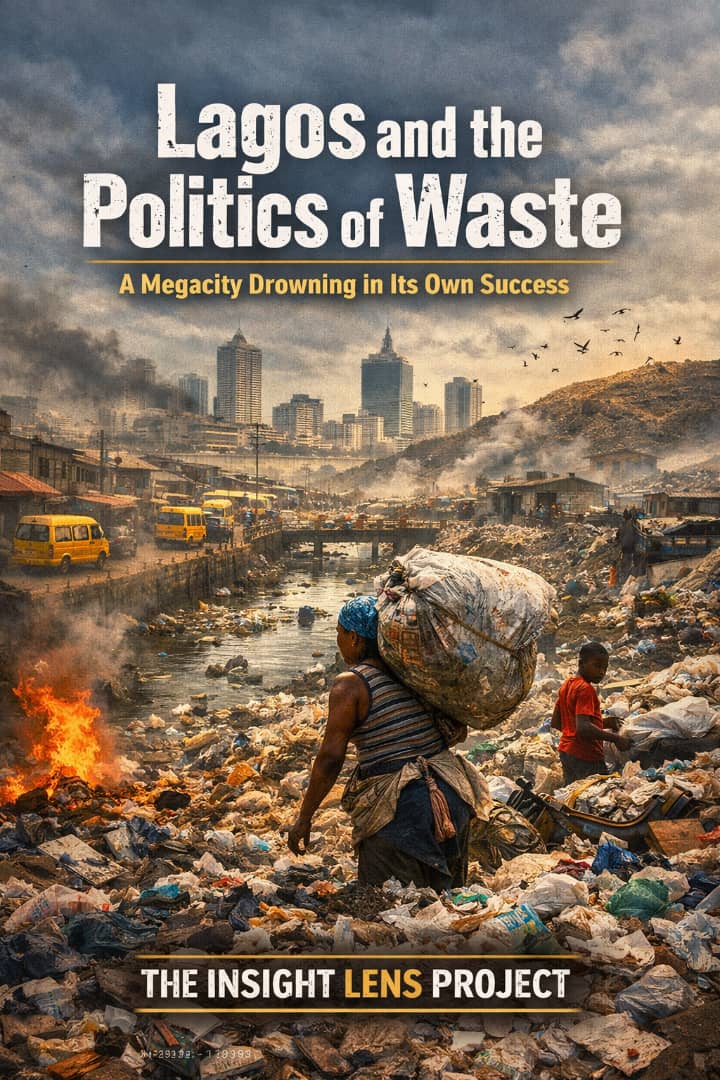
By any measure, Lagos is a marvel of human energy. Africa’s busiest city, home to an estimated 20–25 million people, hums day and night with commerce, migration, ambition and survival. But beneath this celebrated dynamism lies a quieter, more troubling story, one written not in policy documents or glossy budgets, but in refuse heaps, blocked drains and the unmistakable smell of systemic strain. Lagos today generates about 13,000 tonnes of solid waste every single day. How the city manages or fails to manage that waste has become one of the clearest tests of its governance maturity.
At the centre of this challenge is the Lagos Waste Management Authority (LAWMA), an institution with roots stretching back to 1977 and a mandate that has expanded alongside the city itself. Working through nearly 370 private sector participation (PSP) operators, LAWMA oversees household, commercial and industrial waste collection across the metropolis. On paper, the model reflects global best practice, public oversight combined with private efficiency. In practice, the results are uneven. Only between 30 and 70 per cent of Lagos’ daily waste is collected, leaving vast volumes unaccounted for, dumped in open spaces, burned informally, or washed into drainage channels that later overflow during the rains.
The consequences are not abstract. Organic waste, which makes up nearly half of Lagos’ refuse stream, decomposes into methane, a potent greenhouse gas. Plastics, nearly 870,000 tonnes a year clog canals and pollute lagoons, with less than 10 per cent recycled. The economic cost of uncollected waste is estimated at over $200 million annually, factoring in flooding, health care, environmental degradation and lost productivity. For residents, however, the cost is more immediate, delayed collections, rising service charges, and neighbourhoods where refuse can sit for weeks.
Successive governments have not been idle. Lagos has passed environmental protection laws, banned styrofoam and certain single-use plastics, introduced extended producer responsibility frameworks, and aligned waste policy with its broader THEMES+ development agenda. Billions of naira are allocated annually to environmental services, while enforcement agencies patrol highways and black spots for illegal dumping. Pilot programmes, from community composting to digital monitoring and tricycle compactors suggest a government aware that old methods are no longer sufficient for a megacity of this scale.
Yet criticism persists, and not without reason. Urban growth has consistently outpaced infrastructure. Dumpsites such as Olusosun and Solous, among the largest in Africa, are overstretched and nearing decommissioning, even as alternatives struggle to come online fast enough. PSP operators complain of rising operational costs and inconsistent payment compliance by residents. Citizens, in turn, accuse both operators and government of inefficiency, weak enforcement and politicised decision-making. The collapse of earlier centralised waste experiments still hangs over public trust, reinforcing the perception that Lagos’ waste policy is often reactive, responding to crises rather than preventing them.





Amid these tensions lies one of Lagos’ greatest untapped opportunities, the circular economy. Waste, long treated as a burden, is increasingly recognised as a resource. Recycling alone is valued at tens of billions of naira annually, while organic waste offers feedstock for compost, animal feed and biogas. Startups are already digitising collection and encouraging households to exchange recyclables for cash or services. Informal waste pickers, though often marginalised or banned, remain critical to material recovery and could be integrated into a more humane, data-driven system.
The most ambitious frontier is waste-to-energy. Lagos is in advanced discussions on a $400 million plant in Epe capable of processing up to 3,000 tonnes of waste daily, enough to power millions of residents while sharply reducing landfill dependence. Smaller biogas and biodiesel pilots are underway in markets and food hubs, converting organic waste and used cooking oil into energy. These projects come with high upfront costs and foreign exchange risks, but Lagos’ sheer waste volume guarantees steady feedstock, making long-term economics compelling if governance is stable.


Globally, the path Lagos must walk is well-trodden. Sweden sends less than one per cent of its waste to landfills, importing refuse to fuel its power plants. Germany’s deposit-return systems make recycling financially irresistible. Japan enforces meticulous household sorting, while Singapore combines incineration, energy recovery and advanced pollution controls to overcome land scarcity. The common thread is not wealth alone, but discipline, clear incentives, relentless enforcement, public education and data-driven planning.
For Lagos, the lesson is clear. Technology without trust will fail. Enforcement without fairness will breed resistance. And policy without decentralisation will collapse under the city’s scale. A sustainable waste future will require empowering local councils, integrating informal actors, rewarding compliance, and treating citizens not as passive service users but as active partners in urban survival.
In the end, waste is governance made visible. It reveals how a city plans, prioritises and cares for its people. Lagos has the resources, the market size and the policy frameworks to transform refuse into revenue and crisis into opportunity. What remains uncertain is whether political will, institutional discipline and public buy-in can finally align. Until they do, Africa’s most ambitious city will continue to face a defining contradiction of its own making, immense wealth, buried daily under mountains of trash.
©️ Adebamiwa Olugbenga Michael is a Lagos-based political economy and policy intelligence analyst and publisher of The Insight Lens Project, focused on data-driven insights across Nigeria and West Africa.