By Newspot Nigeria Business Desk
There’s something unsettling about how often artificial intelligence now comes up in everyday conversations about work. Not in abstract terms, but in very practical ones, who might lose their job next, what roles will still matter, and whether anyone is really safe.
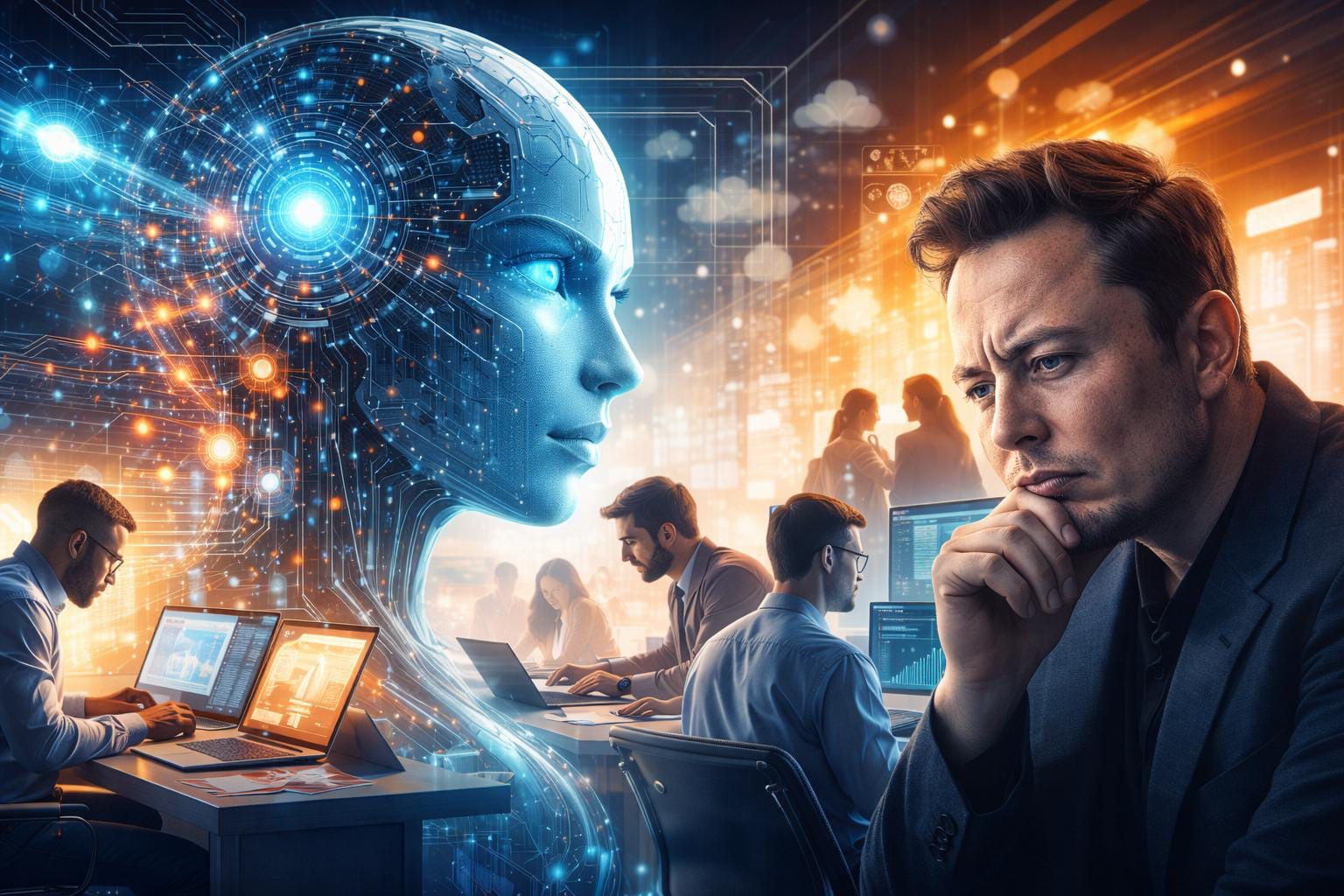
A recent post by Scott Hicks, Provost of Liberty University, captures that anxiety by pointing to comments Elon Musk has made repeatedly over the years. According to Musk, what keeps him up at night isn’t rockets or politics, but artificial intelligence. He has warned that AI could hit the workforce like a “supersonic tsunami,” wiping out many digital jobs almost overnight.
That sounds dramatic, but it also sounds familiar. Many people are already watching software draft emails, summarize documents, schedule meetings, write code, and even make decisions that once required human judgment. What used to feel futuristic is now routine. The shift is not coming. It is already here.

History helps put this moment in perspective. There was a time when entire office buildings were filled with people whose full-time job was manual calculation for banks and institutions. When computers arrived, those roles disappeared. But work itself did not. New roles emerged for people who could design systems, manage processes, and improve the tools that replaced the old jobs.




The same pattern is repeating, only faster.
AI is doing to desk work what spreadsheets once did to typing pools. Routine, rules-based digital tasks are shrinking. Work that involves physical presence, judgment, creativity, care, and leadership is becoming more valuable. Even Musk has acknowledged this, noting that physical labor, skilled trades, and relational roles are likely to last longer than most screen-based jobs.


What stands out is not just the economic shift, but the human one.
Software can move information quickly, but it cannot sit with someone in grief. It cannot mentor a confused graduate. It cannot look a young worker in the eye and say, “You matter beyond your output.” Those moments still belong to people. They always will.
This is where the conversation becomes especially important for educators, leaders, and institutions. If knowledge is now cheap and widely accessible, then education cannot only be about what students know at 22. Its real value lies in helping people learn how to adapt, how to retrain, how to move across different stages of life without losing direction or dignity.
The skill that matters most now may not be coding or prompt engineering, but flexibility. The habit of learning again. The courage to reimagine one’s role. The capacity to grow without panic when systems change.
For societies already under pressure from unemployment and inequality, including many across Africa and the Global South, this shift carries real risks. If adaptation becomes a privilege instead of a shared opportunity, the gap will widen. That makes investment in human development, vocational pathways, and lifelong learning not optional, but urgent.
Still, there is a quiet reassurance in all this. Tools can scale knowledge, but they cannot replace care. They can process information, but they cannot carry meaning. They can optimize tasks, but they cannot love, guide, or heal.
In the end, artificial intelligence may force a deeper question on all of us, if machines can do more, what does it mean to be human? The answer may lie less in productivity and more in purpose.
And that kind of work, the work of presence, compassion, judgment, and service, remains stubbornly, beautifully human.
Published by Newspot Nigeria.