By Bukar Muhammad
Nigerians are a patient people. We queue without complaints, endure darkness with jokes, and turn suffering into comedy skits. But there is one thing even patience should interrogate: a bill this large with so little to show for it.
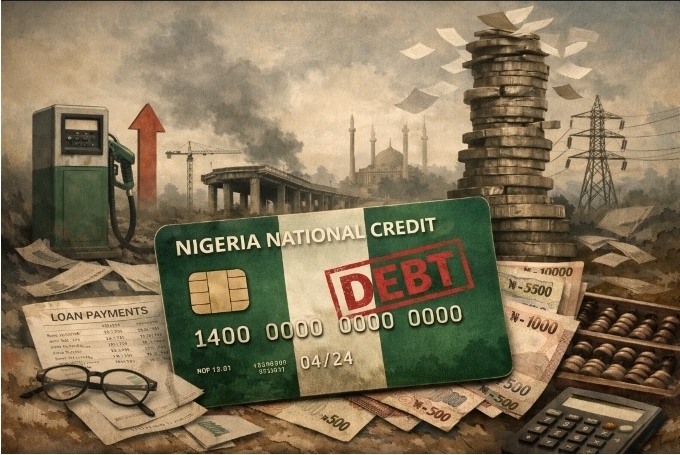
In 2015, Nigeria’s public debt stood at about ₦12.6 trillion. Sensible. Manageable. Almost modest. Eight years later, as President Muhammadu Buhari exited office, that figure had exploded to roughly ₦97 trillion. By the end of 2024, it had galloped past ₦140 trillion. At this point, the debt is no longer a statistic; it is a personality in our national life.
The question Nigerians are quietly asking—in traffic, at fuel stations, and in their living rooms—is simple and devastating: where is the evidence?

Debt is supposed to leave fingerprints. Power that stays on. Roads that do not dissolve after the first rain. Hospitals that heal instead of apologizing. An economy that breathes without borrowing oxygen. Instead, Nigerians were handed rail lines they rarely use, roads they re-patch annually, and an economy that still wakes up tired.





This is not an argument against borrowing. Every serious nation borrows. But serious nations borrow with intention, discipline, and memory. Nigeria borrowed like a man using a credit card he is convinced his children will pay off.
Today, debt servicing consumes an alarming share of government revenue. In plain language, Nigeria now borrows money to pay for money it borrowed earlier. This is not economic strategy; it is financial musical chairs. When the music stops, somebody falls—and it is never the political class.


For the average Nigerian, this debt has materialized as fuel price shocks, disappearing subsidies, higher taxes, and a permanently anxious economy. The loans may have been negotiated in air-conditioned rooms, but repayment is enforced in overheated buses, crowded markets, and silent dinner tables.
Psychologically, this kind of debt does something dangerous. It normalizes hardship. It teaches citizens to expect less while owing more. It turns survival into patriotism and suffering into a civic duty.
And yet, Nigerians are told to move on. Forget the past. Focus on the future.
But debt does not forget. It remembers dates, interest rates, penalties, and default clauses.
That is why a forensic audit of Nigeria’s borrowing from 2015 onward is not optional; it is therapeutic. A nation, like a person, cannot heal from financial trauma without first admitting how the damage was done.
We must ask, calmly but firmly:
What exactly were these loans used for?
Which projects justified their scale?
Who signed, who supervised, and who certified completion?
And most importantly: what measurable value did Nigerians receive?
If the answers are satisfactory, history will be fair.
If they are not, silence becomes complicity.
Nigeria does not need revenge.
It needs receipts.
Bukar is a policy analyst from Kano