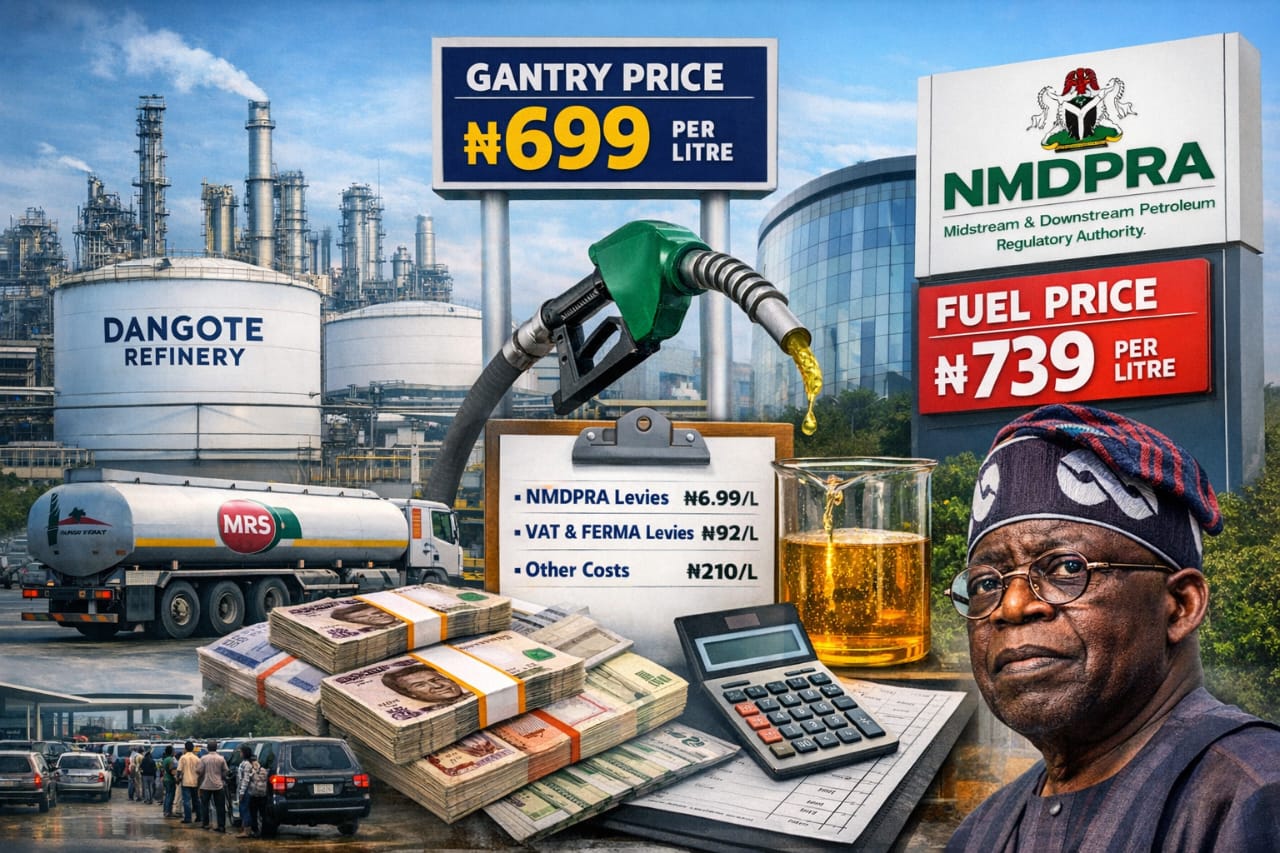
Nigeria’s petrol market has come under renewed scrutiny following Dangote Refinery’s recent gantry price adjustments. On December 15, 2025, reports from major mainstream media confirmed that the refinery set its gantry price at ₦699 per liter, with retail prices beginning at ₦739 per liter at major stations such as MRS. These moves have prompted public debate about regulatory charges, distribution costs, and the transparency of pricing in Nigeria’s post-subsidy petroleum market.

Dangote Refinery, Africa’s largest single-train facility, has actively reduced petrol prices throughout 2025. The gantry price fell from ₦828 to ₦699 per liter, prompting depot and retail adjustments. At MENJ depots, prices dropped from ₦828 to ₦710, while retail stations like MRS now charge ₦739 and AA Rano ₦840. Daily national petrol consumption is estimated at 50–52.9 million liters. Industry observers note that importers face financial pressure due to Dangote’s local supply, with some reporting monthly losses of ₦102 billion, while Dangote claimed ₦60 billion losses in November 2025 alone.
The Nigerian Midstream and Downstream Petroleum Regulatory Authority (NMDPRA) imposes statutory levies on petroleum products:
– Total Levy: 1% of wholesale PMS sales (₦699 gantry → ~₦6.99 per liter)
– 0.5% to the NMDPRA Authority Fund





– 0.5% to the Midstream and Downstream Gas Infrastructure Fund
Other Charges:


– 7.5% VAT on retail (~₦55 per liter at ₦739 retail)
– 5% FERMA road levy (~₦37 per liter at ₦739 retail)
– Minor transport, storage, and administrative costs (~₦3–₦5 per liter)
These levies are mandatory and contribute to regulatory operations, infrastructure development, and sector compliance.
Media commentary has suggested that ₦310 per liter is captured by NMDPRA or other agencies. Verified data indicates this is inaccurate:
NMDPRA levies total ~₦6.99 per liter, far below ₦310.
The remainder likely includes:
– Costs under the naira-for-crude deal, where crude supply is recovered from product sales
– Refinery operational expenses (processing, utilities, staff)
– Distribution logistics and marketer margins
– Taxes and statutory charges outside NMDPRA’s remit
Assuming all deductions as legitimate, retail prices at ₦739 reflect both refinery costs and statutory/operational components, not excessive extraction by regulators.
Petrol pricing directly affects transportation, food prices, and inflation. At ₦739–₦840 per liter, cost pressures are felt nationwide. Clear, public breakdowns of price components could enhance consumer understanding and confidence. Analysts stress that while Dangote’s price reductions demonstrate local production efficiency, transparency is essential to prevent misinformation and guide government policy.
● Forward looking Recommendations
– Transparency Measures – Dangote Refinery and other operators could publish itemized pricing templates showing ex-refinery costs, taxes, levies, and transport.
– Regulatory Clarity – NMDPRA should routinely disclose statutory levies and compliance data to reduce speculation.
– Policy Implications – Government oversight can ensure competitive pricing, prevent anti-competitive practices, and maintain energy security, balancing domestic production and import needs.
Nigeria’s petrol pricing landscape reflects complex interactions among local refiners, regulators, and importers. Verified data shows statutory levies are modest (~₦6.99 per liter at ₦699 gantry), with additional costs accounting for legitimate operational and distribution expenses. Transparent disclosure of these components can reduce public confusion, strengthen trust, and support fair pricing that benefits both consumers and the broader economy.
©️ Adebamiwa Olugbenga Michael is a Lagos-based political and social analyst and publisher of The Insight Lens Project, where he writes on governance, ethnic economics, and public policy using open-source data.