By Newspot Nigeria Global Correspondent
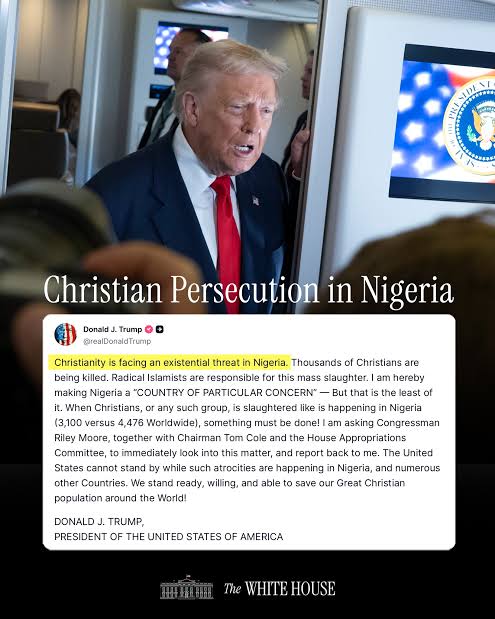
President Donald Trump has warned that his administration may consider direct military intervention in Nigeria if the government fails to curb what he described as widespread attacks on Christian communities. The remarks, posted on his Truth Social platform, have generated diplomatic concern in Abuja and widespread public discussion.
Trump’s statement followed lobbying from conservative Christian groups and some members of the U.S. Congress who have urged Washington to classify Nigeria as a “country of particular concern” for alleged religious persecution. Among those who have drawn attention to humanitarian suffering is Catholic Bishop Wilfred Chikpa Anagbe of the Diocese of Makurdi, who has consistently spoken about displacement and violence in parts of the Middle Belt.
However, analysts and peace experts caution strongly against linking the Bishop’s advocacy to Trump’s remarks. They emphasize that correlation is not causation, noting that the U.S. foreign policy conversation has been shaped over time by many advocacy networks, humanitarian reports, and political interests. There is no evidence that Bishop Anagbe influenced or prompted Trump’s statement. Efforts to portray him as responsible for U.S. policy decisions are described as misdirected and potentially harmful, particularly in a tense security climate where scapegoating can deepen division.

Nigeria’s security challenges remain complex: insurgency in the north-east, banditry in the north-west, farmer–herder conflict in the Middle Belt, and separatist tensions in the south-east. Both Christians and Muslims have suffered violence in different contexts.





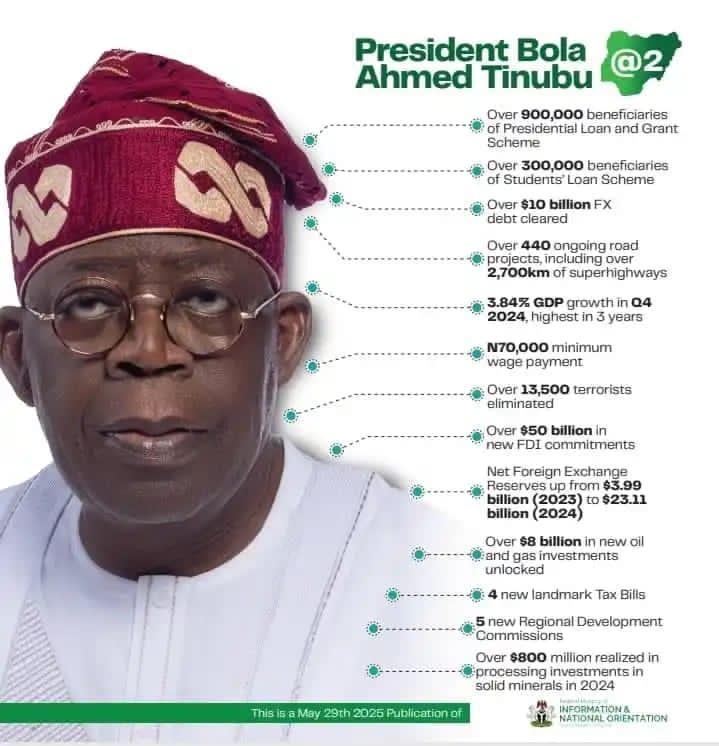
Responding to Trump’s remarks, President Bola Ahmed Tinubu reaffirmed that Nigeria is a secular state with constitutional protections for every faith and emphasized that any international engagement must be guided by data and respect for Nigeria’s sovereignty.
Understanding Why the U.S. Cannot “Just Invade” Nigeria
Public conversation has included speculation that the United States could simply invade Nigeria. However, there is no legal or strategic basis for such an action. The U.S. cannot deploy troops into a sovereign nation without:


- Congressional authorization, or
- United Nations Security Council approval, or
- An official request from the Nigerian government.
None of these conditions currently exist.
Historical instances where the U.S. intervened without full authorization — such as in Panama (1989), Grenada (1983), or Kosovo (1999) — involved far smaller states and generated significant international criticism. Nigeria is a major regional power and one of the largest economies in Africa. Any unauthorized intervention would be illegal under international law and would trigger major diplomatic and economic fallout.
More importantly, even limited military action could disrupt Nigeria’s economy, affecting jobs, investment confidence, oil production, currency stability, trade flows, and household livelihoods. The consequences would be long-term, not temporary.
For this reason, no one should speak lightly about war or foreign intervention. National stability requires restraint, clarity, and diplomatic engagement — not escalation.
Former Global Peace Index Ambassador and conflict resolution analyst Abidemi Adebamiwa has cautioned against emotional reaction to the situation. He noted that discussions about Nigeria’s security have circulated widely abroad. He recalled that when he mentioned to golfing companions over a month ago that he planned to travel, they jokingly advised him to “avoid saying” he was a Christian, reflecting how narratives about Nigeria’s insecurity have traveled internationally. He also observed that some pastors outside Nigeria have asked congregations to pray specifically for Christians in Nigeria, showing global awareness of the situation.
Adebamiwa stressed that while these expressions of concern show how deeply the narrative has spread, they should not be used to blame Nigerians who speak on humanitarian suffering. He emphasized that Bishop Anagbe did not cause U.S. foreign policy decisions and that misdirecting blame risks dividing communities at a time when unity is needed most.
He advised that quiet diplomatic engagement between Abuja and Washington, combined with strengthened internal security coordination and community-level peacebuilding, remains the constructive way forward.
Newspot Nigeria will continue to monitor developments.
—Newspot Nigeria