By Olugbenga Adebamiwa

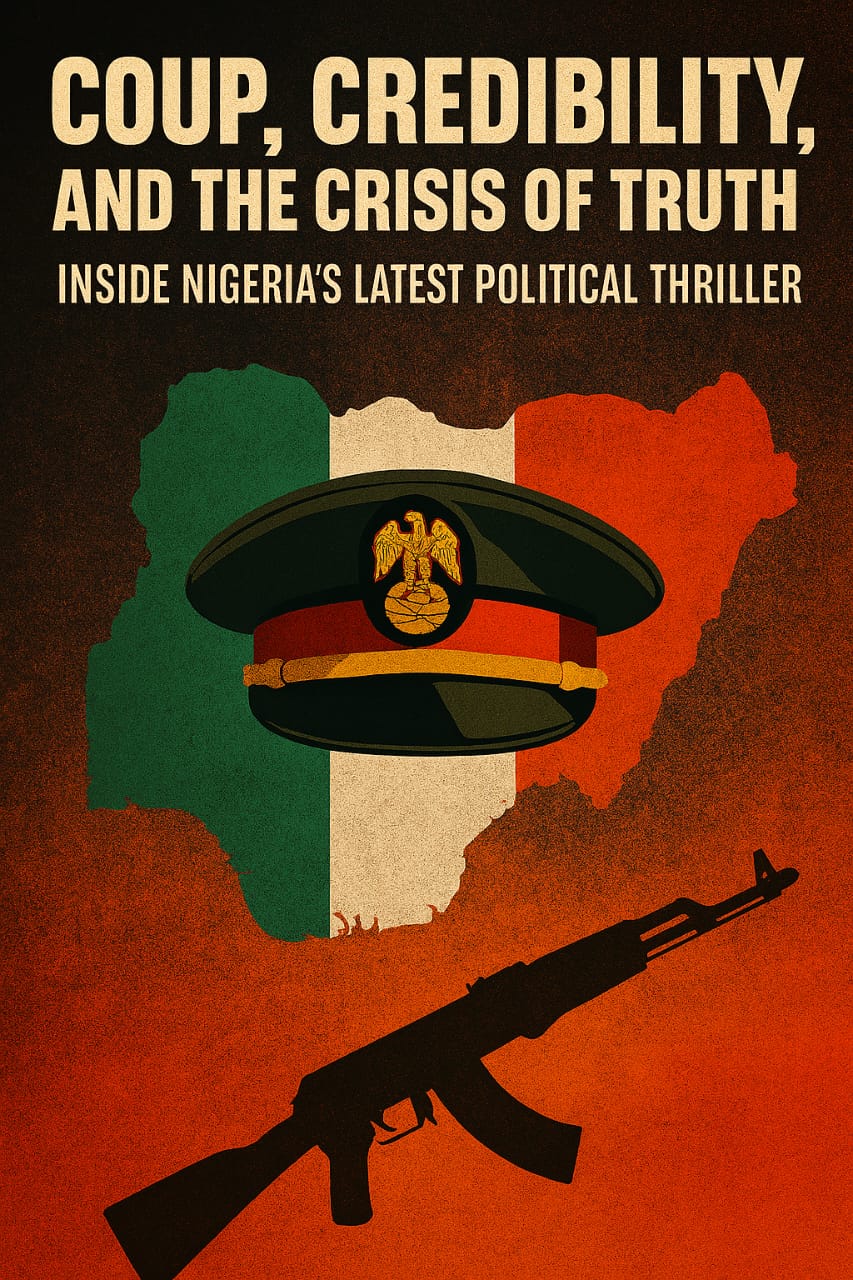
Nigeria’s political space was thrown into confusion in late October 2025 after reports emerged of an alleged coup plot against President Bola Ahmed Tinubu. The story, first carried by Daily Sun and amplified by several other news media, claimed that security agencies had uncovered a conspiracy funded by former Bayelsa Governor Timipre Sylva, allegedly involving senior military officers and billions of naira traced through the EFCC and NFIU. The report described a high-stakes “technological coup plan” complete with drones and advanced weaponry, an extraordinary claim in any democracy, but particularly explosive in a country long haunted by military intervention.
Yet, as the sensational details rippled through social media and fringe outlets, the silence from official quarters grew louder. Neither the Presidency, the Defence Headquarters, nor the DSS confirmed any arrests or investigations. Instead, Nigerians were left with questions that cut to the heart of media credibility, political motive, and the fragile trust between the state and its citizens.
The Daily Sun report reads like a political thriller. It describes how President Tinubu allegedly dismissed early intelligence as “unthinkable,” only to later authorize a multi-agency investigation that “uncovered” Sylva’s involvement. Citing unnamed “security sources,” it claims the NFIU traced suspicious transfers to Sylva-linked accounts, while the EFCC allegedly tied those funds to a planned insurrection. Arrested officers, the paper said, had “confessed” and implicated Sylva as chief financier.

However, none of these assertions are verifiable. No transaction details, dates, or official statements support them. Sylva’s residence was reportedly raided by the DSS, a claim repeated by numerous media outlets, yet no agency has confirmed such an operation. His aide, Julius Bokoru, publicly denied the allegations, calling them “politically motivated falsehoods” and asserting that Sylva was in Malaysia at the time for medical and professional reasons. Cross-checks with credible national outlets such as Punch, Vanguard, and ThisDay reveal no independent corroboration of the alleged coup or any criminal proceedings.





Meanwhile, Premium Times offered the first verifiable glimpse into what may have actually transpired. The publication obtained the names and profiles of 16 Nigerian military officers detained over the alleged coup plot against President Tinubu’s administration. Fourteen of the suspects are from the Nigerian Army, including a brigadier general, a colonel, four lieutenant colonels, five majors, two captains, and a lieutenant, while the remaining two are a lieutenant commander from the Navy and a squadron leader from the Air Force. Among the Army officers, 12 serve in the Infantry Corps, one in the Signals Corps, and another in the Ordnance Corps.
The group includes senior figures such as Brigadier General Musa Abubakar Sadiq of Nasarawa State and Colonel M.A. Ma’aji of Niger State, alongside officers from Plateau, Gombe, Kaduna, Katsina, and other northern states. Most are graduates of the 56 Regular Course of the Nigerian Defence Academy (2004–2008), while others belong to the 44th, 47th, 59th, 60th, and Short Service Courses 38 and 43. Despite these revelations, both the Defence Headquarters and the Nigerian government have yet to issue any official statement on the alleged coup or the status of the detained officers.


Though the Premium Times report provided structure and specific evidence absent in earlier stories, it still left crucial questions unanswered, chiefly, the nature of the evidence linking the detainees to a coup, the absence of official confirmation, and whether the arrests represent a genuine security operation or a preemptive political measure.
Coup rumours are not new in Nigeria’s contemporary democracy. Since 1999, at least half a dozen “plots” have been reported and later dismissed as baseless. The real context lies in Nigeria’s current political tension, rising inflation, insecurity, and elite rivalries ahead of the 2027 elections. In such an environment, rumours of military intrigue can serve multiple political functions, discredit opponents, justify security reshuffles, or test public sentiment.
Indeed, the alleged plot surfaced barely weeks after President Tinubu replaced the service chiefs, a move officially described as “routine” but viewed by insiders as a strategic tightening of control over the military hierarchy. Linking this to a supposed coup could strengthen perceptions of Tinubu as a vigilant leader under siege, a narrative that plays well amid public discontent and elite competition.
The heart of this controversy lies not in whether a coup was planned, but in how it was reported. The Daily Sun’s heavy reliance on anonymous “security operatives” without documentary or testimonial evidence violates a key principle of responsible journalism, verifiability. Nigerian media houses have long struggled with this, where leaks, often politically engineered, are published as “exclusive intelligence.”
In this case, the amplification by smaller online platforms created an echo chamber that gave the story artificial legitimacy. The lack of follow-up investigations, visual evidence, or corroboration from institutional media suggests a high probability of political manipulation. In an era where disinformation spreads faster than correction, such reporting risks undermining public confidence in both the press and state institutions.
To understand why Sylva’s name surfaced, one must read between the lines of Nigeria’s internal power play. A former minister and influential figure in the ruling APC, Sylva commands significant support in the Niger Delta, an oil-rich region central to national revenue and political stability. Tagging him as a coup financier conveniently isolates a potential power broker ahead of the 2027 contest.
Sylva’s public denial and the absence of any formal indictment lend credence to his claim of political persecution. Analysts note that Nigeria’s history of weaponized allegations especially within the same ruling party makes this story plausible as political strategy, not national security emergency. In that sense, the “coup plot” may reveal less about tanks and troops than about tension within Tinubu’s inner political circles.
The alleged coup plot against President Tinubu, as reported by Daily Sun and echoed by others, remains unsubstantiated by any credible or official source. It is a reminder that in Nigeria’s volatile media and political ecosystem, rumours can easily transform into “facts” through repetition. Until tangible evidence emerges, court documents, official statements, or verifiable transactions, this story should be treated as speculative at best and politically motivated at worst.
What endures, however, is a sobering truth, democracy thrives not on fear or fiction, but on transparency and accountability. When the line between intelligence and intrigue blurs, the nation’s credibility suffers. Nigeria deserves journalism that enlightens, not inflames, leadership that reassures, not manipulates, and a public discourse grounded not in whispers of coups, but in hard facts and responsible governance.
©️ Adebamiwa Olugbenga Michael
Political and Social Analyst based in Lagos